
I have previously discussed BIM 5D implementation in several conferences. In every session, I begin by presenting the following image and ask participants to consider: If you were to use BIM, how would you calculate the quantity and cost for the yellow-highlighted Cement Finishes and Metal Panels?
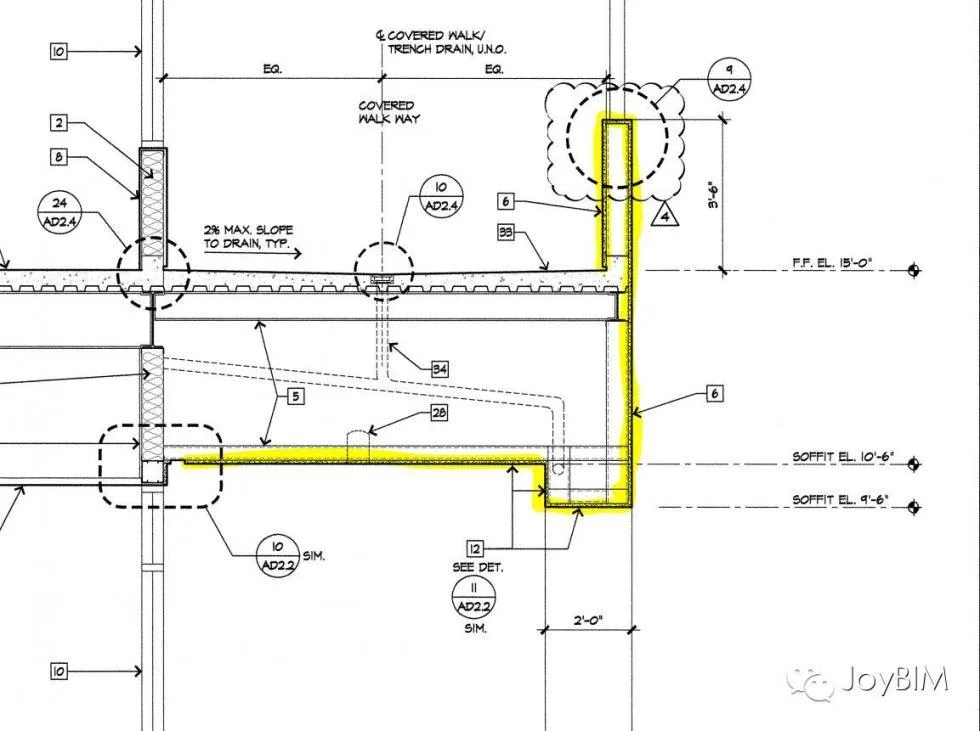
This image is from a project I participated in four years ago. It was one of our company’s earliest pilots for BIM-based quantity and cost calculations. At that time, our budget officer pointed at this detail and asked me: “Can your BIM model reach this level of detail? Does BIM software understand quotas?” I replied: “Do we need to reach this depth? Does BIM software need to understand quotas?” These types of questions were among the many challenges we faced while promoting BIM 5D. In this article, I will share some experiences and insights from a U.S. general contractor’s perspective on implementing 5D.
First, it’s important to note that at that time, Design-Build (DB) projects were becoming increasingly popular in the U.S. Our company used DB projects as pilots for 5D implementation, with the general contractor taking on Pre-Con responsibilities during the design phase. All design models were provided by the design team. For traditional Hard Bid or the widely used DBB process in China, I will share detailed BIM 5D implementation approaches for these in future articles. Let’s first focus on the DB project.
For each initial 5D pilot project, the company assigned two people: a BIM Coordinator and a traditional estimator. The estimator was responsible for budgeting, while the BIM Coordinator bridged the gap between BIM and conventional estimation, translating information as needed.
In the 5D implementation, my role as BIM Coordinator, together with our budget officer, included the following tasks:
1. Using Vico Office, based on the BIM model from the design team, to control quantities and total cost throughout design.
2. Gradually converting the company’s Timberline calculation and cost databases into Vico Office, and transforming the traditional MasterFormat system into the more BIM-friendly UniFormat.
3. Developing standards for architect BIM models, including naming conventions and calculation rules for different building components.
4. Building a corporate database.
During our work, the discussion often returned to the image above. I asked the budget officer: how would you calculate the quantity of Cement Finishes and Metal Panels using traditional methods? He replied that he would use OST to measure the unit quantities of these two materials for this section, then calculate the total length on the floor plan. Multiplying the two would give the total quantity. Next, he would apply loss factors and other rates in Timberline to obtain the final quantities and costs.
He then reversed the question: can your BIM model achieve this level of detail? I answered: do you need it? For this calculation, the model contains three components: Parapet, Exterior Wall, and Soffits. I could extract the Metal Stud quantity for the Parapet from the exterior surface area, and define the Cement Finishes area as the sum of the three component faces. For the Exterior Wall, the exterior cement finish is simply its single-sided area, and the interior finish can be obtained by multiplying the wall length by its height. Similarly, the area of Soffits is used directly to match the details in the image for quantity calculation. After determining the engineering quantities, I applied your loss factors and other quotas to reach the same results. Additionally, during this process, we established calculation rules for Parapet, Exterior Wall, and Soffits, which became part of our database. In future projects, we could reuse these with slight adjustments.
My colleague thought about this and agreed, but pointed out: doesn’t this mean BIM calculations are not fully automated and still require a lot of manual work? I said, that’s right—BIM calculations cannot be fully automated from the start. We still need experts like you with deep budgeting experience to implement BIM 5D. Also, while using BIM, we must still refer to 2D drawings. Even though the drawings are generated from BIM models, the current level of BIM detail cannot match that of 2D drawings. Being familiar with both the drawings and the budgeting process, and knowing how to quickly extract the geometric information you need from the model, will improve work efficiency.
Throughout our collaboration, my colleague shared his extensive budgeting knowledge, including various coefficients and quotas needed for calculations, while I continually translated these into the BIM process. At the end, he joked, “I don’t think I need you anymore. I can use the model to make estimations myself.” I replied, “That’s exactly the goal!” 🙂
One major advantage of applying BIM in DB projects is the use of iterative models. After we establish calculation rules for all components, any model modification can be directly imported. Vico Office detects changes and automatically updates quantities and costs, which is crucial for controlling the total cost and managing the project.
Another challenge in promoting 5D is the quality of the model itself. Many believe that architectural design models are not suitable for construction purposes. U.S. general contractors often encounter the same issue: architects build models mainly for drafting convenience, not considering the contractor’s needs for 4D and 5D. The two most common issues with architect models are inconsistent component naming and non-standard modeling, both of which reduce 5D efficiency. Because of differing priorities, contractors cannot expect architects to make unconditional changes.
To address this, we developed a Revit Template tailored to our needs and provided it to architects. By designing directly in our template, all component properties needed for the project are already standardized, saving architects significant prep work. With free and efficient templates, architects are happy to use them.
Additionally, we created detailed modeling standards for architects to follow, and for our own reference when modifying models. Regardless of how comprehensive these standards are, there will always be aspects of the models we receive that do not fully meet our requirements. Therefore, we established internal guidelines highlighting the most common mistakes and the elements most critical to calculation accuracy. Upon receiving the architect’s model, we can quickly review and adjust it to meet calculation needs.
There are exceptions, of course. Some major firms, such as Gensler or RTKL, already have their own Revit Templates designed specifically for their workflow. Convincing them to use a construction-oriented template is almost impossible. In these cases, your ability to manage and coordinate as a general contractor—and even contract constraints—becomes key. This goes beyond technology alone.
Another essential task in implementing 5D is establishing the corporate database. Most traditional American contractors have a Timberline database, built from years of project accumulation. Migrating the Timberline database to a BIM system is not as simple as exporting and importing. It involves converting from a material-based to a component-based list (from MasterFormat to UniFormat), adjusting calculation rules to fit BIM model characteristics, and integrating with 4D tasks (which I will elaborate in future articles). It is also a process of changing a company’s database management habits. If a company lacks a robust and highly standardized database, its 5D implementation is destined to fail. Building such a database requires years of accumulated project experience.
In summary, successful enterprise-level BIM 5D implementation is not achieved simply by purchasing software but by accumulating extensive experience over time. Unfortunately, many companies today are reluctant to focus on this effort and fail to appreciate the importance of big data for their future growth. In my view, these two points are the greatest challenges to 5D BIM implementation.















Must log in before commenting!
Sign Up