
Since the 18th National Congress of the Communist Party of China, the Party Central Committee, with General Secretary Xi Jinping at its core, has explicitly emphasized strengthening supply-side structural reforms. The goal is to improve the quality and efficiency of the supply system, thereby boosting sustained economic growth and driving an overall leap in China’s social productivity.
Fixed asset investment and construction form a crucial part of the supply system, and their quality and efficiency have a significant impact on the supply system’s performance. The engineering consulting industry plays an indispensable role in enhancing the quality and efficiency of fixed asset investment and construction. From pre-project planning, investment analysis, survey and design, to engineering management, cost control, bidding, and procurement during construction, and facility management during operation and maintenance after completion, engineering consulting firms are expected to provide valuable professional services to the project owner. However, traditional engineering consulting models suffer from shortcomings such as segmented business modules, fragmented information flow, and disjointed consulting, which have long been criticized by owners. This often leads to a vicious cycle of “everyone responsible, yet no one accountable,” placing owners in a passive position. As a result, the traditional engineering consulting model no longer meets the demands for efficiency improvements in fixed asset investment and construction, nor the needs of international projects such as the Belt and Road Initiative.
In February 2017, the “Opinions of the General Office of the State Council on Promoting the Sustainable and Healthy Development of the Construction Industry” (State Council Document No. [2017] 19) explicitly called for the cultivation of “full process engineering consulting.” It encourages enterprises involved in investment consulting, surveying, design, supervision, bidding agency, cost management, and other fields to develop full process engineering consulting through joint operations, mergers, and acquisitions, aiming to build a group of internationally standardized full process engineering consulting enterprises. The policy also mandates that government investment projects lead the way in adopting full process engineering consulting, while encouraging non-government and civil construction projects to participate actively.
With top-level design guidance, full process engineering consulting has become a key direction for the transformation and upgrading of the engineering consulting industry. A critical challenge for every engineering consulting firm is to deeply analyze client pain points and deliver practical, valuable full process consulting services.
1. Solutions for Full Process Engineering Consulting
(1) Overview of Full Process Engineering Consulting
In March 2018, the Construction Market Supervision Department of the Ministry of Housing and Urban-Rural Development issued a consultation document titled “Letter on Soliciting Opinions on Promoting the Development of Full Process Engineering Consulting Services (Draft for Soliciting Opinions) and Demonstration Text of Construction Engineering Consulting Service Contracts (Draft for Soliciting Opinions)” (Jian Shi Jian Han No. AI_T_SC0_9). It clearly defines “full process engineering consulting” as providing engineering consulting services spanning organization, management, economy, and technology — including design and planning — covering pre-research, decision-making, full project implementation, and operation phases. This service can adopt various organizational approaches to continuously deliver partial or comprehensive solutions for project decision-making, execution, and operation.
(2) The Full Process Engineering Consulting General Contracting Model Under the Results Responsibility System
The essence of full process engineering consulting is to continuously provide solutions throughout project decision-making, implementation, and operation. Given the owner’s need for comprehensive project control, only through collaboration among multiple specialized consultants, guided by whole process project management, and delivering integrated solutions, can the effectiveness of full process engineering consulting be ensured. This requirement stems from the owner’s demand for the integrity of building products and completeness of consulting services, placing higher expectations on the consulting party.
From the owner’s perspective, the full process engineering consulting party must assume responsibility for overall project control, providing systematic, integrated, multi-disciplinary consulting services across the entire construction process, rather than handling only phased or partial consulting tasks. Entrusting overall project control inherently requires assuming responsibility for project outcomes.
“Results responsibility” encompasses various aspects and, depending on owner needs, may include:
- Quality outcomes, such as winning the prestigious “Luban Award” for the project;
- Total cost management, including target pricing set by the owner, sharing savings rewards, and compensating for cost overruns within consulting fee limits;
- Reasonable schedule control, such as completing project acceptance within planned timelines.
This customer-centric approach quantitatively aligns with client expectations.
The full process engineering consulting general contracting model (hereafter “consulting general contracting model”) is a results-driven model centered on whole process project management. It integrates multiple professional services, including project planning, investment and financing consulting, bidding agency, survey and design, BIM consulting, cost consulting, engineering supervision, and operation and maintenance management. In this model, the consulting party acts as the overall project controller. Its hallmark is multi-disciplinary collaboration steered by project management, delivering systematic control over project duration, cost, quality, and safety. By simplifying management interfaces, clarifying control responsibilities, enhancing management performance, and accelerating project timelines, it saves investment and ensures quality and safety.
The consulting general contracting model’s result-oriented, systematic, and integrated service features make the consulting general contractor a vital partner for owners, effectively addressing many challenges faced under traditional construction management.
2. How the Consulting General Contracting Model Resolves Owner Pain Points
Construction projects today often involve scale, clustering, and complexity. Owners frequently lack professional project management capabilities but bear the responsibility and risk of management. They spend considerable time, energy, and resources on communication and coordination across various interfaces, often facing conflicts among multiple parties and losing control over management objectives. The consulting general contracting model places the consulting general contractor as the overall project controller. Their accountability for results drives comprehensive and systematic project process management from the owner’s perspective, alleviating many owner pain points.
(1) Eliminating Chaos from Traditional Consulting
Under traditional construction management, owners engage multiple consulting agencies at different stages, creating fragmented services that cause confusion:
- Consultants often have different project understandings or conflicting interests, leading to inconsistent goals, ongoing disputes, and owner frustration.
- Gaps and duplicated efforts arise due to lack of systematic planning and coordination, with no unified control team. Errors often lead to blame-shifting, making accountability unclear.
- Projects lack holistic oversight, with many issues surfacing late, resulting in costly remediation or irreparable damage. For example, late-stage design changes are difficult or impossible, forcing homeowners to accept suboptimal solutions.
In contrast, the consulting general contractor assumes full responsibility for construction management, eliminating conflicts among multiple consultants and enabling systematic planning across the entire construction process, thus avoiding losses and regrets caused by fragmented consulting.
(2) Reasonably Transferring Construction Management Risks
Government and state-funded projects must not only complete construction efficiently but also withstand rigorous audits. Project teams often struggle to defend decisions, facing risks in decision-making and audits. Engaging a consulting general contractor offers a key risk management strategy: owners can contractually transfer construction management risks to the contractor, elevating project control standards. Selecting an experienced consulting general contractor leverages their expertise, enhancing both efficiency and quality.
(3) Overcoming Limitations of Temporary Project Management Organizations
Many government projects still rely on temporary project management teams, which often suffer from weak specialization, new teams working on new projects, incomplete systems, outdated methods, inefficient personnel transition, low efficiency, inflated costs, extended timelines, and elevated safety risks. Given the complexity and professionalism required in construction management, appointing a consulting general contractor effectively addresses these drawbacks.
(4) Freeing Owners from Multilateral Contractual Conflicts
Traditionally, owners sign separate contracts with multiple consulting firms that lack mutual authority but are interdependent, forming a complex multilateral game. This often results in contract disputes, with owners forced to manage and negotiate among all parties, creating an overwhelming burden.
Under the consulting general contracting model, owners focus on core tasks such as project positioning, functional requirements, financing, key milestones, and operational goals. Contractual relationships are simplified, with the consulting general contractor held accountable, freeing owners from the complexities of multilateral conflicts.
(5) Improving and Preserving Project Information Assets
Fragmented services from multiple consultants create “information silos,” preventing a complete and continuous information flow throughout the construction process. Changes in key management personnel often interrupt or lose crucial decision-making and management data, compromising the preservation of project information assets.
In the consulting general contracting model, project information flow becomes the central thread. The consulting general contractor continuously extends, supplements, and enriches this flow during project control, ultimately delivering a complete information chain to the owner as part of the building product’s integrity.
(6) Enhancing Investment Efficiency, Shortening Construction Periods, and Reducing Liability Risks
Traditionally, investment control is fragmented among various consultants responsible for investment consulting, surveying, design, cost consulting, and supervision. Divided responsibilities hinder unified investment control, often leading to failure in managing costs effectively. Separate bidding and disconnected roles among design, cost, bidding, and supervision prolong the construction timeline and reduce efficiency. Introducing multiple consultants increases coordination and management risks, adding to the owner’s burden.
With the consulting general contracting model, all professional consulting services fall under unified control. This integration covers the entire construction process, coordinating work at every stage to reduce risks like budget overruns through quota design, optimized designs, BIM-based consulting, and refined management. A single bidding process selects the consulting general contractor, and multi-disciplinary collaboration eliminates redundant phases, significantly shortening the construction period. The consulting general contractor takes primary responsibility for construction management, transforming accountability pressure into motivation, thereby assuming owner risks and reducing the owner’s liability.
As the overall project general contractor, the consulting general contractor manages the entire construction process, leveraging advanced full process engineering consulting methods to resolve many owner pain points and serve as a trusted partner in project delivery.
3. Tasks Included in Full Process Engineering Consulting Under the General Contracting Model
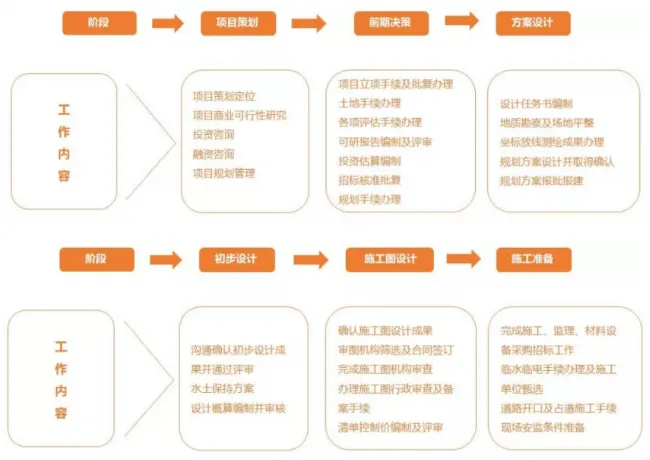
Full process engineering consulting under the general contracting model spans the entire project lifecycle: decision-making, design, contracting, implementation, completion, and operation stages. Key activities at each stage include:
- Decision-Making Stage: Understand stakeholder needs, set high-quality construction goals, and gather evaluation criteria. Consulting deliverables include project proposals, feasibility studies, and evaluation reports, laying the groundwork for design.
- Design Stage: Refine and update research results from decision-making, translating stakeholder needs and quality goals into design drawings and preliminary budget reports, guiding contractor selection in the contracting phase.
- Contracting Stage: Based on prior consulting results, develop bidding plans, contract frameworks, and bidding documents. Define conditions, qualifications, and capabilities for contractor selection, producing bidding documents, contract terms, bills of quantities, and bidding control prices to ensure smooth project execution.
- Implementation Stage: Control cost, quality, and schedule per contract documents. Manage contracts and information flow, coordinate all parties, and complete construction. Organize engineering data for acceptance and handover preparation.
- Completion Stage: Conduct acceptance inspections to verify project performance compliance with contracts. Deliver completed projects and related documentation to operators, ensuring a smooth transition to operation.
- Operation Stage: Evaluate whether construction goals from decision-making have been achieved. Combine operational needs to maximize project value through consulting services such as operation and maintenance management, asset leasing, and financing. While few firms currently offer operation and maintenance consulting, it is expected to become a growing area.
The scope of full process engineering consulting under the general contracting model is flexible, tailored to owner needs and consulting capabilities. However, it must be comprehensive and result-oriented.
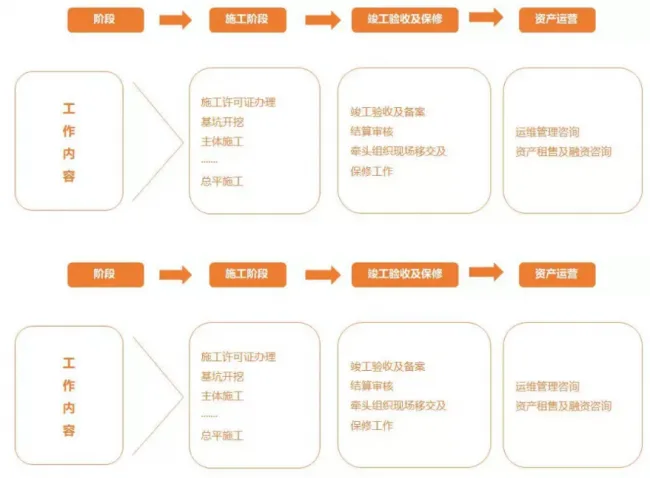
The following figure illustrates the broad scope of work covered under the consulting general contracting model, highlighting its comprehensive, full process consulting features.
4. How to Entrust Full Process Engineering Consulting Under the General Contracting Model
Since the issuance of the “Opinions of the General Office of the State Council on Promoting the Sustainable and Healthy Development of the Construction Industry” (State Council Document No. [2017] 19), pilot plans for full process engineering consulting have been launched nationwide. The guiding principles for entrusting full process engineering consulting across pilot provinces are largely consistent: to explore entrustment methods compliant with existing laws and regulations that promote the development of full process engineering consulting.
The method of entrustment depends on whether the project has obtained feasibility study and bidding approvals:
1. Entrusting Full Process Engineering Consulting Before Feasibility Study Approval
For projects required by law to tender and adopting full process engineering consulting, if entrusted or tendered before project initiation, feasibility study, and approval, the owner or its supervisory unit’s meeting minutes or approvals may serve as a pre-authorization basis for entrustment or tendering. If such approvals are absent, the owner can request a letter from administrative supervisory units to conduct preliminary work, allowing early tendering of full process engineering consulting. The feasibility study report should clearly state the adoption of the full process engineering consulting model. After feasibility study approval, the consulting service cannot be tendered again.
2. Entrusting Full Process Engineering Consulting After Feasibility Study Approval
After obtaining feasibility study and bidding approvals, owners can invite bids for survey, design, and engineering supervision services, which must be publicly tendered. Other consulting services can be directly entrusted to the same consulting firm as part of the full process engineering consulting scope without further bidding.
5. Production Organization Modes Under the Consulting General Contracting Model
The consulting general contractor can adopt one of two production organization models depending on organizational characteristics and project needs:
1. Single-Team Full-Service Model: Led by a Chief Consultant
The consulting general contractor forms an internal “full-service team” led by a chief consultant with comprehensive expertise. Each professional consulting engineer undertakes specialized consulting tasks, collectively delivering full process services to the owner. This model demands high-quality, stable consulting personnel.
2. Departmental Collaboration Model: Project Management Department Leads
The project management department leads, coordinating various specialized consulting departments based on the consulting scope. It issues task orders detailing involved departments, responsibilities, deliverables, and deadlines, and evaluates department performance. Specialized teams—including investment consulting, bidding, surveying, design, supervision, cost consulting, BIM, etc.—work under unified leadership, delivering coordinated results. For non-core tasks permitted by the owner, subcontracting may be allowed, but the consulting general contractor remains responsible for results.
6. Preliminary Exploration of Consulting Service Evaluation Under the General Contracting Model
Consulting services under the general contracting model encompass both technical services (e.g., technical solutions and results) and implicit services (e.g., client communication, internal coordination, training, error correction). Technical service quality depends on professional expertise, skill level, and management efficiency, while implicit service quality relates to corporate culture, service philosophy, communication, and coordination. These aspects are interrelated and collectively define comprehensive engineering consulting.
Evaluation can focus on three dimensions: foundational conditions, interactive capabilities, and result quality.
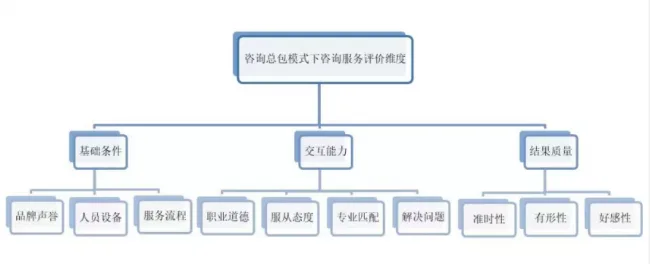
Consulting service performance evaluation under the general contracting model covers the entire process—from service provider selection to final delivery—using criteria tailored to the owner’s specific requirements, technical standards, and quality expectations.
Currently, full process engineering consulting services are relatively new, with limited expert research on evaluation. The proposed three-dimensional evaluation system—covering basic conditions, interaction ability, and result quality—is a starting point. Industry experts and scholars are encouraged to develop comprehensive evaluation frameworks to help consulting providers enhance service performance.
7. Outlook for the Consulting General Contracting Model
The consulting general contracting model emphasizes results responsibility and integrates multi-disciplinary consulting throughout the project management process. It exemplifies comprehensive, systematic services to owners, complementing the traditional engineering general contracting model. Serving as the project general contractor in construction, it becomes an essential partner for owners, especially in prefabricated building projects.
Looking ahead, full process engineering consulting will drive a stratification in the engineering consulting industry. Enterprises such as supervision, cost, bidding, surveying, and design will either develop strong full process project management capabilities, moving toward consulting general contracting, or specialize in niche areas to become subcontractors under the consulting general contractor.
As outlined in the “Opinions of the General Office of the State Council on Promoting the Sustainable and Healthy Development of the Construction Industry” (State Council Document No. [2017] 19), the emergence of internationally standardized full process engineering consulting firms is expected. These firms, with outstanding project management expertise, comprehensive professional capabilities, and large scale, will become pillars of China’s engineering consulting sector.
The rise of consulting general contracting enterprises will significantly enhance China’s engineering consulting industry’s international competitiveness. Together with engineering general contractors, they will lead the Belt and Road Initiative, showcasing “Chinese power” in engineering consulting on the global stage.
Article source: Architecture Magazine














Must log in before commenting!
Sign Up