
— — Shan’an Group’s Mechanical and Electrical Installation Project in the Renovation of Wangfujing Hotel BIM Practice
□ Lu Ban
In July 2013, Shaanxi Construction Engineering Installation Group Co., Ltd. (referred to as Shan’an Group) won the contract for the renovation and mechanical and electrical installation project of Beijing Wangfujing Hotel, with a contract value of 60 million yuan. After evaluating several BIM solutions and collaborating with software vendors and consulting firms, Shan’an Group decided to implement Luban Software’s BIM Technology for this project.
Comprehensive BIM Model Development
Established in 1986, Wangfujing Hotel is a nationally renowned brand situated at the traditional commercial center of Beijing. The renovation aimed to elevate its accommodation, meeting, dining, and banquet facilities, further establishing it as an iconic luxury hotel on Wangfujing Street. The renovation strategy focused on maximizing results with minimal structural changes. After renovation, the hotel’s total construction area reached 44,381 square meters, including 33,100 square meters above ground and 11,281 square meters underground. The building comprises 14 floors and stands 45 meters tall.
As a secondary renovation for a five-star hotel, the project posed significant challenges. The facility’s comprehensive internal systems, advanced equipment, complex pipelines, and high level of intelligent integration added to the difficulty. Furthermore, some concealed engineering data from the initial construction phase had been lost, while the original as-built drawings did not accurately reflect the current building status. Even with on-site investigations, design teams faced missing information. The renovation also required structural reinforcement, necessitating steel structure solutions based on the available drawings.
To address these issues, Shan’an Group and the Luban BIM team used reinforcement scheme drawings to build civil engineering models and developed mechanical and electrical models according to the latest design drawings. Given the discrepancies between the original drawings and the actual dismantled structure, the BIM team meticulously compared the models with on-site conditions to ensure accuracy. Ultimately, the BIM team spent seven person-days to complete the civil BIM models and fifteen person-days for all mechanical and electrical BIM models.
BIM Application in Construction Management
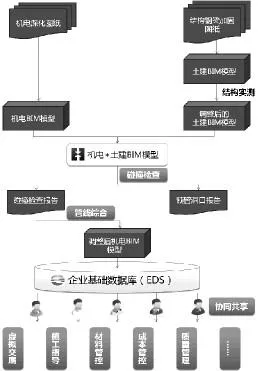
Clash Detection and Reserved Openings: The integrated civil and mechanical BIM models were combined in Luban BIMWorks for collision detection. With a standard floor height of only 2.975 meters, pipeline layout in the hotel’s public corridors was extremely dense, requiring precise arrangement. The existing building, primarily serving as a comprehensive hotel, already had beam openings for pipelines. The new mechanical and electrical systems sought to utilize these existing openings as much as possible to minimize structural impact. Using Luban BIMWorks, Shan’an Group quickly identified collision points and generated detailed inspection and reserved hole reports. For example, each standard guestroom floor (4-14) had 146 collision points; if unresolved, these could lead to project delays and material waste—resulting in up to 146 labor hours and 43,800 yuan in material costs wasted per floor. With BIM Technology, intelligent positioning of reserved holes was achieved, with final reports indicating over 2,000 reserved holes for steel beams and over 3,000 for structural beams, providing precise reference data for steel processing.
Pipeline Integration and Optimization: Based on collision reports, pipeline layout priorities, and construction plans, the BIM team refined the models, removing conflicts one by one. As an older hotel with low ceilings and complex, densely packed pipelines, higher clearance standards were needed. The team optimized the original pipeline layout and designed support systems to meet requirements for aesthetics, clearance, and constructability. Once reviewed and approved by the project’s technical leaders and design unit, the plan served as the construction basis.
Virtual Briefings for Intuitive Visualization: Traditionally, construction briefings relied on 2D blueprints and the spatial imagination of personnel. However, 3D spatial understanding is limited. Through 4D visualization, virtual construction displays, and 3D technology briefings, staff gained an intuitive grasp of pipeline routing, especially at complex nodes. Roaming animations further enhanced coordination and communication between departments.
Automated Drawings and Construction Guidance: After optimising the pipeline layout, plan and section drawings were directly generated within the Luban system, serving as a clear, efficient guide for the construction team. Project technicians noted that the section drawing feature saved significant time and greatly improved convenience.
BIM Application in Cost Management
Once the optimized and approved BIM model was uploaded to the enterprise’s basic data analysis system (Luban EDS), a unified BIM collaboration platform was established. Shan’an Group recognized Luban PDS as a cost management platform based on BIM technology, which innovatively applied advanced BIM methods to construction cost management. Uploading a BIM model with cost information (quantity and cost data) enabled the system to automatically parse, categorize, and organize large volumes of data, creating a multi-dimensional, hierarchical 6D engineering database with visualized 3D graphics.
Rapid Calculation and Accurate Planning: With the BIM model, project quantities could be calculated quickly and accurately. Since BIM data reached the component level, reports could be generated by floor, area, progress, discipline, and construction team, providing essential references for resource planning. Monthly, construction workers accessed Luban BE data and formulated procurement plans based on actual project progress. Project business staff reviewed and confirmed the plans before submitting them for procurement, ensuring timely delivery and reducing material waste and cost overruns.
Comparison and Cost Control: During mechanical and electrical installation, material quantities delivered to the site were promptly provided to BIM technicians, who created comparison tables for the project department. Discrepancies between planned and actual quantities were analyzed, and summary reports were generated to identify causes and improve control.
Data Collaboration and Efficient Sharing: In project management, timely access to engineering data is crucial for decision-making. Previously, such data was held by budget officers, making it difficult for managers to access information promptly, often relying instead on experience. With the BIM-based Luban data management system, completed model quantities were uploaded to the MC system. Managers from various departments could access engineering data according to their permissions, review material demand plans, and share data efficiently. This formed an enterprise database, enabling data sharing, monitoring, and supporting core project decisions. Shan’an Group leaders could access and analyze basic project data anytime via BE and MC, comparing calculations at different project stages. The enterprise-level database consolidated engineering information, available for query and analysis by relevant personnel.
The implementation of BIM by Shan’an Group in the Wangfujing Hotel renovation project received significant attention and praise from the general contractor, China Construction First Engineering Bureau, and the client, Xin Real Estate. Gao Xin, project technical leader at Shan’an Group, stated that BIM technology greatly improved work efficiency, and the 3D models provided practical reference for construction and pipeline layout. Company leaders, including Liu Yaohua (Chairman of Shaanxi Construction Engineering Group), Meng Jian (Chairman of Shaanxi An Second Branch), Zhang Baoan (General Manager), Ren Huimin (Deputy General Manager), and Hu Chunlin (Chief Engineer), visited the site to observe the BIM application and commended its value for mechanical and electrical installation engineering. Liu Yaohua emphasized that Shan’an Group plans to further expand BIM applications, enhance its BIM capabilities, and leverage BIM technology to strengthen its core competitiveness.
















Must log in before commenting!
Sign Up