
The engineering cost industry has closely followed China’s transformation from a planned economy to a market-driven system. The digitalization of this sector has evolved significantly, moving from manual drawing and calculation to computer-aided 2D calculations, then to advanced 3D modeling and computation. The industry has also shifted from quota-based methods to more transparent clearing modes. As engineering cost management enters an era of refined, full-process oversight, leveraging information technology—especially BIM technology—has become crucial. Practitioners must consider how advanced technology can drive productivity and efficiency gains across the industry. Mr. Liu Gang, an expert in engineering cost management, has analyzed how BIM technology supports the transformation and development of the engineering cost industry, including his insights at the 2014 Guanglian Construction Industry Annual Summit.
Project-based production and business operations are characteristic of the construction industry. Engineering cost management plays a key role in investment and risk management throughout the project lifecycle, including estimation, overview, forecasting, settlement, and review. However, without robust IT support, the five main construction phases—decision-making, design, transaction, construction, and completion—suffer from fragmented, discontinuous data and limited collaboration. This fragmentation restricts cost management’s scope and effectiveness, with most control occurring reactively after construction rather than proactively throughout the process.
As construction projects become more complex and unique, traditional management and manual practices can no longer keep pace. Disconnected workflows and fragmented data across project stages impede the accumulation of critical information. Most cost professionals spend their efforts on calculation and review, leaving little time for essential tasks such as project economic evaluation, value engineering, contract management, and risk control.
The emergence of BIM technology is gradually addressing these challenges. Its application represents not only a technological revolution for construction but also a powerful catalyst for improving productivity, management standards, and industry sustainability.
BIM (Building Information Modeling) is a 3D digital engineering data model that integrates all relevant project information. It digitally represents both the physical and functional characteristics of facilities, connecting data, processes, and resources at every stage of a project’s life cycle. BIM provides a comprehensive description of engineering objects, making it widely applicable to all stakeholders in a construction project.
The mission of BIM is to enable the structured organization, management, and exchange of information across all project phases, participants, and software platforms. BIM ensures that the right people have access to the right information at the right time—accurately, timely, and sufficiently.
According to the Ministry of Housing and Urban-Rural Development’s Twelfth Five-Year Plan, accelerating the adoption of technologies such as BIM and developing professional engineering consulting services are top priorities. Integrating cost management consulting with every stage of a construction project’s lifecycle—using BIM for dual gains in productivity and efficiency—has become a core focus. The adoption of BIM is now inevitable, and the real question is not whether to use BIM, but how to apply it effectively. In engineering cost management, this is especially critical.
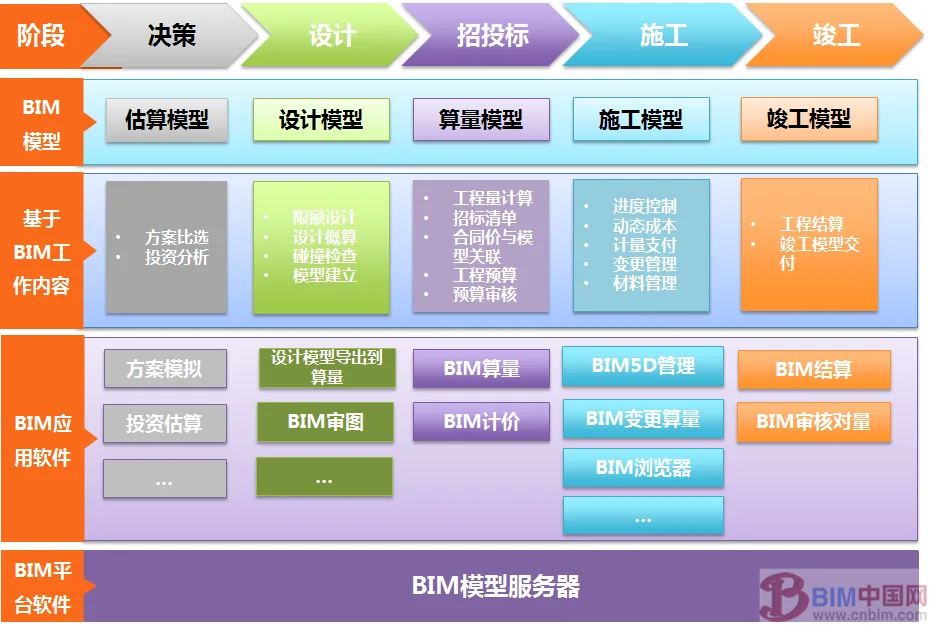
Figure: BIM’s Support for Whole-Process Management in Engineering Cost
Farewell to Yesterday’s Fragmented Processes
Traditionally, engineering cost management is divided into stages: investment estimation, design budgeting, construction drawing budgeting, contract cost, project budgeting, completion settlement, and final settlement. Each stage has operated independently, especially during construction, where budgets are often recalculated from scratch rather than reused. This independence has limited the proactive management of costs, with valuable cost information used only as a simple tool, leaving its full potential untapped for effective cost control and management.
In the conventional model, the owner, designer, and contractor are the key parties in cost management, with shared 3D graphics as their main common ground. However, due to the absence of integrated modeling, significant discrepancies arise from design through to delivery. Key information such as components, project progress, and engineering quantities is only generated during construction, meaning accurate and complete cost data is only available after final settlement. Early-stage construction simulation is nearly non-existent.
To address these issues, BIM integrates critical information—schedules, budgets, resources, and construction plans—on top of traditional 3D models. This enables project managers to forecast site layouts, machinery needs, and material flows at every stage in advance. They can also predict monthly and weekly requirements for funds, materials, and labor, identify and resolve problems early, and optimize plans. Guanglian Da’s BIM 5D product supports construction simulation throughout the project, enabling early guidance, process control, result validation, and eliminating information fragmentation, thus achieving refined management.
Today’s Integrated, Whole-Process Control
Engineering cost management must now embrace full-process control. Traditionally, management began with budgeting and ended at settlement—actual costs were only known after project completion. This approach often resulted in losses or disputes due to quantity changes or contract issues. More refined, whole-process cost management is set to become the industry standard.
Achieving this requires resolving two major challenges through BIM: fragmented, hard-to-accumulate data, and poor collaboration and communication. The ultimate goal is comprehensive project cost data sharing.
Most companies’ historical engineering cost data lacks standardization, making it hard to process and use effectively for cost control. Data analysis is laborious and unsustainable, which hampers information sharing. Therefore, focusing on accumulating new, standardized modeling data is essential—and BIM applications benefit by not being burdened by legacy data.
Effective engineering cost management involves large volumes of information exchange. Without a unified information platform, standardized project codes, and consistent methods, information cannot be fully or promptly shared, reducing efficiency throughout the entire project. Owners, designers, and contractors must establish effective information-sharing mechanisms during BIM implementation. Currently, owner-driven BIM applications offer significant advantages in information control and sharing.
Cost data sharing and collaboration are essential for different project roles. Throughout construction, budget data supports materials planning, cost accounting, and project settlement. However, cost engineers often find it difficult to share their accumulated data with other personnel, making cross-departmental collaboration a challenge. Organizational hierarchies can further impede communication, resulting in inefficiency and unclear responsibilities. This is a key reason why comprehensive cost comparison and management systems are rare in Chinese construction firms.
To achieve full-process cost control, the first step is implementing BIM. Additionally, cost management consultants should help enterprises streamline business processes, establish necessary systems, and adjust workflows accordingly.
Embracing the Future of Project Management
Among the five main construction phases, the construction stage is the most cost-intensive and the least managed. It is also the critical link connecting design and delivery, making it central to cost control and risk management—and the core area for cost management application.
Applying BIM to achieve these goals during the construction phase is a key industry focus. The experience from notable domestic projects involving Guanglian Da offers valuable lessons. Three important aspects are: establishing a BIM solution, confirming BIM’s core value, and recognizing BIM’s significant impact on whole-process cost management.
Establishing a BIM solution requires three principles: addressing the entire project lifecycle, moving beyond mere calculation, and focusing on model development and standards. BIM solutions must enable smooth data transfer across stages and disciplines. As model requirements differ by stage and software, a BIM server is essential for integrating various models. The server serves as the foundation, with modeling as input and collaboration as the goal—facilitating data exchange, integration, and sharing among all project stakeholders and software platforms.
BIM’s core value lies in its technological advancement and alignment with client needs. As industry tools migrate to BIM platforms, BIM-based software now spans the entire project lifecycle. The five core values BIM now offers are: visualization, coordination, simulation, optimization, and graphical analysis. These capabilities are vital for visualized, integrated delivery and management, supporting lean and intensive project management for both enterprises and governments.
The benefits of BIM in engineering cost management include improved accuracy in quantity calculation, better control over design changes, enhanced project planning, accumulation and sharing of cost data, timely project cost data, process simulation, and support for multi-dimensional comparative analysis.
For example, BIM dramatically improves efficiency: traditional manual calculation may take 15 days; manual modeling, 7 days; CAD mapping, 3 days; but BIM modeling only 30 minutes. In terms of accuracy, importing a Revit model ensures 100% export of all components, with civil engineering calculation errors as low as 0.2%.
Using Revit 3D models directly for calculation is a breakthrough in BIM’s application to cost management. The import rate of Revit models to computational models approaches 100%, enabling seamless transfer from design to cost and construction applications. This ensures all stakeholders—owners, designers, and contractors—work from the same model, guaranteeing consistency in information throughout bidding, budgeting, and settlement. It also streamlines calculations, reduces rework, and cuts modeling workload by over 50%.
Practical applications of BIM include optimized design and plans, reduced rework through drawing review, precise calculations and budgets, real-time tracking of changes, and efficient settlement reviews. These advantages collectively demonstrate BIM’s effectiveness in managing engineering costs throughout the entire process.
In summary, the rise of BIM technology brings both opportunity and challenge to the engineering cost industry and all parties involved. For consulting firms, BIM has accelerated the transformation of the entire industry chain, raising the bar for capability and expertise. To remain competitive, consulting firms must harness BIM’s momentum, improve cost management practices, expand BIM consulting services, and gradually transition to comprehensive project management consulting (PMC).














Must log in before commenting!
Sign Up