
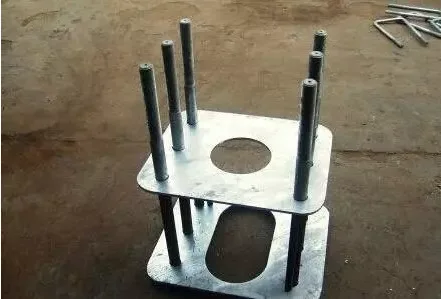
Pre-embedded parts are components installed or concealed within structural elements during construction. They are crucial for ensuring the internal stability and external integration of the structure.

1. Pre-Embedded Construction
(1) After completing the drawing review, a detailed construction plan for embedded parts should be created. This plan must specify the type, quantity, and exact locations of each component, and confirm that all corresponding positions are clearly marked in the drawings to guide on-site work.
(2) When positioning boreholes, it is essential to align with the main control line to guarantee the casing’s accuracy. Careful attention should be paid to error accumulation and elimination during surveying, including reviewing elevation discrepancies.
(3) Following the construction drawings, insert the casing, adjust its placement, and reinforce it as needed. Once completed, verify the relative displacement of the main control line to ensure that any errors remain within acceptable construction tolerances.
2. Error Control
(1) Establish a coordinate and axis network to accurately map the steel structure. Set up a measurement control network for installation that integrates with the original ground measurement controls.
(2) Adjust the structural dimensions to prevent error accumulation. Ensure measurement instruments are calibrated for accuracy, meet structural stress requirements, and maintain manageable dimension tolerances.
(3) Before installing embedded parts, review the plane axis, calculate deviations, and develop an allowable error margin based on the specific type of embedded component.
(4) During structural construction, protect embedded parts from damage or displacement caused by nearby operations. If any displacement occurs, promptly correct it. Replace any damaged embedded parts immediately.
3. Quality Monitoring
(1) Implement a comprehensive quality control system with specialized construction plans coordinated with the main structure to monitor reserved and embedded parts.
(2) Any design changes during construction must be promptly reflected in updated construction drawings.
(3) Drawings should include detailed specifications for routing through floor slabs, entry pipes, and spatial areas.
(4) Strengthen the approval process for design changes to ensure ongoing structural safety and stability.

4. Defect Prevention and Control
(1) The pre-embedded positions in floor slabs must avoid concrete cracking caused by densely arranged structural elements. Temporary springboards can be installed to distribute stress, or steel reinforcement may be enhanced. During construction, avoid stepping on or disturbing these areas.
(2) When pouring concrete, avoid excessive vibration that could displace embedded parts. Large-scale projects should assign on-site inspectors to ensure embedded components and pipelines remain undamaged.
(3) Pre-embedded junction boxes and sleeves must be promptly sealed or filled after installation. This prevents blockages from debris, dust, or waste during subsequent construction phases, which could cause problems during assembly or later use.
Article source: Architectural Technology Magazine
Assembly construction responsibility: Book of Documents
















Must log in before commenting!
Sign Up