
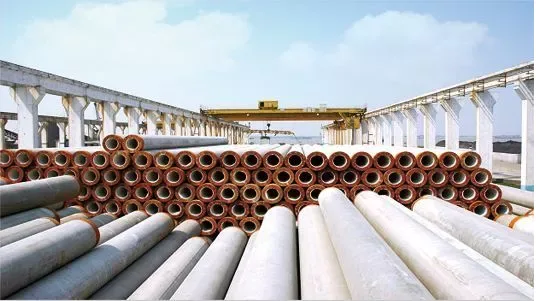
PHC pipe piles are known for their high concrete strength, enabling them to be driven into dense sand layers and heavily weathered rock formations. Below, we summarize key quality control points to ensure the optimal construction of PHC pipe piles. Let’s explore these essential steps together.
1. Entry Control
Before transportation to the site, the pile’s strength must meet 100% of the design specifications.
Upon arrival at the site, inspect the following:
- Product certification, appearance, and external dimensions.
- Appearance standards: No honeycombing, exposed reinforcement, or cracks; uniform color; and no cracks at the pile top.
- Prefabrication specifications: Pile diameter tolerance ±5mm; pipe wall thickness ±5mm; pile tip centerline deviation less than 2mm; top surface flatness within 10mm; and pile top bending less than 1/1000 of pile length (L).
- Markings: Each pile must be labeled with its marker, manufacturing date, and pile number.
2. Site Stacking
- Use the two-point pivot method or hooks at both ends when lifting piles. The angle between the rope and the pile body must exceed 45°.
- Move piles horizontally during loading, unloading, and lifting. Avoid throwing, collision, or rolling.
- The stacking area should be flat, stable, and equipped with proper drainage.
- Place wooden pads at the bottom layer using the two-point support method. Supports should be level, spaced at 2/3 of the pile length (L).
- Stacking limits: For 400mm diameter pipes, up to 4 layers can be stacked; for 500mm and 600mm diameter pipes, stack up to 3 layers. Each layer requires wooden pads with two-point support.
- Separate piles by specification and model when stacking.
3. Preparation Before Construction
Set out the axis using control points from the national triangulation network, confirming accuracy through multiple reviews. Ensure that at least two axis control points on site remain unaffected by pile driving operations.
Check the surrounding environment for nearby buildings, overhead lines, and underground pipelines. Take these precautions:
- Excavate earthquake-resistant trenches 0.5–0.8m wide, with depth determined by soil conditions and slope stability.
- Install bagged manholes with diameters of 70–80mm, spaced 1–1.5m apart, and 10–12m deep.
Determine the piling sequence based on pile density and proximity to buildings:
- If piles are densely packed and far from buildings on an open site, start from the center moving outward.
- If the site is narrow with dense piles and both ends distant from buildings, proceed from the center toward both ends.
- If piles are dense and close to buildings on the sides, begin near the building and proceed outward.
- Prioritize piles by size: larger before smaller, longer before shorter.
Ensure all pile driver components are functioning properly and firmly connected. Pressure gauges must be tested and certified by an authorized body before use.
Prepare the pile driver installation site according to construction requirements, leveling the ground to an average foundation bearing capacity of 35kPa.
Verify pile positions with a maximum deviation of 20mm, and mark pile lengths clearly in meters.
4. Quality Control
- The vertical deviation of the first pile section during lifting and insertion must not exceed 0.5%. Use a theodolite set up at 90° from the front and side to monitor verticality. If necessary, withdraw and reinsert the pile. Adjusting the pile driver position for correction is strictly prohibited.
- When extending the pile, do so when the pile head is 0.5–1m above ground.
- Ensure the upper and lower sections of connected piles align straight, with a maximum offset of 2mm at the joint.
- Clean joint surfaces and grooves thoroughly before connection. If gaps are large, use iron sheets to fill and weld securely. Joint gaps should not exceed 2mm.
- Welding procedure: first, symmetrically spot weld 4–6 points; then two qualified welders perform symmetrical welding. Apply at least two layers: the first with a 3.2mm welding rod backing, the second with a 4mm or 5mm welding rod. Clean and dry the inner layer before welding the outer layer. Welding thickness should exceed groove depth by 1mm, and weld seams must be continuous, full, and free of pores, beads, or cracks.
- Allow at least 5 minutes of rest after welding. Do not cool with cold water or apply pressure immediately after welding.
- During pile pressing, monitor pressure, verticality, time intervals between pile connections, connection quality, and pressing depth. For important projects, conduct flaw detection on 10% of welded joints.
- Welding is prohibited under temperatures below 0°C without reliable measures ensuring quality, or during rain and snow.
- Each pile should be constructed continuously to minimize downtime.
- If the distance between piles is less than three times the pile diameter, that pile must be skipped.
- Control pile top elevation by calculating delivery height based on design specifications and mark this on the delivery device.
- Protect the exposed pile head above ground. Use a pile cutter for trimming. Do not strike with a hammer or forcibly pull the pile.
Article source: Architectural Technology Magazine













Must log in before commenting!
Sign Up