
Constructing steel trusses demands high precision, especially since the work often takes place at significant heights, increasing the complexity of the process. Beyond complying with construction specifications and documentation requirements, the following details are essential to ensure successful installation.
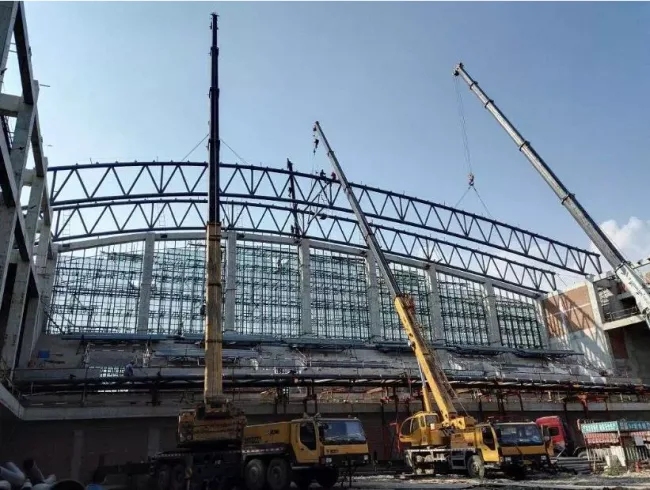
Steel Truss Hoisting
Segmented Lifting Principles
When working with bidirectional trusses, the segmentation and lifting sequence should adhere to these key principles:
(1) Comply with the performance capabilities of on-site cranes to facilitate installation;
(2) Ensure rational and economical segmentation during factory production;
(3) Consider the weight and transportation requirements of individual components;
(4) Avoid placing connection points on the same plane; instead, stagger them by at least 500 mm to enhance structural integrity.
Quality Control Measures
To ensure the quality of steel truss construction, the following measures must be strictly observed:
(1) Control weld seam dimensions precisely according to design specifications, avoiding arbitrary changes in weld height or width.
(2) Use welding techniques with low heat input, small weld beads, and multiple passes and layers to minimize shrinkage.
(3) Allow for shrinkage during assembly and welding by reserving adequate tolerances, correcting components in sections, and controlling deformation.
(4) Employ symmetrical reverse welding by multiple operators to reduce welding deformation.
(5) Select free ends for welding based on assembly layout to prevent excessive internal stress accumulation from welding errors.
(6) Improve component manufacturing accuracy by inspecting lengths and controlling deviations positively.
(7) Conduct precise measurements of spans, centerlines, displacements, elevations, and arch camber using steel rulers, latitude and longitude instruments, levels, and total stations to detect and correct positional deviations promptly, ensuring overall assembly accuracy.
Steel Truss Welding
Preparation
Before welding, clean the joint surfaces within 10–15 mm to remove rust and contaminants. Grind the start and end points of tack welds into smooth slopes and verify the absence of defects like incomplete fusion or shrinkage cavities. Reserve allowances for welding shrinkage at both ends of steel trusses. Correct any deformations caused by processing, manufacturing errors, or transportation before welding.
Welding Precautions
For the first welding layer, remove any protrusions and inspect groove edges for fusion defects or depressions, removing them as needed. Avoid grinding edges that could compromise the groove. Use large-diameter welding rods with moderate current for vertical welding; apply higher current for horizontal welding.
For surface layers, reduce welding current and extend fusion time at groove edges. Minimize interruptions when changing welding rods to maintain weld integrity.
Quality Control During Welding
(1) Preheat and dehumidify steel trusses before welding to prevent defects.
(2) Control welding speed and adjust heat input carefully.
(3) Manage fusion ratios to reduce harmful elements in base and molten metals.
(4) Use welding materials for root welds with low sulfur and phosphorus and high manganese content to improve toughness and resistance to thermal cracking.
Safety Plan
Safety is paramount during steel truss lifting operations. The following precautions should be implemented:
(1) Establish a safety alert zone covering the entire lifting area. Assign dedicated personnel to guard this zone, operating a 24-hour watch to prevent unauthorized access during lifting.
(2) Assign a specialist to inspect the jack and monitor its operation using communication devices to prevent slippage or malfunction.
(3) Similarly, have a dedicated inspector check the oil pump for overheating, leaks, or unstable pressure. If issues arise, halt operations immediately with overall commander approval; never issue unilateral stop commands.
(4) Install stabilizing ropes at both ends of the truss during lifting to prevent swaying.
(5) After positioning the truss, weld it in place carefully to avoid arc burns. Insulate steel strands and anchors during welding.
(6) Prepare for emergencies in advance, applying the principle of safety first and prevention-oriented planning to ensure smooth lifting progress.
(7) Require all personnel entering the lifting site to wear safety helmets. Workers performing high-altitude tasks must fasten safety harnesses. Professionals should wear identification badges and follow signal workers’ instructions closely. Signal workers must carry flags, whistles, and communication devices.
(8) Before crane operation, verify the object’s weight to avoid overloading. Securely tie lifting ropes at appropriate points, confirming tightness at roughly half a meter above the load before lifting. Raise and lower components slowly. Never stand on lifted components or stack other materials on them to prevent accidents.
(9) Ensure that signal language and gestures are consistent between the signal worker and crane operator. Commanders must communicate clearly to avoid misunderstandings. Crane operators should follow signal workers’ instructions precisely for coordinated, safe operations.
(10) When lowering steel components, reduce speed gradually. Construction workers should hold components from the sides and avoid placing hands under the bottom or at joints.
Source: Architectural Technology Magazine













Must log in before commenting!
Sign Up