
The renovation of existing buildings in Europe is extensive, with mature prefabricated construction technology and valuable experience worth learning from. Spain, in particular, has a relatively developed construction market and a successful track record in promoting new designs and technologies. Here, we highlight two representative renovation projects in Spain that utilize prefabricated construction technology, introducing their key technical features.
1. Barcelona Arena (Centro Comercial Arenas de Barcelona)
The Barcelona Arena, originally a bullfighting ring built in 1900, is located in Barcelona, Spain. Before renovation, it featured a closed circular design with an open-air bullfighting area in the middle, surrounded by stands and rest areas. The structure was reinforced concrete with exquisite red brick masonry and red and white arched doors on the exterior, showcasing a strong Moorish architectural style.
In the 1970s, anti-bullfighting activities increased while events at the arena declined. In April 2004, the Barcelona City Council declared the city the first in Spain to oppose bullfighting. Given the arena’s significance in Catalan history, the council decided to transform it into a shopping center without damaging the original exterior walls, preserving its architectural facade.
The renovation was carried out by the renowned London-based firm RSH+P. The internal construction covers 105,816 square meters, including a 46,973 square meter bullfighting arena area, a 5,500 square meter auxiliary building, and a 53,343 square meter parking lot, spread over six floors above ground.
This large-scale, complex project involved both renovation and new construction, combining steel, concrete, and wooden structures to leverage the advantages of each. The following sections outline the technical highlights.
Part One: Exterior Facade Renovation — Base and Top Wall Renovation
The original arena entrance was elevated, accessible only via external ramps and stairs. During renovation, these were removed, revealing the exterior walls beneath. A new open entrance was created on the existing first floor. To provide a wide entrance while preserving the Moorish facade, a “V-shaped steel structure support with concrete prefabricated beam components” replaced the original exterior wall base, perfectly aligning with the architect’s vision.
A high-strength mortar protective cushion was applied atop the original wall, clamped with two prefabricated components connected by bolts. Once the steel support was in place, the original wall below the horizontal prefabricated components was removed, and the V-shaped steel support was installed to transfer the upper wall’s load effectively.
Because the exterior wall is curved, prefabricated beam components were designed with corresponding curvature and asymmetry, requiring exceptional construction precision. The foundations for the V-shaped supports were reinforced to handle a tripled load, maintaining structural stability. The top of the exterior wall was similarly stabilized with clamping prefabricated components.
Part Two: Internal Main Structure Transformation
The open-air bullfighting arena was converted into a shopping center with a completely rebuilt main structure. The circular layout was retained, expanding to nine floors (including three underground). The three underground and ground floors use reinforced concrete, while the upper floors are steel structures.
The interior consists of four symmetrical functional areas surrounding a five-story-high atrium with circular corridors. The rooftop features a “dish”-shaped spatial truss platform, 100 meters in diameter, supported by four giant column groups arranged orthogonally and symmetrically. These columns rest on concrete supports extending through the underground floors, with multiple elevators and escalators providing access.
The disc-shaped platform extends beyond the outer wall and is structurally independent, also serving as a unique sightseeing area. Prefabricated concrete roof panels with embedded transparent glass bricks create a stunning visual effect at night through bottom lighting, highlighting the designer’s craftsmanship. This cantilevered platform appears to float, offering panoramic city views.
Part Three: Wooden Structures
The new roof is a single-layer, wooden ribbed circular dome shell spanning 76 meters with a 10-meter rise. It is lightweight, allows flexible lighting, ensures natural drainage, and facilitates diverse interior layouts.
The dome’s compression ring connects to radial components, with bolted nodes that are cleverly concealed from inside. A circular tension beam around the roof’s edge is supported by 20 steel supports arranged on a dish-shaped grid.
A transparent circular ring 30 meters in diameter at the dome’s center enhances natural lighting. Other roof areas include insulation and anti-glare coatings to reduce light pollution.
The renovation preserves the Barcelona Arena’s historical, cultural, technological, and artistic value. It serves as a “physical historical book,” “historical yearbook,” and “cultural carrier,” making preservation essential.
The project maintained the original facade while upgrading the internal structure and roof. Red and white arched doors were retained, with transition concrete beams on the first floor featuring curved variable cross-sections, and V-shaped steel supports painted red to match the original style. A circular cantilevered roof shields the exterior walls from sun and rain, embodying the principle of “preventive repair and renovation.”
The steel structural renovation maximizes advantages for large spans, lightening the building’s appearance and reducing foundation reinforcement. The detached roof ensures no additional load on the exterior walls, safeguarding structural safety. The wooden dome roof complements the antique walls, enhancing the building’s architectural charm and historical significance.
This renovation exemplifies the principle of “restoring the old as it is,” combining modern design with traditional elements to meet contemporary functional and aesthetic needs, breathing new life into an iconic historic building.
2. Mercat de Santa Caterina Market in Barcelona
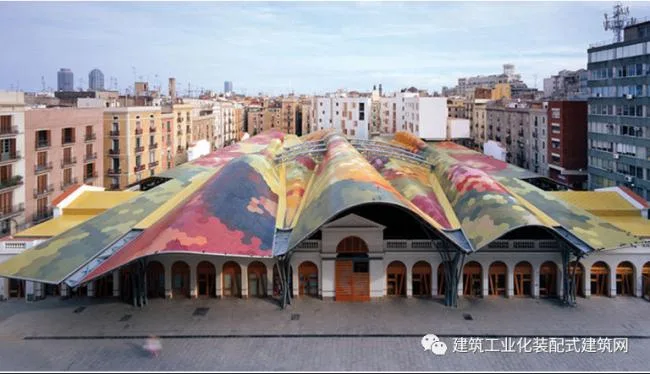
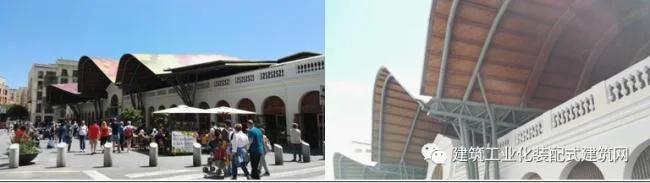
Completed in 2005, the Santa Caterina Market, designed by Spanish architect Enric Miralles Benedetta Tagliabue/EMBT, successfully integrates concrete, steel, and wood composite structures. Its colorful ceramic roof tiles, inspired by various fruits, are embedded within the wavy steel and wood composite roof.
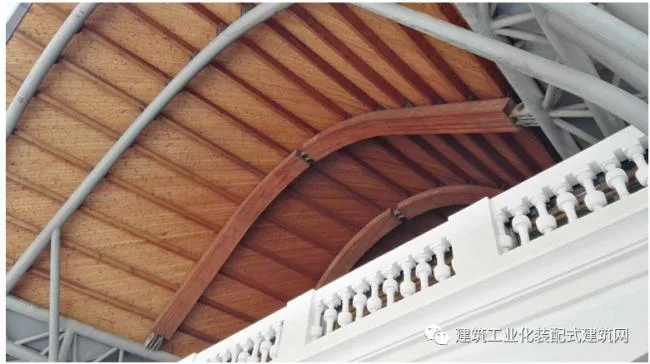
On the exterior of the original single-story building, an irregular, tree-like steel structure was installed. This, along with steel columns, supports the spatial truss chords arranged in a Z-shape above the market. A triangular arched wooden structure caps the truss. The asymmetrical design and material combination create a harmonious space, fostering a relaxed and joyful atmosphere.
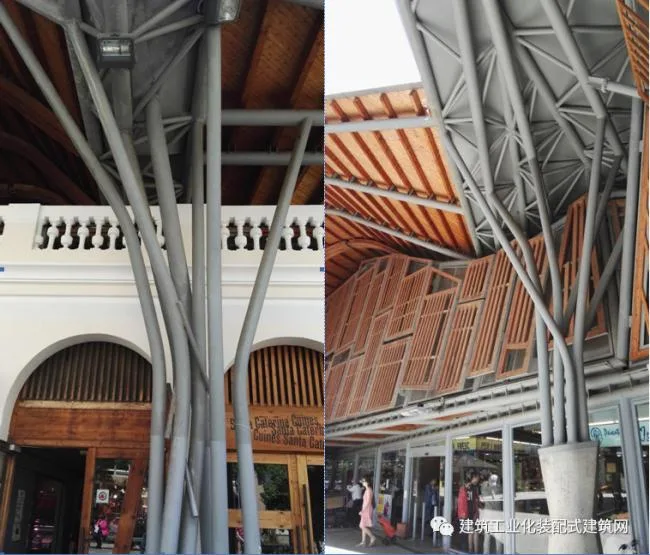
Node construction of irregularly shaped columns and large-span spatial truss chords

The roof design is inspired by various natural fruits and vegetables sold in the market
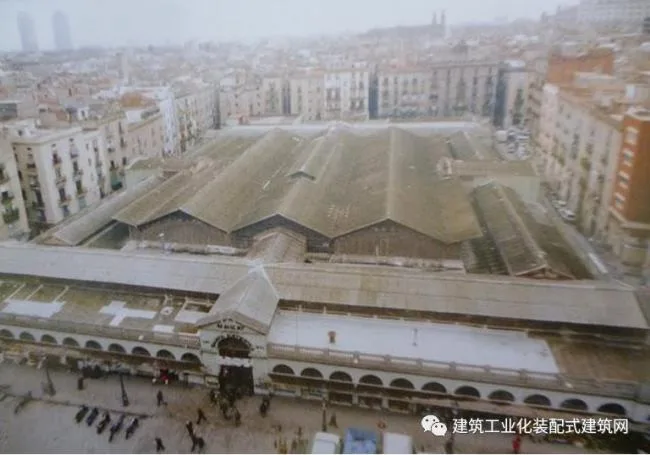
The market’s original appearance before renovation (1980)
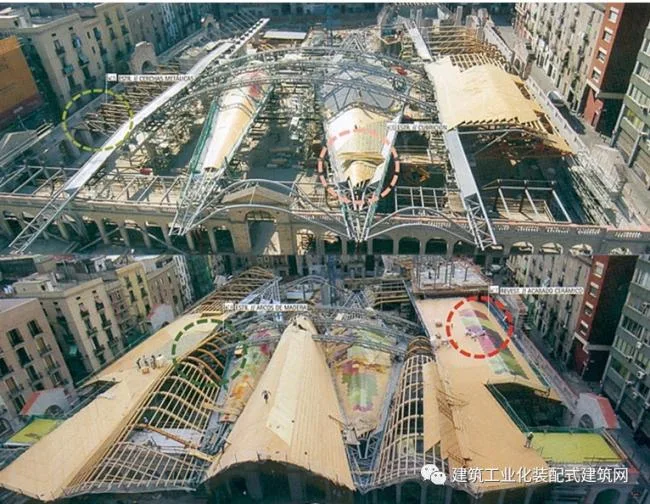
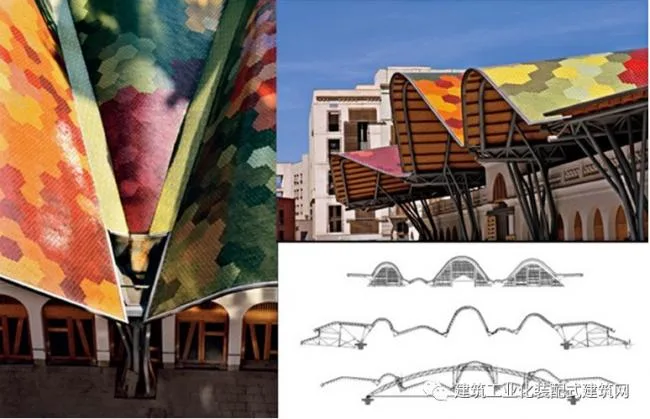
Due to the large span of the spatial truss running along the market’s depth, the designer incorporated three curved arch trusses in the middle to suspend the roof’s central and folded truss sections. These arch trusses rest on prefabricated concrete beams spanning the market’s depth axis.
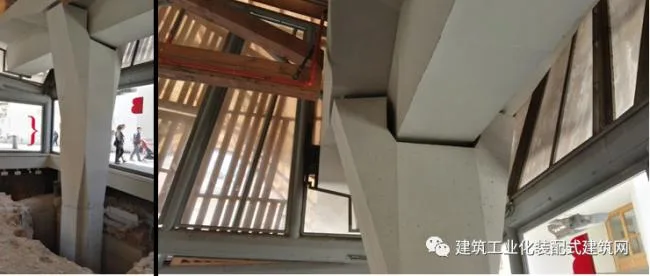
In these two exemplary renovation projects, multiple prefabricated construction technologies were integrated, demonstrating several advantages:
- Shortened Construction Time: Prefabricated components manufactured off-site and assembled on-site, often integrating construction and decoration, drastically reduce on-site construction duration.
- Environmental Protection: Factory production and dry on-site assembly minimize construction waste, preserving the environment.
- Cost Savings and Safety: Factory precision improves accuracy and resource reuse, lowering costs and reducing risks associated with on-site formwork.
- Diverse Components: Prefabricated concrete parts can be customized with specific templates to achieve decorative facade effects.
- Technological Advancement: Innovative processes and methods derived from prefabricated technologies offer valuable insights for the industry.
In summary, prefabricated construction technology, originating from ancient times, remains a practical solution that balances economy, safety, sustainability, and aesthetics. With ongoing advancements in materials, design, and construction techniques, the potential for renovating and designing existing buildings continues to expand.












Must log in before commenting!
Sign Up