
In larger underground garages or extended residential buildings, it is common practice to install post-construction pouring strips to minimize cracks caused by differential concrete shrinkage and primary settlement. However, during actual construction, various quality issues often arise in these post-pouring strip areas, including severe steel bar corrosion, concrete slag inclusions, misalignment, and leakage. These problems primarily stem from defects in the formwork support process of the post-pouring strip, which can be summarized as follows.
1. Defects in the Cast-in-Place Strip
(1) Removing the formwork of the post-pouring strip simultaneously with the adjacent formwork causes the beams and slabs on either side to remain unsupported for extended periods. This changes the stress distribution in the components, leading to irreversible deformation and sometimes structural cracking.
(2) Even when the post-pouring strip’s formwork support system remains intact, the dense steel reinforcement in this area makes it difficult to remove cement slurry and debris during concrete pouring on both sides. This results in slag inclusions within the post-pouring strip and increases the risk of leakage.
(3) Delays in pouring the post-pouring strip can cause water to accumulate within it, soaking the steel bars and promoting corrosion.
2. Improvement Measures
In response, technical teams and project personnel collaborated on extensive testing and refinement, developing a new formwork support method called the “reserved cleaning belt type post-pouring strip construction process.” This innovation effectively addresses quality issues in post-pouring strip construction and significantly improves overall forming quality.
3. Construction Technology
The key innovation of this method is erecting the post-cast strip formwork simultaneously with other beam and slab formworks, while leaving 100 mm-wide garbage cleaning strips along both sides of the post-cast strip. Additionally, 100 mm-wide formwork strips are overlapped in the center of the post-cast strip (the cleaning strip formwork also controls the protective layer thickness of the reinforcement) (see Figure 1). These cleaning strips prevent cement slurry from overflowing the side formwork steel teeth into the post-pouring strip during concrete pouring on adjacent sides, which would otherwise be difficult to clean once the mortar hardens. Furthermore, before pouring concrete into the post-pouring strip, debris inside the formwork can be easily removed through these cleaning strips, simplifying the cleaning process.
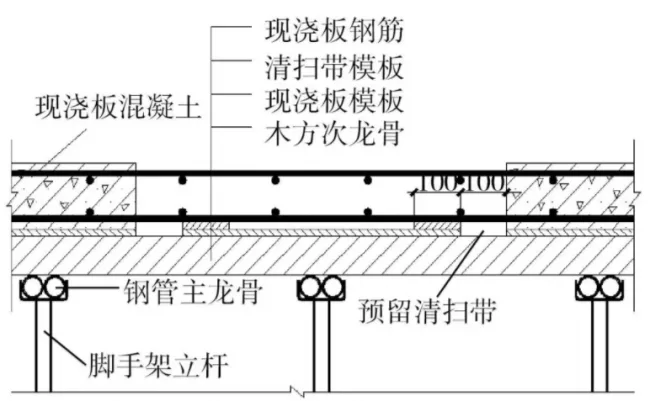
Figure 1: Installation diagram of cleaning belt formwork
When pouring concrete for the post-cast strip, the reserved 100 mm-wide formwork strip is aligned with the cleaning strip. Since both strips have the same width, they match perfectly. The formwork support system remains unchanged, ensuring that after pouring, the lower surface of the post-pouring strip concrete connects tightly and smoothly to the adjacent concrete without visible joints.
This method also involves establishing an independent scaffold support system for the post-pouring strip. Short steel pipes serve as the main BIM learning keels, connected with other keels to form an integrated scaffold support system. After removing the scaffold supports on either side of the post-pouring strip, the scaffold in the post-pouring area can be retained independently. This maintains a consistent stress distribution in the beams and slabs adjacent to the post-pouring strip, matching the designed load conditions.
Implementing this technology has significantly enhanced the construction quality of the post-pouring strip area. Upon demolding, the concrete surface is smooth and even, free from slag inclusions or misalignment. Post-rain inspections showed no signs of leakage, greatly reducing future maintenance costs and saving social resources.
(Ronglian Zhu: Hebei Fangze Construction Engineering Group Co., Ltd.)













Must log in before commenting!
Sign Up