
Summary: As construction industrialization advances, prefabricated concrete structures are set to dominate the residential construction market. Floor systems, representing a significant portion of the overall structure, benefit greatly from composite floors. These floors merge the strengths of prefabricated and cast-in-place methods, offering unique advantages that support widespread application. This article explores the stress characteristics and classifications of composite floor slabs, discusses their pros and cons, reviews their development and current research both domestically and internationally, and underscores their importance in advancing construction industrialization in China.
Keywords: Composite floor slabs; Classification; Development history; Research status
1. Introduction
The ongoing industrialization of construction has rendered traditional, labor-intensive building methods unsuitable due to low productivity, high energy consumption, and significant environmental impact. Consequently, the construction industry must evolve. Prefabricated concrete structures have emerged as a key form in this transition, with composite floor slabs playing a crucial role. Given the substantial proportion of floor systems within structures, and the complexities of traditional construction techniques that slow project progress, there is a pressing need for innovative composite floor slabs. These new slabs should offer high load-bearing capacity, excellent seismic performance, rapid construction, environmental benefits, and cost-effectiveness, thereby fostering the growth of building industrialization.
2. Stress Characteristics and Classification of Composite Floor Slabs
2.1 Stress Characteristics of Composite Floor Slabs
Composite floor slabs are categorized based on their support conditions during construction:
For primary stress composite slabs, where reliable safety supports are installed beneath during construction, their stress characteristics closely resemble those of cast-in-place concrete slabs.
In contrast, secondary stress composite slabs, constructed without reliable safety supports, exhibit the following features:
- Tensile steel stress, deflection, and curvature under secondary stress are greater than those in cast-in-place slabs under similar conditions. This is attributed to the lower height of the prefabricated bottom plate during construction, a phenomenon known as “steel stress advance”.[1]
- During construction, compression is mainly borne by the concrete in the prefabricated bottom plate’s compression zone. In service, however, compression shifts primarily to the post-poured concrete. This alternating compression leads to smaller compressive strain in the post-poured concrete compared to cast-in-place slabs, termed the “compressive strain lag”.[1]
2.2 Classification of Composite Floor Slabs
Composite floor slabs can be classified based on stress performance into two types:[2]
- Primary Stress Composite Floor Slabs: These feature reliable safety supports installed beneath the prefabricated bottom plate during construction. The supports bear all construction loads, with the bottom plate acting as formwork for the cast-in-place concrete composite layer. Once the composite layer gains sufficient strength, supports are removed, and the slab bears all operational loads. The slab experiences single-stage stress and is known as a “one-time stress composite floor slab”.
- Secondary Stress Composite Floor Slabs: These slabs are installed without support beneath the prefabricated bottom plate during construction. The bottom plate bears construction loads directly. After the cast-in-place composite layer reaches design strength, the combined structure supports all operational loads. The slab experiences two-stage stresses and is called a “secondary stress composite floor slab”.
Additionally, composite floor slabs are categorized by construction type:
- Reinforced Concrete Truss Composite Floor Slab: Steel bars are fabricated into trusses and embedded within concrete to form a prefabricated bottom plate. This plate is installed on-site, after which concrete is poured atop to complete the steel bar truss composite slab.[3] See Figure 1.
- PK Prestressed Concrete Composite Floor Slab: This slab uses an inverted “T”-shaped prefabricated ribbed thin plate as the bottom plate, reinforced with spiral ribs and high-strength steel wires. During construction, transverse perforated steel bars are inserted into reserved holes on the ribs, and concrete is poured to complete the slab.[4] See Figure 2.
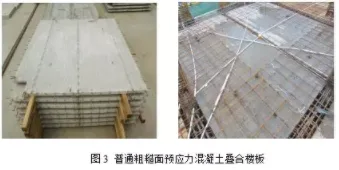
- Ordinary Rough Surface Prestressed Concrete Composite Floor Slab: Prestressed steel bars are arranged within the prefabricated bottom plate, which features a rough composite surface. Negative bending moment steel bars are placed at supports, followed by concrete pouring to form the slab. See Figure 3.
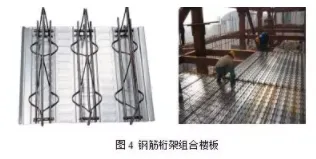
- Steel Truss Floor Slab: Steel bars are fabricated into trusses and welded to galvanized steel plates, forming a combined template. These are transported to the site and laid on steel beams, where concrete is poured to complete the slab.[5] See Figure 4.
- Composite Floor Slab of Profiled Steel Sheet and Concrete: This slab uses pressed thin steel plates with alternating concave and convex shapes as the bottom plate, which also serves as formwork. Steel bars are arranged in the cast-in-place layer, and concrete is poured to form the slab atop steel beams.[6] See Figure 5.
- SPD Composite Prestressed Concrete Hollow Floor Slab: A fine aggregate concrete composite layer is poured on the rough surface of a prestressed concrete hollow slab, bonding to form a unified structure that shares loads. See Figure 6.
- Prestressed Concrete Double T-Plate: This prefabricated load-bearing component combines slab and beam, consisting of a wide panel with two narrow, high ribs. Concrete is poured to form a monolithic unit. See Figure 7.

2.3 Advantages and Disadvantages of Composite Floor Slabs
Composite floor slabs leverage the benefits of cast-in-place and fully prefabricated floors, offering several advantages:[1]
- They exhibit greater overall stiffness and improved seismic performance compared to fully prefabricated slabs, while enabling faster construction and better suitability for industrial production than cast-in-place slabs.
- Prefabricated bottom plates are factory-produced with high mechanization, ensuring quality and rapid assembly, unaffected by seasonal constraints.
- Reusable templates reduce formwork demands on-site, minimize wet operations, improve the working environment, enhance efficiency, and significantly shorten construction timelines.
- Smaller size and lighter weight facilitate easier transport and installation, providing flexibility compared to fully assembled slabs.
- Use of prestressing reduces steel consumption and improves structural performance. Employing varied concrete grades and compositions tailored to stress demands saves cement, yielding economic benefits.
- Reduced on-site waste effectively controls environmental pollution.
However, some drawbacks exist:[1]
- Age differences between the prefabricated bottom plate and the cast-in-place composite layer cause differential shrinkage stresses, with greater age differences leading to larger stress variations.
- Complex construction procedures and node structures require precise installation and stringent quality control.
- Transportation of prefabricated components can be challenging in mountainous regions with limited access.
3. Development and Research Status of Composite Floor Slabs
3.1 International Development History
Since the 1920s, concrete composite technology has been applied abroad, initially in bridges and later extensively in housing during the 1940s and 1950s. Early composite structures combined steel or wooden beams with cast-in-place slabs, evolving into prefabricated reinforced or prestressed concrete components combined with cast-in-place slabs.
Poland: In the 1950s, the “universal component” — a composite panel available in various forms such as groove, I-shaped, and ribbed types — was widely used. The DMSZ composite floor slab employed prestressed small beams topped with clay hollow blocks and concrete, achieving economic efficiency.
United Kingdom: The “Shitaer Tang” stacked floor system was prevalent, and British Concrete Limited developed the “Bizang” prestressed slab, featuring a dovetail groove composite surface to ensure bonding between old and new concrete.
Former Soviet Union: Early 1960s developments included prestressed thin plates with rough surfaces topped by ceramic aggregate concrete (C7.5–C10), demonstrating safe and reliable composite behavior.
France and West Germany: During the 1970s, prestressed base plates incorporating shear steel bars were poured with concrete to form composite slabs, leading to the establishment of design methods and regulations.
Japan: In the 1980s and 1990s, Japan developed various PC composite panel components widely used in civil, high-rise, and industrial construction. Notable are composite floor slabs paired with U-shaped semi-prefabricated beams and mouth-shaped semi-prefabricated columns, assembled on-site and concreted to form integrated structures.
Europe and the United States: Early adopters of profiled steel reinforced concrete composite slabs, with Professors Porter and Ekberg pioneering calculation methods for longitudinal shear capacity, advancing composite slab theory and practice.
3.2 Domestic Development
In 1961, Professor Zhu Bolong of Tongji University developed an assembled integral ribbed floor slab combining prefabricated I-shaped beams and thin plates with a cast-in-place concrete topping, offering lightweight, rapid construction and economic benefits.
In the late 1970s and early 1980s, Chinese research groups from over ten universities investigated composite structures, finding that rough composite surfaces and clean, moist conditions during casting enhance bonding. Manual scratching of prefabricated plates (25–40mm thick) with at least 2mm depth improves performance.[11]
In 1980, the Beijing Institute of Building Engineering tested 30 composite panels, showing that specimens with reserved joint reinforcement exhibited 20–30% higher shear strength than cast-in-place ones. Rough and grooved surfaces performed moderately, while smooth surfaces performed poorly, with significant displacement and reduced strength.[12]
Subsequent studies by Hou Jianguo (1993) demonstrated that composite surface shear capacity depends on surface roughness, concrete strengths, reinforcement ratios, prestress levels, and geometric factors.
Other researchers, including Cui Guangren, Xiao Guotong, Zhou Xuhong, Liu Hanchao, Jiang Xinliang, Nie Jianguo, Zhang Jingshu, Liu Yunlin, Luo Rong, Tan Yongchao, Zhao Peili, Feng Mingyuan, and Huang Chao, have contributed extensive experimental, theoretical, and practical insights into composite floor slabs, leading to innovative designs such as the PK prestressed concrete composite slab, honeycomb-shaped steel plate slabs, and shale aggregate concrete composite floors.
3.3 Research on Stiffness and Bearing Capacity
Researchers such as Qian Yongmei, Shen Chunxiang, Hu Xiaogang, Liu Yi, Wu Xuehui, Gong Jianglie, Sun Lei, Malan, Wu Fei, Wu Fangbo, Huang Hailin, and Zhao Qile have advanced understanding of stiffness and load-bearing behaviors of composite slabs through experimental tests, finite element analyses, and theoretical derivations. Their work has refined calculation methods for deflection, cracking loads, ultimate bearing capacity, and overall stress performance, often aligning with or improving upon existing design codes.
Conclusion
Composite floor slabs offer excellent overall integrity, rigidity, formwork savings, reduced environmental impact, and facilitate industrialized construction, significantly enhancing efficiency and quality. However, challenges remain in simplifying calculation models, structural analysis, and developing comprehensive standards. Continued research is essential to improve theoretical frameworks, resolve joint treatment issues, and optimize reinforcement strategies, thereby supporting China’s construction industrialization efforts.
References
Zhou Wanghua. Modern Concrete Composite Structures. Beijing: China Architecture & Building Press, 1998:1-11.
Zhao Shunbo, Zhang Xinzhong. Design Principles and Applications of Concrete Composite Structures. Beijing: China Water Resources and Hydropower Press, 2001:1-38.
Yongxing Li, Lu Jiang, Zhiqiang Yu, Jie Li, Yongwei Li. Test research on the behaviors of steel bar truss and concrete superimposed floor slabs. The 2nd International Conference on Civil Engineering, Architecture and Building Materials, Yantai, China.
Dong Bing. Experimental Study and Engineering Application of PAK Prestressed Concrete Composite Floors. Changsha: Hunan University, 2012.
Huang Wei, Su Yanjiang. A review of research on several composite floor slabs in the construction of new urbanization. Proceedings of the Academic Symposium on Science and Technology Support for New Urbanization Construction, 2014:148-153.
Shenyi. Experimental study on stiffness of closed-end profiled steel plate concrete composite floor slabs. Hefei: Hefei University of Technology, 2012.
Wang Chunping. Experimental Study on the Bending Performance of Composite Mortar Steel Wire Mesh Composite Panels. Changsha: Hunan University, 2007.
Zhang Pengli. Mechanical Performance Analysis and Application of Four Sided Simply Supported PK Prestressed Concrete Composite Floors. Changsha: Hunan University, 2013.
Zhou Mingjie. Design and Engineering Application of Steel Concrete Composite Structures. China Building Materials Industry Press, 2005, pp. 33-34.
He Shoumin. Experimental study on stiffness of steel truss composite floor slabs. Hefei: Hefei University of Technology, 2013.
Research Group on Assembly Integrated Beam and Plate Research. Experimental Study on Design Method of Assembly Integrated Beam and Plate. Journal of Building Structures, 1982, (6): 1-19.
Sang Aihua, Lin Yuanzheng. Research and Application of Prestressed Thin Plate Composite Floor Slabs. Building Technology, 1984, (11): 1-9.
Hou Jianguo, He Caixu. Study on the stress performance of the composite surface of prestressed concrete composite slabs. Journal of Wuhan University of Water Resources and Electric Power, 1993, 26 (3): 73-82.
Cui Guangren, Sun Fuying. Experimental study on prestressed concrete hollow slab composite integral slab. Journal of Luoyang Institute of Technology, 1999, 20 (4): 89-92.
Xiao Guotong, Qin Entang, Xu Youlin, et al. Experimental study on the performance of GRC concrete composite slab structures. Electric Power Construction, 1997 (2): 1-10.
JGJ/T258-2011. Technical specification for precast ribbed concrete composite floor slabs. Beijing: China Architecture & Building Press, 2011.
Liu Hanchao, Jiang Qingqing. Experimental study on inverted “T”-shaped simply supported plate. Journal of Central South University (Natural Science Edition), 2004, 1 (35): 147-150.
Jiang Xinliang, Yue Jianwei. Study on the bearing capacity of ceramic composite laminates. Journal of Sichuan University (Engineering Science Edition), 2006, 6 (38): 6-11.
Nie Jianguo, Chen Bilei, Chen Ge. Experimental study on reinforced concrete composite slabs. Industrial Construction, 2003, 33 (12): 43-46.
Zhang Jingshu. Research on Seismic Performance of Prefabricated Ribbed Bottom Plate Composite Panels. Lanzhou: Lanzhou University, 2013.
Liu Yunlin. Experimental study and numerical simulation of the stress mechanism at the joint of bidirectional composite floor slabs. Hefei: Hefei University of Technology, 2014.
Luo Rong. Design Principle and Mechanical Performance Study of PKG Prefabricated Bottom Plate and Its Composite Plate. Kunming: Kunming University of Science and Technology, 2018.
Tan Yongchao. Study on the Mechanical Properties of Honeycomb Shaped Steel Plate Concrete Composite Plate. Xuzhou: China University of Mining and Technology, 2016.
Zhao Peili. Study on the flexural performance of reinforced concrete partially composite slabs. Nanning: Guangxi University, 2018.
Feng Mingyuan. Study on the flexural performance of prestressed concrete composite slabs with steel ribs. Jinan: Shandong University, 2017.
Huang Chao. Prototype Stacking Test Study on Assembled Integrated Shale Ceramic Aggregate Concrete Composite Floor Slabs. Wuhan: Wuhan University of Technology, 2017.
Qian Yongmei. Analysis of Bidirectional Stress Performance of Concrete Unidirectional Thin Plate Stacked into Rectangular Plate. Journal of Harbin Jianzhu University, 2002, 35 (1): 38-42.
Hu Xiaogang. Experimental Study on the Bearing Capacity Performance of Prestressed Concrete Bidirectional Composite Plates. Tianjin: Tianjin University, 2005.
Liu Yi. Performance Study of Self Supporting Reinforced Concrete Composite Panels with Steel Trusses. Hangzhou: Zhejiang University, 2006.
Wu Xuehui. Nonlinear Finite Element Analysis and Deflection Calculation of Prestressed Concrete Composite Plates. Tianjin: Tianjin University, 2007.
Experimental Study on the Bearing Capacity Performance of PK Prestressed Concrete Composite Floors. Changsha: Hunan University, 2008.
Sun Lei. Experimental study and theoretical analysis of the bearing capacity of steel truss floor slabs. Hefei: Hefei University of Technology, 2013.
Research on the Performance of Concrete Composite Floors with Ribbed Steel Trusses in Xi’an. Xi’an: Xi’an University of Architecture and Technology, 2013.
Wu Fei. Experimental study on the stress performance and stiffness of composite floor slabs with reinforced trusses. Hefei: Anhui Jianzhu University, 2014.
Wu Fangbo, Huang Hailin, et al. Experimental Study and Calculation Method of Stiffness of Prefabricated Prestressed Concrete Ribbed Thin Plates for Composite Panels. Journal of Hunan University, 2011, 38 (4): 1-7.
Zhao Qile. Static load test research on reinforced concrete composite slabs with spliced joints in truss structures. Zhengzhou: Zhengzhou University, 2017.
Article by Science and Technology Research Center of China Construction Technology Co., Ltd.














Must log in before commenting!
Sign Up