
Traditional house construction involves manual cement mixing, on-site pouring, and lead hammer measurements, whereas modern methods utilize factory prefabrication, standardized components, and rapid assembly.
In Shanghai, prefabricated buildings—often likened to “LEGO building blocks”—are becoming increasingly common. The city has completed over 10 million square meters of such buildings, doubling this figure for two consecutive years. Beyond construction sites, prefabrication companies produce an average of more than one million square meters of standardized components monthly, with some reaching world-class standards and exporting to countries like Japan.
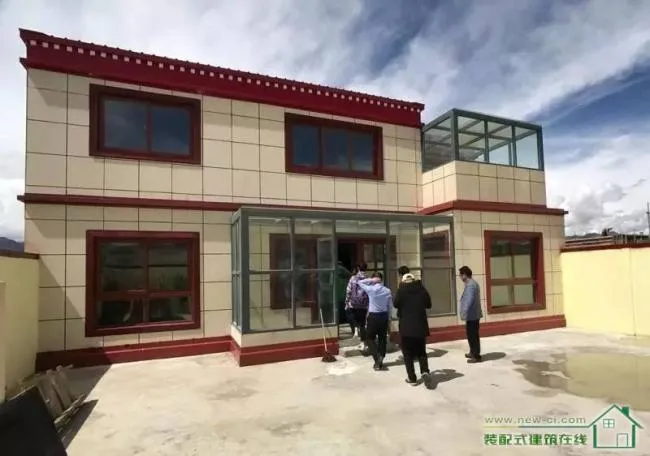
In contrast, most residents of Tibet still live in simple adobe or brick houses, which often have hidden quality issues and insufficient seismic resistance. The unique physical and geographic conditions in Tibet create challenging construction environments and short building periods. Prefabricated, eco-friendly, and energy-efficient buildings can address these challenges, protect Tibet’s fragile ecological environment, and provide effective seismic protection.
But how can a house built in Shanghai succeed on the snowy Tibetan Plateau? At the invitation of the Housing and Urban-Rural Development Bureau of Shigatse City, Tibet Autonomous Region, a doctoral research group from Shanghai Jiaotong University, including two professors from the School of Marine and Architectural Engineering, traveled to Tibet in summer to study and plan prefabricated building technologies suited to the plateau. Their goal was to resolve key technical challenges in introducing prefabricated buildings to Tibet and to offer public training on new concepts and technologies in the construction industry. This team is part of a national college student volunteer initiative for cultural, technological, and health outreach in rural areas and plans to return to assist Tibet again in October.
Adapting to Local Conditions: Innovating Architecture and Embracing Tibetan Culture
Shigatse, situated at an average altitude of over 4,000 meters, is Tibet’s second-largest city and the site of Shanghai’s counterpart construction efforts. With over 600 years of history, Shigatse was historically the political and religious center of Later Tibet and the residence of successive Panchen Lamas. This rich cultural heritage gives local Tibetan houses a distinct ethnic character.
Prefabricated modular buildings are manufactured in factories and then assembled on-site. Promoting these buildings in Tibetan regions requires sensitivity to local acceptance of innovative architecture. Zhu Fengfeng, a doctoral student leading the research group’s planning, told Jiefang Daily Shangguan News that “the promotion of prefabricated buildings in Shigatse must respect local conditions and highlight the cultural landscape.” Combining modern building technologies with traditional Tibetan styles—while improving living standards—has been a key focus of the group’s research and planning.
Besides adapting the appearance of prefabricated buildings to match Shigatse’s style, it is crucial to tailor technical approaches and industrial supply chains to local conditions.
Jiefang Daily Shangguan News reported that much of the Qinghai-Tibet Plateau lies along tectonic plate boundaries, making it prone to frequent earthquakes. The welded steel frame structures used in prefabricated buildings meet stringent strength requirements and offer excellent seismic resistance. Incorporating seismic protections directly into rural Tibetan housing can significantly enhance the overall earthquake resilience of these communities.
Steel components in prefabricated buildings have a service life of up to 80 years. Using light steel frames and precast slabs in Tibet suits the local environment and ensures homes last 40 to 50 years. Since Tibetan houses traditionally have thick walls—partly due to local beliefs about safety—the research team recommends producing wider and thicker prefabricated panels to meet these cultural expectations and reassure residents.
As part of China’s national “Belt and Road” initiative, Shigatse, a key city connecting western China and South Asia, is undergoing a construction boom. However, the fragile snowy plateau environment creates a tension between development and ecological protection, complicating engineering projects.
Despite increased infrastructure investment—2.6 billion yuan last year—the Shigatse government has yet to see the expected growth in infrastructure development. Labor and material shortages during peak construction seasons, combined with harsh weather, limit large-scale construction in Shigatse and the wider Tibetan region.
Liang Qingxue, a doctoral student leading public training efforts, told Jiefang Daily Shangguan News that Tibet benefits from being a latecomer in adopting prefabricated building technology. “Prefabricated buildings offer high seismic resistance, require less labor, and have shorter on-site construction cycles. Since these methods are already being promoted in major cities like Beijing and Shanghai, Tibet can learn from their experiences and avoid pitfalls,” she said.
Huang Jubi, Secretary of the Party Leadership Group of Shigatse Municipal Bureau of Housing and Urban-Rural Development, shares this optimism: “Moving away from traditional extensive construction methods and actively promoting green, ecological, and prefabricated construction technologies are critical challenges that Shigatse must address in its planning and development.”
Furthermore, developing prefabricated buildings in Tibetan areas holds national defense significance. Zhao Chenjun, a doctoral student and member of the 2017 “Three Visits to the Countryside” national key project, noted, “Tibet’s border location, high altitude, harsh living conditions, and difficult environment for border guards make rapid, modular prefabrication with short construction times and strong mobility a valuable asset for China’s border defense.”














Must log in before commenting!
Sign Up