
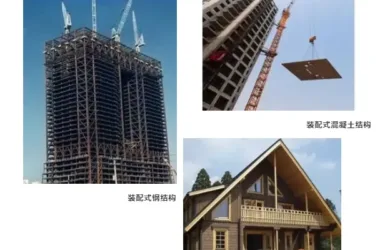
Prefabricated buildings are concrete structures assembled on-site using precast concrete components and reliable connections. As the world’s largest developing country, China heavily relies on the construction industry to sustain its economic growth, and prefabricated buildings are playing an increasingly important role. These buildings are categorized into five types: block buildings, panel buildings, box buildings, skeleton panel buildings, and raised floor buildings.
Block Buildings — These structures use prefabricated block materials to build walls, though they are somewhat limited in their classification as truly prefabricated. Block buildings have a narrow range of applications, primarily in rural residential construction. By increasing cement strength or steel reinforcement ratios, the number of floors can be expanded. Blocks come in small, medium, and large sizes, each suited for different uses. Small blocks are manually transported but require many laborers; medium blocks can be handled with machinery such as cranes for improved efficiency and reduced construction time; large blocks have declined in use due to advancements in prefabricated components and inherent disadvantages. Joint connections between blocks primarily use cement mortar masonry, providing energy-saving and environmentally friendly benefits.
Panel Buildings — These are assembled from large prefabricated inner and outer wall panels, floor slabs, and roof panels. With their low self-weight and strong overall integrity, panel buildings significantly improve labor productivity and earthquake resistance. The internal equipment pipelines should be carefully designed to minimize crossovers and allow centralized layout while ensuring ease of maintenance and replacement. Before waterproofing, the cavities at panel joints must be thoroughly cleaned, and sealing materials should be applied fully, densely, uniformly, and smoothly.
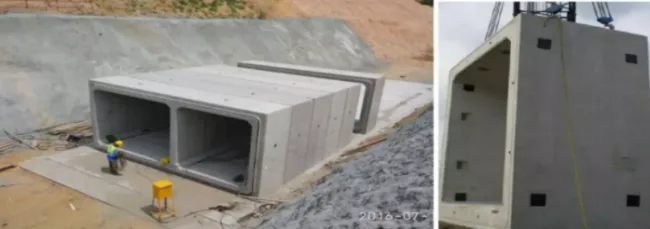
Box-Type Architecture — As the name implies, these buildings consist of box-like units. This type exhibits a high degree of industrialization, with assembly varying based on interior decoration. Some boxes come fully decorated inside and only require connection of reserved energy lines before occupancy. Box-type buildings are further divided into full box type, board box type, core box type, and skeleton box type, based on their internal load-bearing core.
Skeleton Panel Buildings — Composed of prefabricated skeleton frames and panels, these structures are commonly used in cast-in-place construction. Their load-bearing systems include beam-column and slab-column frameworks. Interior walls are generally non-load-bearing, allowing for customized partitions according to individual decoration needs, offering flexibility. Reinforced concrete frames incorporate prefabricated wall panels for all or part of the shear walls, ensuring adequate rigidity. The connections at nodes are critical, requiring careful stress analysis and joint treatment. Different connection methods should be selected based on environmental and construction conditions at each node.
Raised Slab and Raised Floor Buildings — Driven by evolving construction environments and methods, these buildings use slab-column structural systems within skeleton load-bearing frameworks. Construction involves sequential pouring of floor slabs on the concrete base, erecting prefabricated reinforced concrete columns, and using hydraulic jacks along the columns to lift slabs and roof panels to their designated heights for fixation. Exterior walls can be chosen from cast-in-place or prefabricated options depending on site conditions. Most work is performed at ground level to enhance safety and reduce vertical transportation and high-altitude tasks, requiring significant early-stage effort but saving considerable manpower, materials, and costs later by minimizing formwork, scaffolding, and construction area. High-rise floor slabs are typically beamless with reserved holes for uniform pouring, similar to composite panels. Wide column spacing and high floor slab load capacity make this system ideal for large buildings and shopping malls with expansive spans. Raised slab construction is usually installed on the ground floor before overall lifting, markedly improving construction speed and shortening timelines.
Classification of Precast Concrete Structure Connections
The 1997 Uniform Building Code (UBC97) simplifies frame connections into two categories: integral connections and strong connections. Integral connections behave as a unified whole, similar to cast-in-place structures. Strong connections refer to those with high bending resistance in prefabricated components; under seismic stress, these connections maintain elasticity even when parts of the component undergo inelastic deformation. New Zealand classifies frame node connections into four types: precast continuous beams passing through cast-in-place columns; cast-in-place columns with precast beams; precast T-beams with cast-in-place columns; and precast prestressed components with precast U-shaped thin-walled beams.
Domestic classification of connection methods was outlined in 2009 by the Shenzhen Housing and Construction Bureau’s “Technical Specification for Prefabricated and Assembled Integrated Reinforced Concrete Structures.” It categorizes connections into composite beam connections, column-to-shear wall connections, composite slab connections, stair slab connections, and prefabricated exterior wall cladding connections. The 2014 “Technical Regulations for Prefabricated Concrete Structures” primarily recommend steel sleeve grouting technology, considered a mechanical connection in the U.S., as well as the domestically developed grout anchor overlap technology tailored to China’s conditions. Appropriate measures can achieve performance equivalent to cast-in-place construction.
Examples of Prefabricated Construction Technology Applications
The core of industrialized construction lies in industrialized production modes. The current construction technology system encompasses full sets of main structure technologies, decoration and renovation technologies, and facility and equipment systems. Main structural technologies include prefabricated concrete structures and vertical connection techniques for prefabricated shear wall components. Load-bearing steel bar connections in prefabricated components primarily use steel sleeve grouting and grout anchor overlap technologies. Below is a brief overview of leading construction groups: Longxin Group, Zhongnan Group, Yuhui Group, Yuanda Zhugong, Baoye Xiweide, and Beijing Vanke.
Longxin Group’s Core Technology — Utilizes a prefabricated and assembled frame shear wall structural system for public buildings under 100 meters, with prefabricated columns, beams, composite panels, stairs, and balconies, while shear walls are cast-in-place. For residential buildings below 100 meters, they employ an integrated prefabricated assembly shear wall system with composite panels, floor slabs, and balconies. Exterior wall columns are prefabricated and connected with sleeves or external wall formwork (PCF), with structural layers cast-in-place. Interior walls use prefabricated finished panels. Additionally, a new light steel and lightweight hybrid residential system was developed with China Construction Technology Group for multi-story buildings and villas up to six floors.
Zhongnan Group’s Technical System — This group integrates advanced foreign technologies with local design advantages to create the “New Precast Concrete” system. Adjacent prefabricated shear walls within a floor are connected with integral joints. For fully enclosed floors, a reinforced concrete ring beam is cast at the top of shear walls. Where no cast-in-place beam exists atop the shear wall, continuous horizontal cast strips are added. Vertical steel bars of adjacent shear walls are connected via steel sleeve grouting and grout anchor overlaps.
Yuhui Group’s Precast Concrete Shear Wall Technology — Yuhui’s hallmark is an assembled integral precast concrete shear wall structural system, based on patented vertical shear wall connection technology. Components include vertical shear wall panels, horizontal composite floor slabs, stair slabs, and balconies. While assembly is straightforward with easy manufacturing, challenges include large component size, heavy weight, demanding hoisting equipment, and limited component variation.
Yuanda Residential Engineering — Yuanda conducted the world’s first full-scale seismic experiment on a fully assembled building. The 1:1 scale test took place at Yuanda Zhugong’s R&D base in Lugu, Changsha. The 285-square-meter, three-story villa “Fengdan Bailu” underwent earthquake simulations at levels 6 through 9. The structure uses a concrete bolt riveting tenon system, blending traditional Chinese techniques with modern manufacturing. This design offers high seismic resistance, minimizing earthquake damage.
To align with national policies promoting energy conservation, reduced consumption, emissions reduction, environmental protection, and sustainable resource use, China must vigorously develop construction industrialization. Domestic construction companies should embrace new knowledge, adapt to changing conditions, and contribute actively to the prefabricated construction sector. They should also explore and adopt advanced foreign standards appropriately, conducting multiple simulations and real-world tests to establish new norms suited to healthy industry growth.
Current challenges in modern architectural industrialization include: a lack of top-level institutional design; outdated technological systems and standards; immature new structural technologies; weak industrial chain capabilities; insufficient understanding among regulators and practitioners in some regions; and inadequate industrial foundations in central and western China. Future development should focus on increased economic policy support, accelerated coordination and standardization of technological policies, piloting government investment projects to lead market promotion, comprehensive city-based initiatives, and strengthened efforts to build industrial base enterprises, enhance industry training, and encourage enterprise transformation and upgrading.












Must log in before commenting!
Sign Up