
BIM (Building Information Modeling) refers to a building information model that uses computer-aided design based primarily on 3D graphics and an object-oriented approach related to architecture.
So, what exciting possibilities arise from combining BIM technology with VR?
The two key advantages of BIM are enhanced 3D visualization and the creation of virtual models. These strengths align perfectly with the demands of VR. However, if you’re wondering why BIM matters—or if you’re struggling with BIM or just working on construction drawings—then VR+BIM might not be the right fit for you!

Over the past few months, I’ve gathered data and hesitated about using VR in projects. As an engineer, my focus remains on structural design and mechanical analysis, or perhaps pursuing BIM project management as a development goal. VR demands substantial additional research, and it’s challenging to master flexible applications in limited spare time. Another practical concern is whether owners or project stakeholders are willing to invest in VR technology.
1. What is VR, and how does it differ from AR and MR?
Keeping it simple, based on my understanding:
VR (Virtual Reality) creates a fully immersive experience presenting virtual, futuristic, or non-real environments through head-mounted displays.
AR (Augmented Reality) overlays digital elements onto the real world, enhancing your perception of reality.
MR (Mixed Reality) blends VR and AR, merging virtual objects with the real world in an interactive and enhanced way.
2. What can VR do for us?
For designers, VR offers a direct way to present design concepts to clients, enabling faster and clearer communication. Although Revit has improved significantly over traditional 2D design software, the difference is striking when compared to 3DMax rendering—making Revit’s visuals seem less impressive.
If you want to impress consultants or clients, VR is the better choice. As highlighted in an article about BIM+VR, VR not only displays design outcomes but lets people experience the design in an immersive way.
Faster plan approval
When considering ways to shorten construction timelines, reducing design and build time is key. However, design phases often lack flexibility to be shortened without compromising designer health or design quality. Construction schedules face many uncontrollable factors like resident disruptions, government events, weather, and holidays, requiring buffer time.
In government or complex projects, much time is wasted during conceptual design stages, as designers repeatedly explain ideas and revise plans to accommodate owners’ evolving visions. Many decision-makers lack professional expertise. VR presentations simplify understanding, enabling faster approvals. Saving time by eliminating even one meeting or revision is more valuable than making minor adjustments later.
Accelerated product launch for owners
Before construction is complete—or even before model rooms are built—VR allows owners to showcase properties to potential customers. For example, a BIM video from the Hong Kong BIM Association demonstrated how a government shared rental housing project used Revit models to show room conditions and future decoration possibilities. VR lets potential buyers virtually explore apartments or renovated stores.
Additionally, game engine-based software can perform crowd flow analysis, which benefits hospitals, shopping malls, and public transit facilities. In summary, VR enhances BIM workflows and helps clients visualize unfinished buildings.
3. Current VR adoption and successful cases
A survey by CGarchitect revealed that VR+BIM adoption leads in Europe, with nearly double the application rate compared to the United States—a surprising finding with unclear reasons. VR+BIM usage saw significant growth in 2015 and 2016.
China has fewer successful VR+BIM cases. For example, Shanghai Disney’s BIM model was developed by a domestic design institute, while the VR component was created by a foreign team. Leveraging their entertainment and gaming expertise, the Disney team designed immersive model presentations and 3D VR rooms (VR Caves) for project discussions.
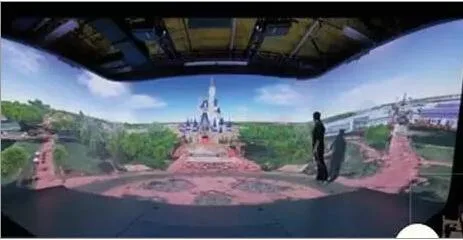
Shanghai Center
Regarding the Shanghai Center project showcased in Stingray’s promotional video, VR wasn’t used during construction but was likely added recently. The project’s Revit model was extensively refined in 3DMax to highlight exterior facades and interior designs within Stingray.

USS Arizona Memorial (National Park Service, USA)
This project commemorates the sinking of the USS Arizona during the Pearl Harbor attack in World War II. Using scanning equipment, the underwater wreck site was captured as a point cloud model and virtually recreated in a memorial hall. Visitors can experience the sunken battleship without salvaging it or diving underwater—offering a more impactful experience than physical exhibits.
4. Software and hardware considerations
Computers
VR demands powerful computer hardware, particularly high-end graphics cards and ample memory. If your computer struggles with Revit, it likely won’t handle large-scale VR software. On a side note, it’s ironic when design and construction teams complain about network issues, outdated computers, and printers, yet push for cost savings that ignore the value of engineers’ time and innovation.
VR devices
Mainstream VR devices are mostly head-mounted displays (HMDs), including HTC Vive, Microsoft HoloLens, Samsung Gear VR, Facebook Oculus Rift, and Google Cardboard (which I am less familiar with). These devices aren’t specifically designed for the construction industry, so some usability issues may arise.
Software
Currently, I’m exploring workflows involving Revit, 3DMax, and Stingray, since BIM models are created in Revit. The process involves exporting FBX files from Revit, refining materials and polygons in 3DMax, and adding special effects in Stingray.
5. Future prospects and opportunities
VR+BIM applications rely on game engines and require substantial expertise, posing challenges for engineers balancing design and VR development. Therefore, these technologies are likely to be adopted primarily in high-end projects, often relying on specialized outsourcing firms for model production.
However, some advanced companies, such as Beijing Aibo Jiesi Information Technology Co., Ltd., are already applying VR+BIM in operations and maintenance, exploring new market opportunities.
Ultimately, VR+BIM bridges hot topics in construction and investment, potentially disrupting the low-price competition dominating the construction market. And when you’re enjoying VR content, if someone interrupts, you can quickly switch views and pretend you’re examining interior designs!












Must log in before commenting!
Sign Up