
Recently, the Chongqing Municipal Government issued the Implementation Opinions on Further Promoting the Reform and Sustainable and Healthy Development of the Construction Industry (referred to as the “Implementation Opinions”). These opinions aim to drive innovation through big data intelligence and accelerate the transformation and upgrading of the construction industry.
According to the Implementation Opinions, the transformation and upgrading of Chongqing’s construction industry will focus on six key modernizations:
- Building Digitalization
- Industrialization of Production
- Product Greening
- Integrated Contracting
- Service Integration
- Intelligent Management
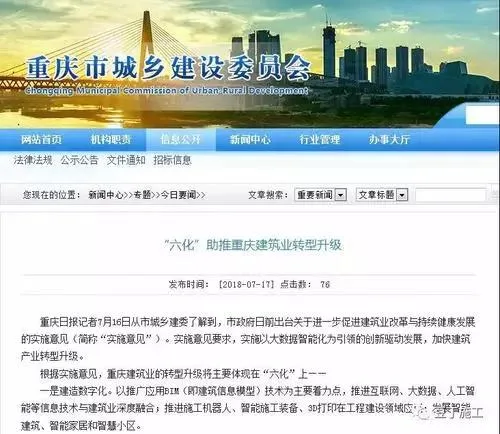
The original text is as follows:
The Chongqing Municipal Government recently issued the Implementation Opinions on Further Promoting the Reform and Sustainable and Healthy Development of the Construction Industry (referred to as the “Implementation Opinions”). These guidelines emphasize innovation driven by big data intelligence and aim to accelerate the transformation and upgrading of the construction industry.
According to the Implementation Opinions, the transformation and upgrading of Chongqing’s construction industry will mainly be reflected in the following six modernizations:
1. Building Digitalization
This focuses on promoting and applying Building Information Modeling (BIM) technology. It encourages the deep integration of information technologies such as the Internet, big data, and artificial intelligence with the construction industry. Applications of construction robots, intelligent construction equipment, and 3D printing in engineering construction will be promoted. Additionally, the development of smart buildings, smart homes, and smart communities will be advanced.
2. Industrialization of Production
Industrialization will be promoted through the use of prefabricated buildings. This includes coordinating the entire industry cluster covering prefabricated building design, production, construction, decoration, transportation, equipment manufacturing, and operation and maintenance. The goal is to ensure that prefabricated buildings make up more than 15% of the new construction area in the city by 2020.
3. Product Greening
The initiative aims to increase the percentage of green buildings rated two stars or above. By the end of 2020, 50% of new urban buildings should meet green building standards. Emphasis will be placed on regional centralized cooling and heating to promote large-scale development of renewable energy buildings. A green building materials evaluation system will be established to encourage the use of eco-friendly materials. Efforts will focus on government agencies, hospitals, and shopping malls to improve energy efficiency in public buildings. During the 13th Five Year Plan period, at least 5 million square meters of energy-saving renovations for public buildings will be completed. Additionally, the goal is to achieve a full decoration ratio exceeding 20% for newly built commercial housing in the main urban area by 2020.
4. Integrated Contracting
The policy supports accelerating the pilot of engineering general contracting. Government investment projects, prefabricated building projects, and projects implemented through the Public-Private Partnership (PPP) model should generally adopt the engineering general contracting approach. The city aims to cultivate 50 key engineering general contracting enterprises by 2020.
5. Service Integration
Enterprises in investment consulting, surveying, design, supervision, bidding agency, and cost consulting are encouraged to expand their business scope. Government investment projects should lead in promoting full-process engineering consulting, with the goal of cultivating 30 full-process engineering consulting service enterprises by 2020. The architect responsibility system will also be explored and implemented.
6. Intelligent Management
The integration of smart devices, BIM, the Internet of Things, Internet Plus, cloud computing, big data, and other information technologies is being widely applied across the city’s construction sites. A three-level linked “smart construction site” management system, covering construction authorities, enterprises, and projects, is gradually being established. By the end of 2019, housing construction projects over 20,000 square meters and municipal infrastructure projects costing over 20 million yuan will be included in the management of “smart construction sites.”
To protect the rights of construction workers, reduce the burden on enterprises, and achieve full labor contract coverage by 2020, the government plans to reduce the upper limit of the reserved proportion of engineering quality guarantee deposits from 5% to 3%. A fee list for construction enterprises and projects will be established, and collection of fees not included on this list will be prohibited.













Must log in before commenting!
Sign Up