
How can we build bridges that offer the best durability and sustainable lifespan? What is the biggest challenge they face? The answer is straightforward — the weight of the bridge.
Current construction methods often concentrate excessive energy and materials into bridges and other structures, which compromises their sustainability. Concrete, the foundation of modern architecture, is far from the ideal building material. It is vulnerable to pollution and prone to cracking, discoloration, and collapse due to exposure to rainwater and carbon dioxide, as seen in the sinking and tilting Millennium Building in San Francisco.
Modern smart buildings, however, are performing better. The integration of emerging technologies promises to transform construction methods and materials across the industry. The shift toward new materials, additive manufacturing, robotics, and next-generation artificial intelligence (such as FPGAs—field-programmable gate arrays) will usher in innovative “building workstations,” creating an automated manufacturing ecosystem. Robotics will enable the creation of smarter surfaces, objects, and even entire buildings. By combining these four technologies, the construction industry is on the brink of breakthrough changes, paving the way for smarter, more sustainable cities.
Imagine a construction robot intelligent enough to embed smart functions directly into building materials. For instance, if you feel hot sitting in a room, the current setup offers no way for the room itself to detect your discomfort—you must manually adjust the thermostat. But if the room’s walls were made of smart composite materials that function like skin, they could sense your condition and automatically adjust the temperature for your comfort.
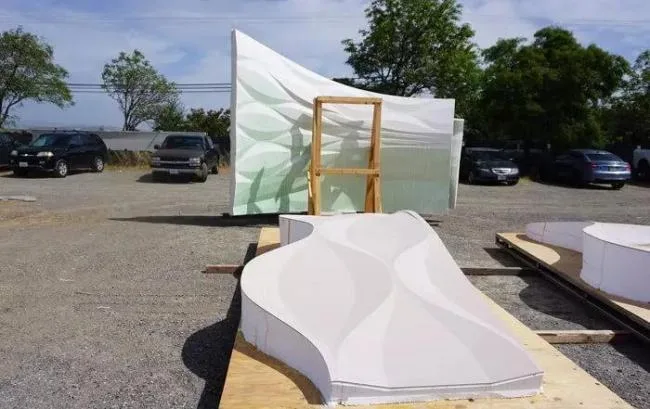
The image shows a close-up of prefabricated panels used to build the tower of the Miami 1000 Museum. Image courtesy of Kreysler & Associates.
Smart bridges and roads hold immense potential. They can become intelligent through IoT technology, enabling them to respond to their environment, or more sustainable by blending advanced natural materials with concrete and steel. To make these infrastructures responsive, multifunctionality must be integrated. For example, why not use 3D printing to create channels within bridge beams during fabrication, instead of adding wiring afterward through secondary processes? Integrating multiple functions into a single production step is more efficient and innovative.
With additive manufacturing, designing complex, intricate structures is no longer a challenge. Through robotics and 3D printing, intelligent infrastructure—such as bridges, roads, and houses—that cannot be built by human hands alone becomes possible. Traditional buildings often rely on orthogonal lines and right angles, but 3D printing robots can overcome these limitations, enabling more organic and efficient designs.
Future construction will utilize softer, artificially synthesized materials like carbon fiber and polymers, as well as natural substances such as silk and cotton. Compared to dense, heavy concrete, these materials will enable buildings that are lighter, more sustainable, and cost-effective. Such advanced composites are already used to create futuristic architecture and high-performance vehicles, including 3D-printed yachts.
By integrating sensors into lighter, stronger materials, buildings will be able to carry more information and even store energy like batteries. Unlike concrete, composite materials and FPGA-embedded substances are sustainable. During construction, 3D printing will allow sensors and wiring to be embedded directly into structures, enabling bridges, roads, and buildings to monitor their own temperature, pressure, and other vital parameters—much like the human nervous system. Over their lifecycle, these structures could communicate internally and even self-repair, mimicking biological systems.
Bill Kreysler, Chairman of Kreysler & Associates, has been a pioneer in using lifelike composite materials, contributing to projects like the Boathouse Pavilion in Tulsa and the 1000 Museum Tower in Miami by Zaha Hadid Architects. Thanks to Kreysler’s innovations, fiberglass has become a widely adopted building material.
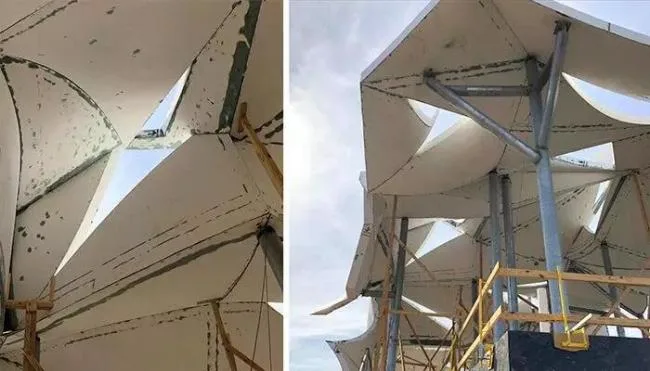
▲ Located in Tulsa, the Boathouse Pavilion is composed of 130 glass fiber reinforced composite panels shaped like sails. Image courtesy of Kreysler & Associates.
Composite materials also play a critical role in the evolving automotive industry, where lightweight synthetic components help reduce vehicle weight and emissions.
The biomimetic capabilities of these materials enhance sensitivity, allowing buildings to adapt instantly to environmental changes. Future walls will behave like biological tissues, capable of self-repair when damaged. Smart fiber materials contain resin inside fibers, similar to human blood. These resins include uncured bubbles like epoxy. When damaged, exposure to air triggers oxidation, initiating a self-healing chemical reaction analogous to how the human body heals wounds.
Like human skin, mechanical sensors embedded in these materials act like nerve endings, detecting changes and adapting accordingly. Numerous experiments with self-healing concrete have demonstrated the feasibility of this concept. Employing composite materials in construction will further develop and enhance sustainable building practices.

Concrete self-healing materials repair cracks similarly to how the human body heals wounds.
Though it may sound like science fiction, these technologies already exist today. With continued support, these seemingly futuristic ideas will become a reality within the next decade. The industry’s first step toward mainstream adoption of advanced buildings is to construct landmark projects that demonstrate their feasibility. By showcasing innovative concepts on facades and other non-essential structural elements, Kreysler and like-minded pioneers can prove that these projects are safe, sustainable, affordable, and efficient.
To realize the possibilities of the future, the construction industry must now focus on building educational and demonstrative infrastructure. Only by embracing today’s potential can builders lead the construction industry into the future.













Must log in before commenting!
Sign Up