
The traditional approach to secondary decoration in unfinished houses has long suffered from typical industrial issues, including material waste, significant damage to the building’s structure and functionality, challenges in ensuring quality, and excessive construction debris. For years, consumers have criticized the industry for its lengthy chains, numerous intermediaries, and information asymmetry. As early as 1999, national regulatory authorities advocated for the adoption of one-time or menu-style decoration models, which paved the way for the current full decoration system. Although full decoration has been seen as the future of the industry since its inception, its adoption has been slow and has yet to fully meet its original goals. Technological limitations have prevented full decoration from achieving a seamless blend of customization and scalability. Key challenges include the disconnect between architecture and decoration, limited design options, low design quality, and significant resource waste. As a result, full decoration implementation in residential areas remains sluggish, with traditional secondary decoration of unfinished houses still widespread.
Recently, the overall transformation of the industry—driven by overcapacity and growing industry and social consensus—has accelerated the maturity of industrialization models and supporting technologies centered on prefabricated construction. Against this backdrop, national and local governments have introduced favorable policies to promote full decoration in residential buildings, encouraging its development through various initiatives. Prefabricated construction and full decoration are integral components of building industrialization. Their combination, known as prefabricated full decoration, has seen significant technological advancements and large-scale applications in regions such as Beijing, Shanghai, and Jiangsu.
This article aims to analyze the current development status, technical features, and the applicability and efficiency potential of Building Information Modeling (BIM) for prefabricated full decoration. It offers readers and industry professionals a fresh perspective on this topic but does not delve into specific application methods.
Prefabricated Full Decoration vs. Traditional Decoration
Prefabricated full decoration primarily involves dry construction methods, assembling and installing industrialized interior components on-site to complete fixed surface finishes and the installation of equipment and facilities within the building’s functional spaces. These processes meet the basic requirements for building functionality and performance. According to the Evaluation Standards for Prefabricated Buildings (GB/T51129-2017), effective from February 1, 2018, “achieving full decoration” is a mandatory criterion for classifying a building as prefabricated.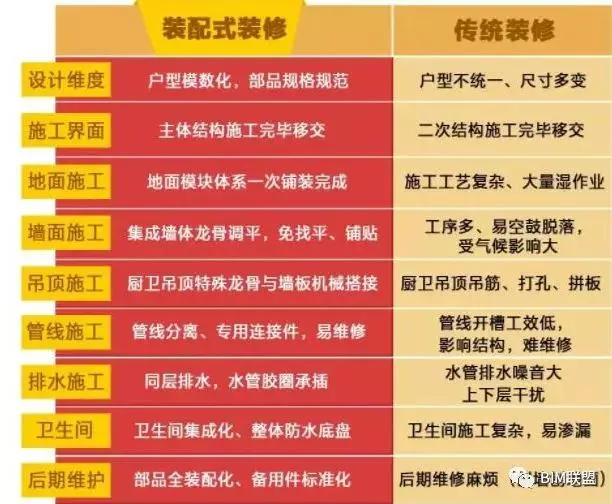
Comparison between prefabricated full decoration and traditional decoration techniques:
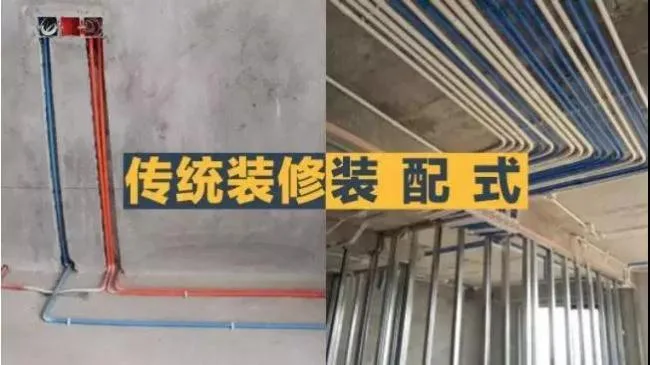

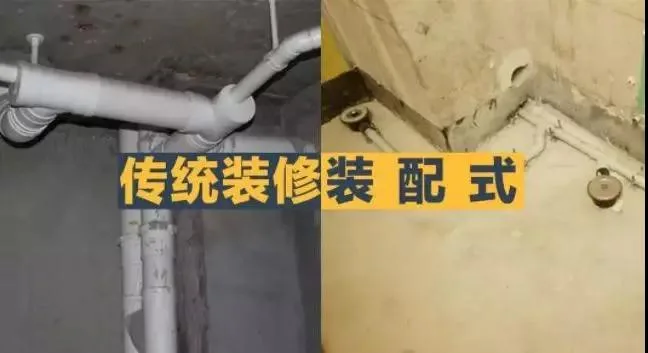
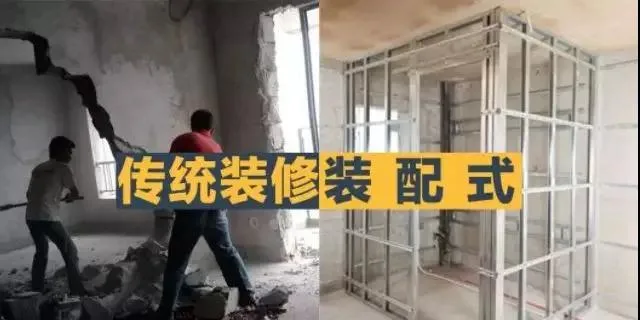

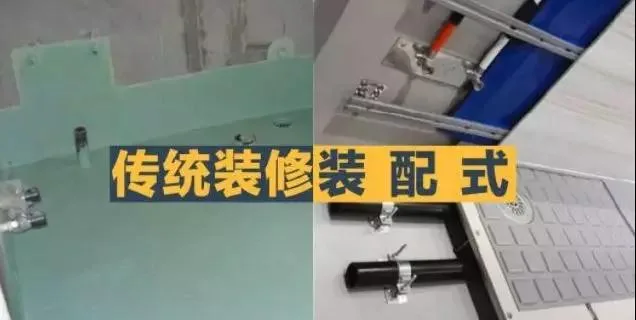
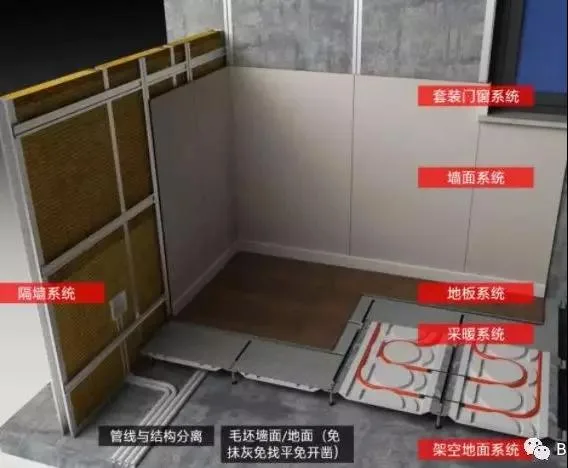
Key Characteristics of Prefabricated Full Decoration Technology
1. Separation Method Construction: Also known as the SI system (Separation of Support Skeleton and Infill), this method separates the three major decorative surfaces—walls, floors, and ceilings—from the main structure, as well as mechanical and electrical pipelines. Currently, light steel keel is primarily used for overhead separation.
2. Main Component System: This includes the wall system, floor system, ceiling system, partition system, HVAC system, electrical system, water supply and drainage system, integrated kitchen, and integrated bathroom.
3. Construction Efficiency: By greatly reducing wet work and emphasizing mechanical installation, the traditional sequential decoration process transforms into parallel installation, significantly boosting efficiency. Typically, a 50m2 unit completed with prefabricated full decoration takes just 10 days.
4. Structural Durability: As all pipelines are integrated into the six-sided overhead system, there is no need to damage the original structural body, which greatly enhances its durability.
5. Life Cycle Applicability: Prefabricated full decoration allows for large interior spaces with external shear walls and no vertical load-bearing components. Partition walls and other elements can be flexibly adjusted over the building’s decades-long lifespan, appealing to consumers who value adaptable and practical living spaces.
6. Material and Indoor Environmental Friendliness: Cement production is a significant source of carbon emissions, posing challenges to energy conservation and environmental protection—one reason for promoting prefabricated buildings in China. Thanks to the adjustable height of light steel keel and overhead pipeline separation, prefabricated full decoration requires no leveling or grooving of structural surfaces, eliminating cement use throughout. Components are mechanically installed without the need for paint, coatings, or various decorative adhesives, achieving zero indoor air pollution in hard installations.
In summary, prefabricated full decoration offers marked advantages in enhancing decoration quality and efficiency, reducing labor and resource waste, and embodies typical industrial characteristics. While it has clear technological benefits, it may not always be economically advantageous. Additionally, industrial production demands mold construction and production lines, which require certain building scales and volumes. Therefore, this method is primarily applied in government-subsidized housing and similar projects. For instance, the interior decoration cost of Qingtangwan public rental housing in Beijing is approximately 1000 yuan/m2 (according to the project designer), while the interior decoration cost of Dingjiazhuang affordable housing in Nanjing (including kitchen and bathroom equipment) ranges from 1100 to 1300 yuan/m2 (data from the project’s interior decoration contractor).
Prefabricated Full Decoration and BIM
Prefabricated full decoration involves three major integrated systems: architectural design and construction, fine decoration design and construction, and component design and production. It thus emphasizes precise design and deep professional collaboration at the technical level.
First, design modularity serves as the foundation of all industrial products and acts as the lowest common denominator and standard. Building on this, modular components combine to form large-category components that conform to the modular system, aligning with the building’s spatial dimensions for efficient large-scale manufacturing. Beyond modularization, spatial standardization adjusts the size of base and component modules to ensure versatility, flexibility, and diversity of space. Finally, construction assembly methods reflect the implementation of these foundational principles.
While industrialization and standardization are frequently highlighted in the industry, the true technological core lies in modularity and modularization. From multiple ongoing projects, it is evident that the primary challenges for prefabricated full decoration are not technological but relate to resource integration and professional collaboration. Today, this integration heavily depends on information technology—precisely where BIM excels. BIM’s capabilities in collaborative design, visualization, analysis simulation, and integration of non-physical information deliver significant efficiency and quality improvements throughout the design, production, installation, and maintenance stages of prefabricated full decoration.













Must log in before commenting!
Sign Up