
Foundation pit support engineering involves numerous unpredictable factors and significant risks. The main priority during design and construction is to ensure the safety of both the foundation pit support system and the surrounding environment. Consequently, foundation pit monitoring is essential. Through construction monitoring, timely feedback is provided to guide construction activities, optimize processes, and inform design modifications.
This article explores the application of BIM technology in monitoring a deep foundation pit project for a three-story basement office building. By creating a three-dimensional model of the foundation pit and conducting simulation analysis throughout the project lifecycle, the approach achieves information-driven construction and management. BIM technology offers advantages such as multidimensional visualization, collaborative workflows, construction simulation, and parameter informatization. It allows for the accurate and rapid identification of deformation-sensitive and hazardous points during monitoring, intuitively displays the extent of foundation pit deformation, and effectively prevents safety incidents in deep foundation pit engineering.
1. Overview and Monitoring Plan of Deep Excavation Engineering
1.1 Overview of Deep Excavation Engineering
A three-story basement is planned for an office building in Nanchang. The designed ground elevation is set at 35.300 meters, while the deepest foundation pit bottom elevation is 21.400 meters. This results in an excavation depth of approximately 13.9 meters, covering an area of about 4,312 square meters. The soil layers within the excavation depth include plain fill soil, strongly weathered siltstone, moderately weathered siltstone, and fractured zones of moderately weathered siltstone. The foundation base is located in the moderately weathered siltstone.
The safety level for the north side of the foundation pit—adjacent to a road—and the south side—adjacent to a railway line—is classified as Level 1, with an importance factor of 1.1. The east and west sides of the foundation pit are rated Level 2, with an importance coefficient of 1.0.
The support system features rotary excavation piles as the enclosure structure, with pile specifications of 800@1100. Rotary excavation piles are used, combined with open ditches for organized drainage. At the top of the piles, a 1000×1100 top ring beam and a 1000×1100 waist beam are installed, along with two 800×1000 concrete supports, providing lateral support for the retaining piles.
1.2 Deep Foundation Pit Monitoring Plan
Excavation support projects carry significant risks and are subject to many uncertainties that can affect safety. During excavation, it is crucial to obtain accurate data through monitoring and on-site observations. This data must be analyzed promptly to detect any emerging dangers or trends of hazardous conditions and to develop necessary emergency responses for unexpected events.
The monitoring items, alarm thresholds, and frequency requirements for this project’s foundation pit support engineering are detailed in the following tables: Table 1 – Monitoring Layout for Foundation Pit Items and Table 2 – Warning Values for Foundation Pit Monitoring Items.
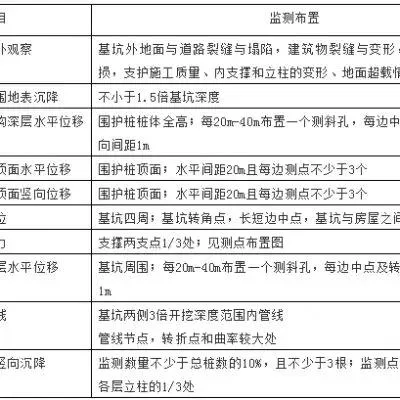
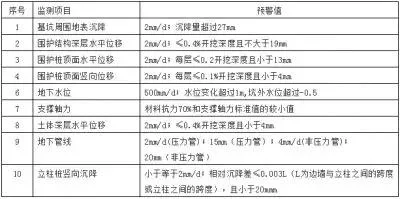
Table 2: Warning Values for Foundation Pit Monitoring Projects
2. Application of BIM Technology in Safety Monitoring of Deep Foundation Pits
2.1 Overview of BIM Technology Application in Safety Monitoring
A BIM model is established for monitoring deep foundation pits (see Figure 1). During construction, BIM technology leverages multidimensional visualization, construction simulation, and full parameterization capabilities. Based on the monitoring plan’s requirements and monitoring types, deformation monitoring points are positioned within the model with associated parameter information.
Engineering deformation monitoring data is linked to the BIM model, enabling real-time monitoring through multidimensional visualization. The system simulates early warning functions based on parameter values from monitoring points, facilitating intelligent safety monitoring of deep foundation pit engineering.
2.2 BIM Modeling for Safety Monitoring
Autodesk Revit, one of the most widely used BIM software platforms, was utilized to create the safety monitoring model for this deep excavation project.
Following the specific safety monitoring requirements for this project, a BIM model was developed encompassing all deep foundation pit components, including earthwork, rotary excavation retaining wall piles, column piles, top ring beams, waist beams, lattice columns, concrete supports, and soil nail walls. Each element was defined as a “family” with added parameter data and then imported into the project file.
Using the design and construction drawings’ plan dimensions and elevation data, an integrated deep foundation pit safety monitoring model was created (see Figure 1).
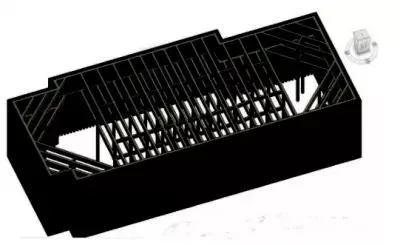
Figure 1: BIM Safety Monitoring Model for Deep Excavation Engineering
Application of the BIM Deep Foundation Pit Safety Monitoring Model
(1) Construction Simulation of Deep Foundation Pit Engineering
The construction simulation sequence for this project includes:
- Site leveling, positioning, layout, and installation of construction enclosure rotary excavation piles, engineering piles, and column piles.
- Dewatering the pit and constructing lattice columns.
- Excavating soil to the level of the first concrete support, followed by constructing the top ring beam and concrete supports.
- Once the first concrete support attains strength, excavate soil to the bottom of the second concrete support, constructing the waist beam and second concrete support.
- Finally, excavate to the bottom elevation after the second concrete support reaches strength.
Based on this initial plan, a detailed construction schedule was developed. The plan was imported into timeline tools, and scene animations of rock, soil, and support structures were created using Navisworks software. Animations and selection sets were attached, simulations debugged, and collisions checked to predict hazards and enhance construction safety through simulation.
(2) Construction Safety Monitoring of Deep Foundation Pit Engineering
Throughout construction, BIM technology’s capabilities in multidimensional visualization, construction simulation, and parameter management are leveraged via a multidimensional safety monitoring model created in Revit. This model supports dynamic safety warnings during construction.
A multidimensional deformation monitoring family was established within the BIM model, incorporating various monitoring data such as foundation pit displacement, internal forces in supports, deformation levels, and groundwater changes. This integration links monitoring data directly to the model, enabling parameter-controlled display and warning functions.
When monitored parameters—such as surface settlement around the foundation pit, horizontal displacement of retaining structures, vertical displacement of pile tops, groundwater levels, support axial forces, and settlement of underground pipelines—exceed warning thresholds, audible alarms are triggered. Different alarm sounds specify the monitoring item that triggered the alert, with the urgency of the sound reflecting the severity of the exceedance.
Real-time monitoring data is streamed to the BIM warning system, vividly illustrating danger zones and deformation risks for each monitored area at any given moment. This enables distinguishing the severity of risks, predicting deformation and stress trends, and dynamically adjusting construction plans. Such timely interventions help quickly address hazardous spots, resolve conflicts, mitigate risks, and avoid safety incidents. The system also simulates foundation pit monitoring warnings based on changes in monitoring point alerts.
3. Conclusion
In deep foundation pit projects, BIM technology effectively establishes a safety monitoring model that simulates construction processes, positions deformation monitoring points according to monitoring plans, and integrates parameter data with the model. This multidimensional visualization facilitates real-time monitoring, while warning functions simulate alerts based on parameter thresholds. Alarm sounds indicate specific monitoring issues and their urgency, enabling intelligent safety monitoring and preventing accidents in deep foundation pit engineering. Overall, the application of BIM technology in safety monitoring for deep foundation pit construction holds great promise.
[References]
Lu Jun, “Application of BIM Technology Combined with WEB System in Foundation Pit Monitoring,” Wuhan University of Science and Technology, 2016(05)
Yu Lina, Wu Mai, Geng Huixuan, “Research on the Application of BIM Technology in Foundation Pit Construction,” Journal of Graphic Science, 2017(08)
Yu Weiliang, “Research on Construction Simulation of Deep Foundation Pit Engineering Based on BIM Technology,” Zhejiang Architecture, 2018(04)













Must log in before commenting!
Sign Up