
A Brief Discussion on the Application of BIM in Ancient Architecture
China’s long architectural history is marked by a rich and brilliant ancient architectural culture, which holds significant cultural and national importance. Ancient buildings are not only valuable for their historical and artistic merits but also serve as crucial scientific resources. They provide tangible evidence for studying history and inspire new artistic designs and architectural innovations. However, over time, many ancient structures have suffered varying degrees of damage, raising concerns about their preservation and restoration.
Protecting and restoring these ancient buildings requires detailed information about their structure and condition. Incorporating comprehensive data into construction models of these buildings is essential. In today’s era of information technology, this is achievable through Building Information Modeling (BIM). BIM offers an effective solution by enabling detailed construction models that accurately integrate the unique characteristics of each ancient building. This allows even those unfamiliar with ancient architecture to understand the significance of each structure, playing a vital role in the cultural preservation of our architectural heritage.
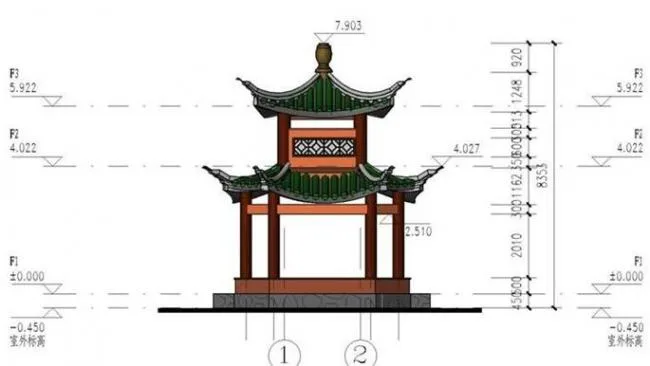
Below are some specific advantages of applying BIM technology in ancient architecture:
1. Surveying Advantages:
Traditional surveying of ancient buildings typically relies on CAD software, which accurately records two-dimensional information but struggles with organizing and statistically managing this data. Consequently, the information saved often lacks intuitive readability, systematic organization, and transferability.
In contrast, building information models created with BIM software offer superior solutions to these issues. Using BIM technology for surveying and mapping ancient buildings provides multiple benefits. For example, creating a model with Revit Architecture involves recording all data derived from surveying, ensuring that every measured detail is embedded in the digital model.
By defining attributes such as length, width, and height, the data appears clearly in family type lists within the software. This method not only captures the physical shape of the model but also presents the data in an intuitive and organized way. Unlike traditional CAD, which requires separate drawings for plans, elevations, and sections—often cumbersome and error-prone—Revit enables the creation of a 3D model directly from simple operations on plans and elevations. From this 3D model, 2D views like floor plans and cross-sections can be automatically generated with ease.
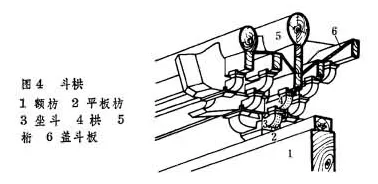
2. Three-Dimensional Applications from Point to Surface:
Renovating ancient buildings differs significantly from modern architectural design. It involves maintaining the historical appearance, preserving original features like ceilings, door handles, and woodwork, while adapting spaces to modern living standards for comfort and usability.
When original details are difficult to find using conventional methods, BIM facilitates the entire renovation process by integrating multidimensional technologies such as 3D scanning, virtual reality, operational management, cloud applications, and simulation. This comprehensive approach greatly enhances efficiency and quality in restoration projects.
For instance, in the renovation of old houses on Sinan Road, 3D laser scanning was used to capture point cloud data on-site. These data points were then refined and imported into software like AutoCAD and Autodesk Revit to generate geometric shapes for modeling. The scanned data serve as a reference base model, enabling the creation of complex surface geometries by gridding point clouds and establishing polyhedral surfaces, which are connected to form patches and faces for detailed architectural representation.
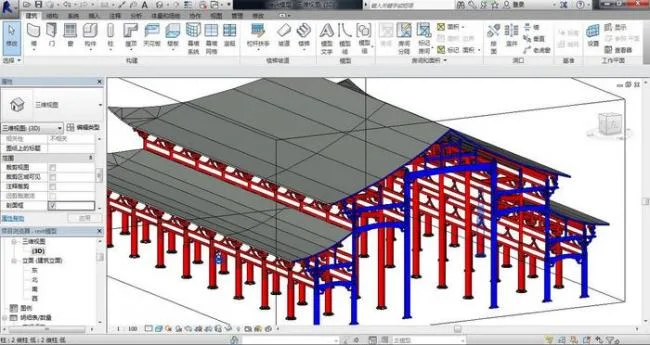
3. Integration of Modeling and Cloud Computing:
Applying cloud technology to ancient architecture renovation projects represents an innovative advancement. Utilizing Autodesk BIM 360’s cloud storage capabilities allows 3D models to be accessed and data queried on mobile devices like iPads and iPhones, facilitating on-site construction guidance and collaboration among multiple parties.
Traditional measurement methods often lead to data loss and mismatches. By contrast, BIM and other advanced multidimensional technologies help establish accurate databases, which are invaluable for ongoing historical preservation efforts. Cloud technology enhances on-site productivity by providing intuitive, real-time guidance, preserving the three-dimensional nature of architectural designs without distortion from two-dimensional conversions.
Furthermore, green performance analysis has been conducted on historically protected buildings using Autodesk Ecotect software, ensuring smooth integration and sustainable preservation based on detailed BIM models.
4. Driving Forward New Concepts in Preservation:
Protecting and renovating ancient buildings has long been a priority in the industry, yet without reliable methods to collect comprehensive on-site data, true preservation and design innovation were difficult to achieve.
The Sinan Road renovation project successfully addresses this challenge, showcasing the integration of BIM-based cloud storage, cloud computing, 3D laser scanning, point cloud data processing, grid model restoration, virtual reality, lighting analysis, and personnel simulation. These technologies collectively support effective ancient building protection, historical data preservation, and innovative design.
Applying BIM’s multidimensional technologies to historical building preservation opens new avenues for innovative design while maintaining the integrity of these structures. This approach provides valuable experience and a foundation for other firms engaged in ancient architecture design.
Currently, BIM’s value in China focuses primarily on ensuring quality and improving design efficiency. With a three-dimensional visual information model, all stakeholders can verify designs collaboratively, enhancing communication and coordination across disciplines. This improves project control, reduces conflicts, and minimizes errors.
Of course, the potential applications of BIM in ancient architecture extend far beyond these benefits. As the field of architecture evolves, BIM will undoubtedly continue to offer remarkable advantages, helping us complete design, construction, and management tasks more effectively and efficiently. Continued exploration and research will further advance BIM technology and its applications.













Must log in before commenting!
Sign Up