
The completion of the Galaxy SOHO project has spotlighted the application of BIM (Building Information Modeling) technology in the industry. There is growing evidence that BIM is becoming increasingly essential in the construction of complex buildings. BIM is based on three-dimensional digital models and encompasses process management elements such as design, project information, visualization, and coordination.
Its application is reflected in geometric space, spanning from planning and design to the installation of components. BIM technology permeated every aspect of the Galaxy SOHO project, and CCDR was privileged to participate in implementing BIM for the curtain wall of the East Section of Galaxy SOHO (Figure 1).
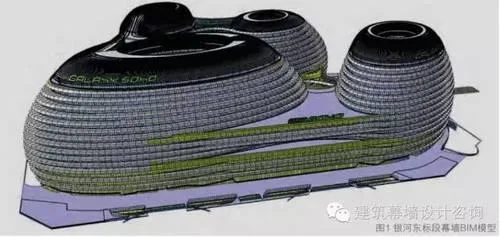
This project represents a significant exploration and practical application of BIM for curtain walls. The rounded and streamlined curtain wall system posed fresh challenges for design and construction:
- Numerous non-standard unit blocks prevented reuse of standard nodes;
- A large number of hyperbolic panels required optimization into deployable surfaces;
- Panel dimensions could not be described with conventional measurements;
- Installation and positioning were difficult;
- The quantity of special profiles was hard to determine.
These challenges led the owner’s design management team to recognize that existing curtain wall detailing methods, implementation processes, fabrication techniques, and installation approaches were inadequate. Consequently, they decided to integrate curtain wall BIM into the design management system. The selected BIM team needed to:
- Understand the geometric properties of surfaces;
- Master industrial parametric modeling software—CATIA;
- Develop software capable of extracting construction data from digital models;
- Coordinate multidisciplinary collisions.
The industry’s challenges provided CCDR the opportunity to serve as a subcontractor for curtain wall BIM implementation. BIM services have emerged within the curtain wall sector, and the successful deployment on Galaxy SOHO has yielded many benefits, consolidating numerous feasible processes and practical experiences. Post-Galaxy SOHO, BIM became an internal project requirement, leading CCDR to implement curtain wall BIM on notable projects such as Datong Museum, Wangjing SOHO, and Lingkong SOHO.
1. Advantage
1.1 Industrialization Genes
The steel structure and curtain wall sectors share many similarities with the manufacturing industry. Large curtain wall companies operate their own ERP systems, which streamline the delivery and production of models and electronic bill of materials internally. BIM reinforces the industrialization traits of the curtain wall industry, improving quality and efficiency in detailing design and overall project management. This results in cost savings and significant benefits for the construction sector.
Mainstream BIM software in construction derive design philosophies and industrial processes from manufacturing, moving beyond the traditional blueprint-based design delivery model. Industrialization through BIM is thus an inevitable path for the curtain wall industry. The initial synergy between curtain wall construction and BIM is no accident.
(1) Modular curtain walls are increasingly adopted for complex systems. These units consist of horizontal and vertical frames assembled in the factory, onto which glass, aluminum, and other panels are installed to form components (Figure 2). These are transported and secured onsite via connectors to embedded keels. This industrial logic aligns perfectly with BIM technology, connecting design, analysis, simulation, assembly, and maintenance through an integrated workflow.
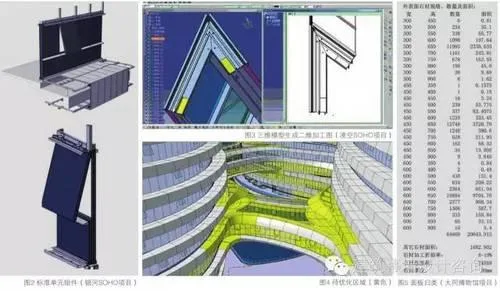
(2) BIM advances the curtain wall industry to higher industrial standards. Since its development in China in the 1980s, the curtain wall sector’s deepening design, drawing standards, and cost control systems have moved toward industrialization. BIM models can generate 2D machining drawings difficult to produce with AutoCAD (Figure 3), significantly reduce reliance on 2D blueprints by extracting data from models, define design and production via 3D solids, and integrate data into PLM systems.
(3) Top-tier industrial manufacturing software is preferred for curtain wall BIM design. Initially, Rhino was widely used for surface design and data analysis due to its ease of use and extensive plugins, catering well to preliminary conceptual design and geometric calculations. For detailed design, CATIA is favored for its powerful geometric modeling, precision, and stable parametric environment, facilitating drawing generation and data extraction. Notably, Frank Gehry used CATIA in the late 1990s to address complex architectural challenges, leading to the development of DigitalProject on the CATIA platform.
1.2 Complex Curtain Walls Can Be Constructed
1.2.1 BIM and Parametric Design
Architects create exterior forms and curtain wall skins by inputting design logic, establishing mathematical modules, and setting geometric constraints in software. The skin textures display complex features—correlation, dynamics, nonlinearity, and gradients. Buildings like Galaxy SOHO, Wangjing SOHO, and Lingkong SOHO utilize this design methodology.
Parametric design generates models driven by parameters, while BIM integrates data based on models to support applications throughout the project lifecycle. BIM not only manages parameterized models but also adapts model data to new construction conditions, material supply, and other variables.
It is important to distinguish parameterization (software’s parametric modeling capability) from parametric design (a design methodology). BIM software supports parametric modeling, making the combination ideal.
The core parametric design application within BIM is panel optimization. To avoid visual errors, single curved surfaces should replace hyperbolic ones when possible, and flat surfaces should replace single curved surfaces as much as feasible (Figure 4). Uniform specifications (Figure 5) help reduce costs.

1.2.2 Structured Data
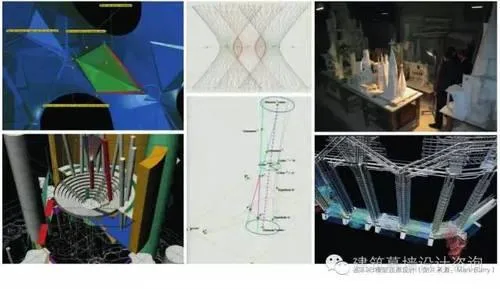
Handling massive design and construction data requires meticulous data planning. In complex curtain wall systems, Dassault Systemes’ CATIA is widely used as the BIM platform, employing a “Top-Down” data management philosophy. The software operates by nested relationships between “Product” and “Part” (Figure 6), with data reference between parts handled via “publish parameters”.
“Product” and “Part” are virtual concepts; actual projects are subdivided by size and location. Effective data planning is crucial for future data extraction and utilization. For instance, in Galaxy SOHO, the entire curtain wall project was treated as a “product”, refined progressively by tower, floor, and location. Finally, each unit was defined as a “part”, with connectors and keels behind unit panels treated as “features.”
A clear data hierarchy and consistent naming conventions are foundational to managing design information and positioning parameters. Uniform field names and composition structures enable efficient data retrieval across parts and phases. For example, the code “TW2-CLD-F06-FLK” denotes “Tower 2 – Aluminum Curtain Wall – Sixth Floor – Side Hanging Panels” (Figure 7).
1.2.3 Efficiency
The idea that complex curtain walls can be constructed is relative. Antoni Gaudí’s building, designed and built over 100 years ago, showcases dynamic, undulating forms with intricate textures created from ceramic tiles, mosaics, and colored glass. This complex curtain wall system required handmade materials and craftsmanship, with construction ongoing at the Sagrada Familia Cathedral to this day.
Fifteen years ago, BIM was nonexistent. Later contractors used 3D models to simulate the design and construction, successfully reconstructing Gaudí’s vision (Figure 8). This underscores BIM as a necessity for constructing complex buildings today.
1.2.4 Data Extraction
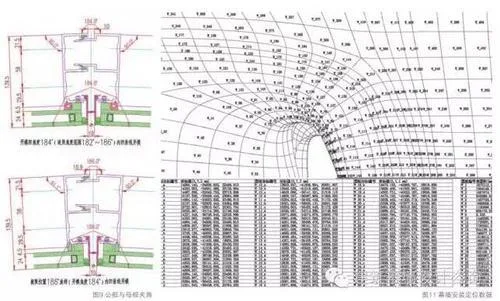
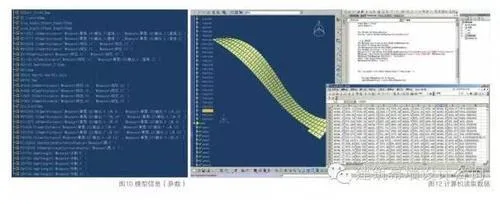
Once the skin is discretized, non-standard unit curtain walls emerge, bringing enormous data demands. These include keel lengths, angles between male and female frames (Figure 9), number of adapters, and adapter angles (Figure 10). Traditional CAD methods cannot track this level of detail for thousands of units.
For practical and economic reasons, BIM’s data management capabilities are essential:
- BIM models can extract and manage design data for thousands of non-standard units, including geometry, materials, and construction details of keels and connectors, which increase exponentially.
- BIM provides installation coordinates for unit blocks (Figure 11).
Data extraction involves traversing all “products” and “parts” (Figure 12) per the data structure, reading parameters, and populating data in prescribed formats. This process forms the core of ERP systems in curtain wall enterprises.
1.2.5 Data Bill of Materials
Compared to standard curtain walls, complex units feature profiles of varying lengths and non-standard panel shapes, complicating fabrication and management and increasing costs. Traditional processes add at least 5% extra non-standard costs and cannot guarantee schedules.
BIM transforms this process. During modeling, unique codes are assigned to components such as panels, keel frames, and unconventional profiles within “user-defined features” per data planning. The computer then calculates input parameters based on geometry, assembles the entire curtain wall model, and extracts data to generate a bill of materials.
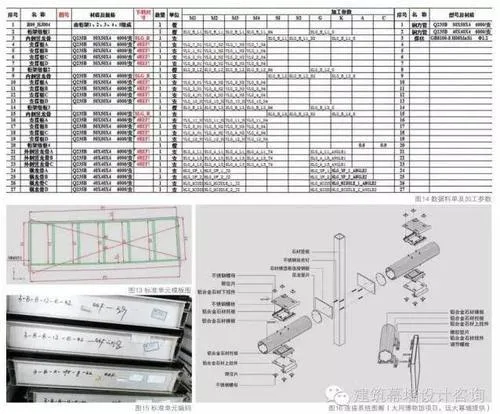
Each component in the bill of materials has a unique identifier, facilitating material processing, stacking, and swift assembly per standard unit templates (Figure 13). Based on profile geometry, communication with suppliers generates production orders as data sheets (Figure 14), CAD files, and 3D models.
Manufacturers mark bill of materials numbers on the panel backs when materials leave the factory. Recently, large companies use barcodes and two-digit codes (Figure 15) to help organize materials onsite for acceptance and installation sequencing.
1.3 Visualization
BIM excels at visually expressing professional designs and processes. The 3D virtual environment enables rapid transmission of design and simulation information among project partners, greatly aiding coordination. Key visualization requirements in curtain wall BIM include node design and construction process simulation.
Nearly all design intentions (node designs) can be coordinated via 3D models (Figure 16), and construction sequencing can be simulated, achieving WYSIWYG (what you see is what you get) to reduce costly design rework.
Mr. Pan Shiyi of SOHO China emphasizes the importance of building the structure virtually first to identify issues before construction. SOHO China requires design meetings, briefings, and supplier discussions to use the BIM model as a reference—shifting from “speaking while looking at pictures” to “speaking while looking at the model.” This is a powerful endorsement of BIM visualization.
1.4 Cost Estimation
I liken cost estimation for curved curtain walls to the “iterative development model” in software engineering. Compared to straightforward curtain walls, curved and irregular ones have more cost uncertainty. Shape adjustments impact project planning data, costs, and construction.
BIM connects these factors into a dynamically updated data model, enabling iterative design cycles that continuously improve and optimize the curtain wall’s BIM model. The goal is small, timely adjustments to solve problems and reduce costs.
The ZAHA design team exemplified this approach, adjusting building forms from early design through completion. BIM models enable quick, real-time cost evaluation through programmatic data extraction.
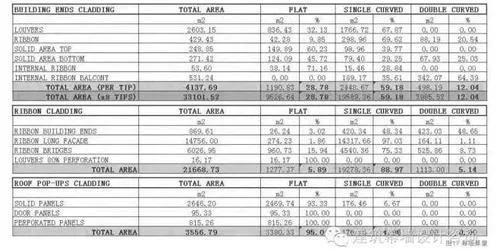
The basic cost calculation principle is based on unfolded surface area. For simple shapes, this is the sum of regular polygon areas. However, irregular panels make traditional CAD-based length × height calculations invalid. Instead, a computer program must recognize panels via geometric rules to distinguish flat, single curved, and hyperbolic plates. These are then classified (Figure 17), and surface areas calculated after unfolding curved panels. Automated summarization by the program delivers fast and accurate statistics.
Beyond panels, profiles behind the curtain wall are crucial for cost estimation. Manual and 2D methods struggle to finely manage profile costs and their impact on overall curtain wall expenses. BIM accurately calculates usage for standard and non-standard profiles.
1.5 Professional Coordination
BIM’s workflow integrates numerous design datasets into a single model, tracks versions by project milestones, and updates model data dynamically, essentially managing a model/database. Professional coordination—the core BIM function—summarizes various discipline models to perform clash detection.
Building construction is complex, involving extensive design coordination and process data. Visualization gives project managers clear insight into design issues.
Curtain wall construction begins after the main structure is complete and often runs parallel to mechanical and electrical work. The curtain wall occupies space closely related to other disciplines. Mr. Pan Shiyi likens it to a bag’s skin that must fit snugly without overfilling.
BIM strengthens space management in the following ways:
- The curtain wall transfers loads to the main structure via structural edges. BIM verifies edge beam sizes and embedded parts locations to avoid collisions during installation.
- BIM manages spatial relationships between curtain walls and interior finishes, such as alignment between secondary partition walls and curtain wall keels, and positioning of curtain wall operable windows relative to rooms.
- Coordination between curtain walls and mechanical/electrical systems: for example, floodlighting wiring and fixture layouts require alignment with curtain wall designs during detailed design stages; rooftop mechanical layouts necessitate extensive coordination.
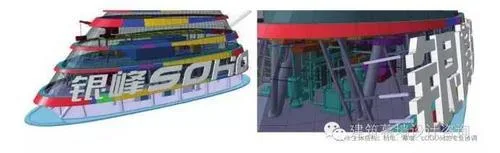
- Coordination with signage, including main building logos and lightbox advertisements on curtain walls (Figure 18).
- Coordination with landscape design, such as handover points between curtain walls and landscape flooring.
Traditionally, coordination meetings resolve design inconsistencies or new spatial issues during construction. BIM models, however, realistically replicate physical space, detect clashes during design, and facilitate earlier, more effective collaboration among stakeholders.















Must log in before commenting!
Sign Up