
“Learning World”
Multi-purpose Space and Lower Grade Classrooms
“Especially in terms of structure and design, like in this project, when elements are closely interconnected, some parts cannot be effectively represented by physical models, which can become a burden. I’m not saying it’s impossible, but without tools like ARCHICAD or similar 3D CAD software, it would be extremely difficult.”
Designing large wooden structures usually takes more time than designing reinforced concrete buildings. However, with today’s trend of shortened project timelines, it has become challenging to allocate sufficient design time.
“If we didn’t use ARCHICAD, completing such a large wooden building within a short period wouldn’t leave enough time to perfect the design. This could lead to many issues and potentially extend the construction period. For this project, we have used ARCHICAD from the very beginning of the design phase, which was crucial when combining digital models with physical ones. In fact, I believe the reason we completed this project on time was because we utilized ARCHICAD for analysis and communicated through BIMx.”
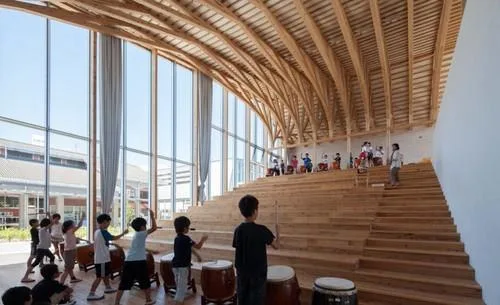
Yamaga Elementary School, Japan | Coelacanth K&H Architects Inc. | www.coelacanth-kandh.co.jp
Image source: © Satoshi Asakawa
How effective is the workflow using ARCHICAD and BIMx? This is clearly demonstrated in the two main areas discussed earlier: the “path of learning” and “Learning World.” For example, “Learning World” might seem like just a few connected inner courtyards, but in reality, the space between the two rows of buildings has been carefully considered and designed as part of the learning environment.
“Typically, these inner courtyards face classrooms, making them difficult to access. Therefore, we designed an open space on the side facing the courtyard that can be freely used. This allows the space to serve both as a play area and a learning environment. In fact, the space is currently used for observation, learning, and other outdoor educational activities, exactly as we envisioned.”
Even these complex and hard-to-describe ideas can be clearly communicated through BIMx. Architects can receive practical feedback directly from users.
“With the help of BIMx, users can see the design exactly as we envision it. This is crucial because it allows clients and users to fully understand the space. Particularly for those who are used to video games, this form of interaction feels very natural. In another kindergarten project currently under construction, teachers were completely engaged with the models on screen. They made requests like ‘turn it to the right’ and shared many questions and opinions.”
Nanjing Jade Curtain Structure Supporting the Building
The widespread use of ARCHICAD and BIMx extends beyond clients to technical engineers and construction workers. Designing and building wooden structures present many technical challenges, and ARCHICAD has played a significant role in overcoming them. One particular challenge became a highlight of this project — the invention of a brand-new wooden frame that supports the large indoor space.
“Our idea was to replace plywood with locally sourced ‘Ayamachi cedar.’ However, despite abundant local timber, thick and long pieces are expensive. We also felt it was inappropriate to place heavy wood over children’s heads. So, we developed a concept using traditional housing beams with a diameter of 105mm. This is a unique and unprecedented method by Coelacanth, but its implementation was quite challenging. For such a large wooden structure, the beam size seemed too small to support the school’s wide roof and classrooms spanning eight meters. We modeled the idea through BIMx, handed it over to structural engineers for analysis, then refined the model and repeated the process. This close collaboration led to the development of an innovative wooden structural framework.”
Even in Japan, few people are familiar with the term “Nanjing Jade Curtain Structure.” This name comes from a traditional New Year’s street performance broadcast on television, where performers sing and dance while extending bamboo curtains diagonally, shaping them into various forms. Similarly, this new structure uses many fine wooden pieces (105mm diameter), staggered and radiating to form an arched roof support.
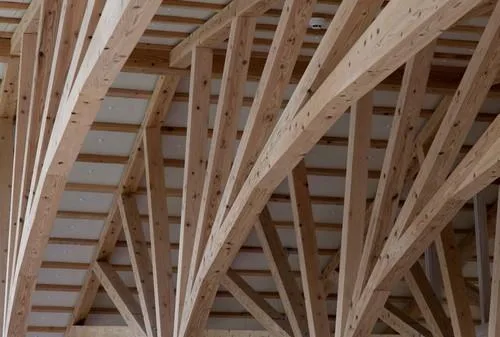
Innovative Wooden Structure Concept — “Nanjing Jade Curtain Structure” Coelacanth K&H Architects Inc. | www.coelacanth-kandh.co.jp
Image source: © Satoshi Asakawa
ARCHICAD Handling Large Wooden Structures
Building Construction — Complete Beauty
“With this new wooden structure, the 105mm diameter beams effortlessly support classrooms spanning eight meters. For larger spaces like gymnasiums, thicker beams of 240mm diameter are used, but the structural principle remains the same,” explains Horiba.
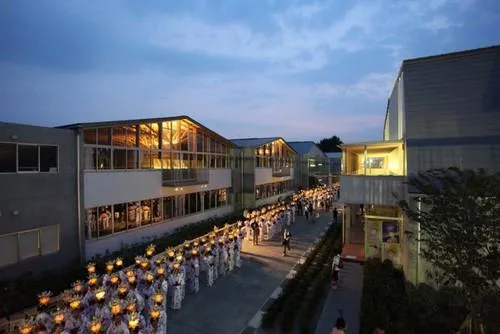
Mountain Deer Lantern Festival Coelacanth K&H Architects Inc. | www.coelacanth-kandh.co.jp
Image source: Coelacanth K& H Architects Inc.
The advantage of the Nanjing Jade Curtain Structure is that it can be supported by ordinary wood over an eight-meter span, while showcasing the natural beauty of the timber. Using reinforced concrete would result in a simple box shape, but this structure, like a wireframe, creates stunning architectural design. The staggered wooden beams create a visually beautiful and intricate pattern.
“The beams are staggered at slight angles, forming an elegant pattern. We have received overwhelmingly positive feedback. However, studying and analyzing this structure is challenging. It is difficult to describe its complexity in words, and physically modeling it is nearly impossible. This is why ARCHICAD is so essential — its ability to manage repetitive, complex elements makes it ideal for this type of wooden structure.”
“In the Shanlu Elementary School project, we designed nine different Nanjing Jade Curtain structures ranging from regular classrooms to the gymnasium, each serving different purposes. Developing these structures was complex, raising questions about wood handling and construction methods. Since this structure is unprecedented, it was crucial for carpenters to fully understand it. Before construction began, we invited seven to eight local craftsmen to collaboratively build a physical model for this unique structure. The carpenters were initially skeptical because they had never worked with this method.”
Pride in True Craftsmanship
“At first, they wondered ‘Is this even possible?’ and questioned what we considered a building. But once we started, progress was smoother than expected. While challenging, once a module was defined, it simply needed to be repeated,” says Kudo. BIMx and physical models played a vital role in communication with carpenters during early design and construction. As work progressed, carpenters gained confidence in the outcome.
Even after completion, the structure remains visible, not hidden behind the roof. This allows carpenters’ craftsmanship to be appreciated by building users, which is highly meaningful. As the structure took shape, morale improved significantly, Horiba adds. The project’s focus was not only on using local timber but also on delivering other important benefits.
“For architects, designing a structure that carpenters enjoy building and can be proud of is a crucial responsibility. This project strongly reinforced that sense of duty.”
Shanlu Elementary School, constructed by local craftsmen and builders using local timber, has received praise from clients, the city, teachers, children, and residents. The original intention by Kudo and Horiba was to encourage children to proactively use the “Learning World” open spaces for both learning and play. On the evening of the Ghost Festival (the eighth day of the first lunar month), a parade featuring one thousand dancers wearing colorful lights on their heads marches along the “path of learning.” Shanlu Elementary School has illuminated the beauty of the area and daily life, becoming an essential part of the local community.
About Coelacanth K&H Architects
Coelacanth K&H Architects aims to make architecture an integral part of people’s lives rather than just monuments.
The firm is dedicated to maximizing the use of available resources such as light, wind, land, and the urban environment, while passing on humanity’s history and cultural heritage to the future.
They believe that careful observation of current conditions is essential to avoid missing vital information. Much like archaeologists uncover history through clues, architects must understand the fragments of knowledge that hold the key to designing innovative spaces.
About Graphisoft
In 1984, Graphisoft launched ARCHICAD® — the industry’s first BIM software designed specifically for architects, sparking the BIM revolution. With innovative solutions, Graphisoft has consistently led the industry’s development, introducing groundbreaking products such as BIMcloud®, the world’s first real-time BIM collaboration software; EcoDesigner™, the first fully BIM-integrated green design solution; and BIMx®, a leading BIM visualization mobile app. Graphisoft is part of the Nemetschek Group. (Compiled by Yang Jie from ChinaBIM)














Must log in before commenting!
Sign Up