
ARCHICAD + BIMx: Maximizing the Use of Local Wood and Technology in Japan

This project received the Grand Prix Award from the Japan Institute of Architects (JIA) for its unique large-scale wooden structure.
In 2014, the Japan Institute of Architects honored Coelacanth K&H for their design of the Yamaga Elementary School in Kumamoto Prefecture. Despite being an established leader in Japan’s construction industry with numerous accolades, this project presented significant challenges. Under the direction of chief architects Kazumi Kudo and Hiroshi Horiba, the company’s team successfully delivered this highly creative work, supported by powerful tools like ARCHICAD and BIMx.
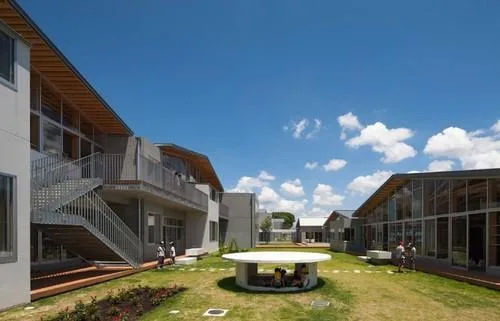
Yamaga Elementary School, Japan | Coelacanth K&H Architects Inc. | www.coelacanth-kandh.co.jp
Image source: © Satoshi Asakawa
Concept: Constructing Large Buildings Using Local Wood

Architects
Hiroshi Horiba (left) | Kazumi Kudo (right)
Yamaga is a densely forested city at the foot of the mountain range running north to south through Kyushu, within Kumamoto Prefecture. The region is renowned for its high-quality cedar wood, known locally as “Ayamachi,” which serves as the primary building material for the Yamaga Elementary School project.
“Initially, the plan was to build a three-story reinforced concrete structure,” Kudo recalled with a smile. “We joined the project by submitting a design proposal.” Notably, the solicitation specified the use of reinforced concrete with no mention of wood.
The client was initially hesitant about constructing a large wooden building, particularly given the project’s size of nearly 9,000 square meters (97,000 square feet). However, during the research phase, it became clear that the site was located in one of the region’s prime timber-producing areas.
Yamaga Elementary School – Proposal Highlights
“If conditions allowed, we proposed using solid wood rather than plywood to fully leverage the region’s abundant timber resources,” explained Horiba. Both architects brought prior experience from a 2,700 square meter wooden kindergarten project in Fukuoka, Kyushu, which they had jointly completed.
“That kindergarten project gave us valuable expertise in wooden structural design,” Horiba added. “It gave us the confidence to take on the much larger Yamaga Elementary School project.” Kudo nodded in agreement, emphasizing the unique spatial quality that wood creates compared to concrete. “In Fukuoka, we had to use plywood due to local limitations. This time, we aimed to challenge ourselves by using solid wood.”
Coelacanth’s proposal, centered on utilizing wood, stood out among many competitors, opening the door to innovation and experimentation throughout the project.
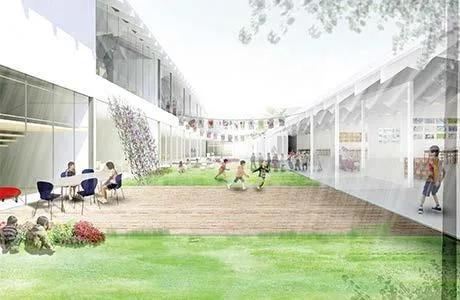
Yamaga Elementary School, Proposal
Coelacanth K&H Architects Inc. | www.coelacanth-kandh.co.jp
Embracing the Challenges of Wooden Structures
The school’s layout features rows of buildings with herringbone-patterned roofs. On closer inspection, the campus is divided into three zones running south to north: the northern district houses sports facilities, music halls, libraries, and catering services; the central district, known as “The Road to Learning,” includes two floors of senior classrooms, a performance stage, and administrative offices; while the southern district, called “Learning World,” consists of lower-grade classrooms with flat roofs, craft rooms, science labs, and special tutoring spaces. The sports field lies to the east.
Interestingly, the “Road to Learning” is open to the public, allowing local citizens to freely use the path. Historically, a public road ran through the school, and the community is accustomed to this openness.
“The school has always fostered openness, directly connecting to a neighboring temple without barriers,” the architects explained. “Our site plan preserves this openness and connection, uniting previously mixed pedestrian and vehicle paths into the ‘Road to Learning.’ This restructuring maximizes the use of existing elements.”
Given the use of wood, fire safety was a major consideration. “Wooden structures must be separated by fire zones to prevent spread. We addressed this in our design between the ‘Road to Learning’ and ‘Learning World.’” The architects innovatively incorporated these safety features while expanding learning spaces.
Cultural integration was also key. In discussions with teachers and residents, the prominent local festival—the “Mountain Deer Lantern Festival”—was a major focus. Traditionally held on campus, the festival draws over a thousand dancers who queue up outside the school before entering.
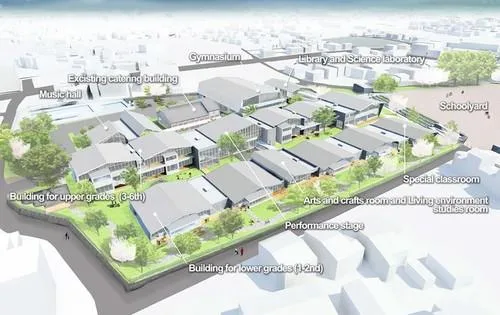
Architectural Composition
Coelacanth K&H Architects
“We redesigned the streets so that over a thousand dancers can queue comfortably to enter the campus. This idea further shaped the ‘Road to Learning’ concept,” they said.
Coelacanth K&H actively sought community input and integrated local history and culture into their plans. This collaborative approach, supported by ARCHICAD and BIMx software, fostered innovative communication among staff, clients, and residents.
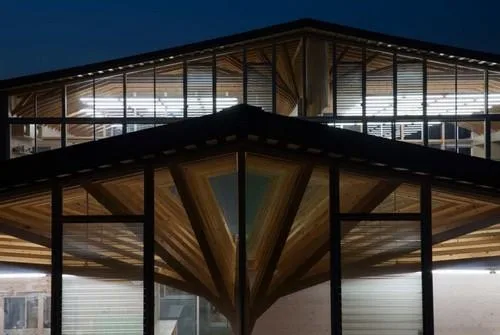
Yamaga Elementary School, Japan | Coelacanth K&H Architects Inc. | www.coelacanth-kandh.co.jp
Image source: © Satoshi Asakawa
High-Quality Design Tools
“Coelacanth is known for producing detailed physical architectural models,” the team shared. “Our six founding members all come from the same university research department.”
While physical models are uncommon in early design stages today, Coelacanth prioritizes creating both overall and detailed models for volume analysis. This approach leads to high-quality design and fosters collaboration. Physical models and 2D drawings serve as effective communication tools for clients, consultants, and local residents who may not have architectural expertise.
This philosophy inspired the integration of ARCHICAD’s 3D CAD software into their design process, enhancing communication and innovation. (Compiled by Yang Jie from ChinaBIM)
















Must log in before commenting!
Sign Up