
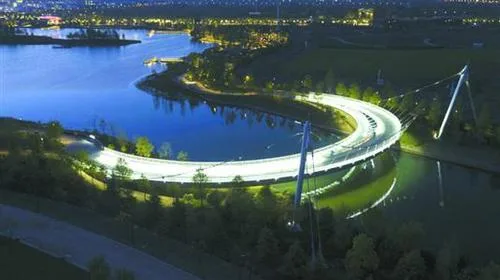
Next to the Star Wish Park in the Shanghai International Tourism Resort, where Disney is located, a winding wooden boardwalk extends along the southern shore of the lake. Two elegantly curved landscape bridges, resembling flowing ribbons, stretch across the blue sky and clear water. These bridges are given enchanting names: Qiyuan Bridge and Fantasy Bridge.
3D Modeling Transforms Traditional Bridge Design
These are no ordinary bridges. Each consists of a combination of main and auxiliary spans, with the secondary bridge deck made from transparent glass. Walking across feels like stepping on waves in mid-air. Even more remarkable, the main and auxiliary bridges are circular curves with different radii, connected only by a series of steps at the center. Their starting heights and slopes also differ, creating a dynamic visual experience for pedestrians.
Qiyuan Bridge and Fantasy Bridge are China’s first spatially curved beam single-sided suspension bridges. They surpass similar structures worldwide in main bridge width and feature a uniquely complex combination of main and auxiliary spans—a world first. Pang Xuelei, Chief Engineer at Shanghai Shendi Project Management Co., Ltd., explains that the bridges curve horizontally, vertically, and in depth, making design and construction highly complex. Many bridge components and connection points are difficult or impossible to represent accurately using traditional 2D drawings. However, with the latest BIM (Building Information Modeling) technology, these complex spatial structures can be precisely modeled, simultaneously reducing project costs.
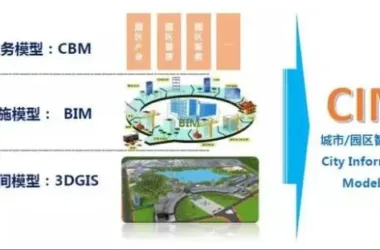
What exactly is BIM technology? According to a recent training session held for major state-owned enterprises in Shanghai, BIM is a revolutionary digital design and construction method that replaces traditional two-dimensional drawings with three-dimensional models. It plays a key role in advancing information management within the construction industry and supports its transformation and modernization. Currently, BIM technology has been applied to 162 rail transit projects and major developments in Shanghai, including the Shanghai Tower, the National Convention and Exhibition Center, the Disney Project, Phase II of Metro Line 9, and the Zhoujiazui Road River Crossing Tunnel.
Simulation Reduces Engineering Costs
At the BIM Technology Center of Shendi Group, technicians demonstrated the software’s capabilities by simulating projects in 3D. Upon visiting the actual sites, all pipelines, equipment, facilities, and drawings matched the simulations perfectly. This approach prevents costly design conflicts between different disciplines and effectively reduces project expenses.
Standing on the Qiyuan Bridge, visitors can enjoy a clear view of the towering spires of the Disney Castle in the distance. Walking out along the steel cantilevered auxiliary bridge, suspended from the main span, one can gaze through the anti-slip glass deck at the flowing water below. At night, floodlights illuminate the slender suspension cables, lifting the main bridge’s structure in a gentle glow. Embedded LED lights in the handrails make the glass deck of the auxiliary bridge sparkle like a scene from a fairy tale. During fireworks displays, the colorful explosions in the sky, reflected in the lake’s surface, create a shimmering, abstract painting-like effect. It’s clear that modern BIM technology and construction techniques have brought these dreams to life with vivid reality.
Looking ahead, BIM technology is set to become increasingly widespread in Shanghai’s engineering projects. According to the Municipal Commission of Housing and Urban-Rural Development, a notice from the Shanghai Municipal Government Office issued in October 2014 mandates that by 2017, all government-funded projects above a designated size in Shanghai must apply BIM technology. Similarly, most large-scale social investment projects will also adopt BIM, positioning Shanghai at the forefront of BIM application and management nationwide.












Must log in before commenting!
Sign Up