
BIM technology, also known as Building Information Modeling, organizes various construction-related data to create building models and simulate real-world building conditions through digital information. Compared to traditional methods, BIM offers five key advantages: visualization, coordination, simulation, optimization, and graphing.
Currently, steel structure construction still relies on conventional project management methods. Information across different stages such as detailed design, production, and installation tends to be isolated, leading to delays and inaccuracies in data exchange. This inefficiency results in significant waste of manpower, materials, and financial resources.
BIM technology introduces a new approach to steel structure construction by laying the groundwork for digital, integrated industrial management. It creates a platform for information sharing and collaboration across engineering disciplines, enabling refined management practices. By linking construction elements like personnel, machinery, and materials, BIM tracks the entire process status.
With BIM, a dynamic visual database, a permanent materials library, and a comprehensive acceptance system for steel structure construction can be established. Logistics can be fully traced, material inventory can be conducted with precision and efficiency, and construction progress and costs can be visually managed. This facilitates seamless information sharing among all stakeholders, improving material utilization rates.
Moreover, the integration of intelligent process design, automated layout and nesting, CNC equipment networking, and cloud computing significantly reduces management errors and data transmission costs across different domains. BIM also provides a technical platform for building extensive engineering databases.
1. Project Overview
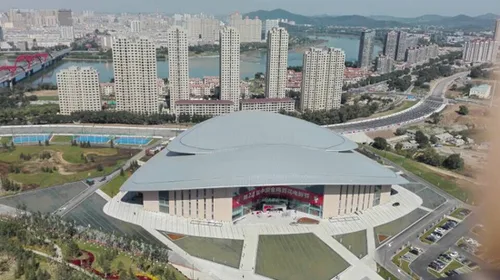
The Jilin People’s Grand Theatre is situated on the east side of Nanft Street, facing the Songhua River to the north. The total construction area covers 37,007.98 m², including 27,985.12 m² above ground and 9,022.86 m² underground. The complex primarily consists of a large theatre, a small theatre, four cinemas, and office support buildings. There is no civil air defense facility. The building stands 34.6 meters tall, with four floors above ground and one underground. Structurally, it features a frame shear wall system, and the roof uses aluminum alloy hammered upright panels.
The theatre is classified as Grade B, with a building grade of III, foundation grade II, and foundation pit safety grade I. Its exterior design draws inspiration from Manchu customs and culture, incorporating regional elements throughout the detailing. The four cinemas are named after Jilin City’s four seasons: spring, summer, autumn, and winter, with interior designs reflecting the beauty of each season. The grand theatre accommodates over 1,500 spectators, and together with the cinemas and small theatre, the total capacity exceeds 2,600 people.
2. Key Challenges in Construction
Construction of the People’s Grand Theater began in August 2013 and was completed by July 28, 2015. Due to Jilin’s high altitude, the effective construction period was only 15 months, significantly shorter than the typical 3 to 4 years for similar theatres in China. This project holds the record for the shortest construction time for a large theatre in the country.
Located beside the Songhua River, the design includes an 18.3-meter-deep elevated main stage warehouse. The project faced major challenges such as high water inflow, geological conditions with large pebbles, and difficulty drilling anchor holes. The main structure involves large spans, vast spaces, multiple anisotropic structures, and a tight schedule.
The lobby roof, a highlight of the theatre, presented four main construction difficulties:
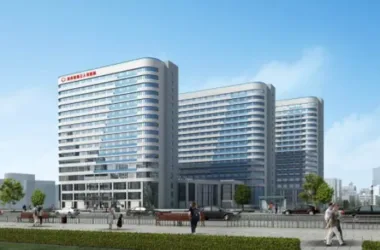
First, the ceiling encompasses a large area with multiple curved surfaces. The theatre’s main structure uses a spherical design featuring a stepped curve at the interface between the ceiling and outer curtain wall, and an arc-shaped ceiling between the inner wall and outer curtain wall. Designing and constructing these complex curved surfaces combined with dome shapes posed significant challenges. As illustrated in Figure 1:
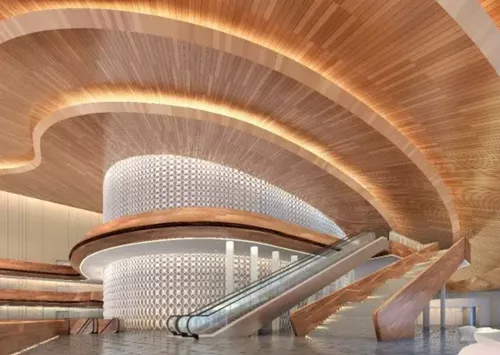
Figure 1: Rendering of Jilin People’s Grand Theatre
Second, the suspended ceiling has curved, arc-shaped horizontal and vertical profiles, complicating manual positioning and installation of recessed light troughs. The hall walls are designed with GRG (Glass Reinforced Gypsum) panels, which struggle to precisely fit around curved shapes, door openings, fire hydrants, and other features.
Third, onsite constraints are significant. Conflicts between the designed roof structure and existing site elements such as prominent pillars, eaves, and reserved HVAC vents restrict the elevation of interior walls.
Fourth, the mesh steel structure requires strict fixation. Secondary steel structure support points cannot be welded or clamped but must fit precisely onto spherical stress points of the main structure, making fixation and locating these spherical points highly challenging.
Application of BIM Technology in Steel Structure Construction
To address these challenges, BIM technology was employed for comprehensive project planning. The theatre’s roof features a streamlined, stepped hyperbolic surface, captured via 3D scanning. Scientific data splicing and analysis ensured an accurate model, facilitating material numbering, processing, and highlighting the design intentions. The roof steel structure canopy covers over 20,000 square meters.
BIM’s total station was used to accurately position the model coordinates onsite, simplifying installation. The large-span steel truss beam was lifted using a 400-ton crawler crane, complemented by a segmented lifting plan for complex curved steel trusses, completing the steel structure assembly efficiently.
3.1 Construction Simulation
First, onsite 3D scanning was conducted to survey the project. Taking into account site conditions, climate, and geography, a 1:1 real point cloud was captured, producing a detailed point cloud model (see Figure 2). Next, coordinate system alignment matched the onsite conditions with the BIM model and drawings using collected 3D data and feature points. This alignment allows for accurate later construction applications.
Both the 3D models and point cloud data clearly represent construction details and site conditions, enabling early problem-solving and significantly reducing rework and design changes. This approach raises construction planning to the level of individual drawings, allowing direct use of plans for material ordering. The result is improved accuracy and a shortened construction schedule, which is central to BIM’s value.

Figure 2: Point Cloud Model
3.2 Collision Detection
3.2.1 Model Creation: The initial onsite modeling was completed using Rhino software. Starting from existing drawings, an initial model was created. Due to the height difference exceeding 10 meters between some design tops and the main steel structure, a transition steel layer was needed onsite. Because this layer bears structural loads, its model establishment and adjustments required manufacturer involvement, as shown in Figure 3.
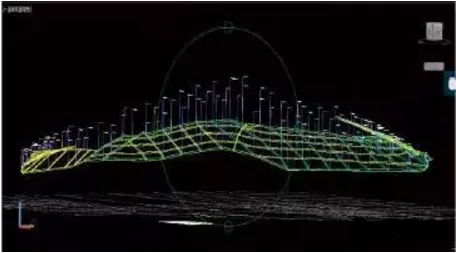
Figure 3: Initial Model
3.2.2 Simulation and Collision Adjustment: The initial model was matched with the onsite point cloud based on grid lines and column features, including reserved layers, air vents, and supports. The model was adjusted to the correct elevation and checked for collisions. Comprehensive collision adjustments were made, ensuring the transition layer followed the curvature of aluminum panels. After initial aluminum plate collision resolution, further adjustments were made to steel frame components that didn’t align with site conditions. Steel frame modifications required manufacturer confirmation.
3.3 Segmentation, Ordering, and Installation Positioning
Once collision adjustments were finalized and approved, the model was segmented, laid out, and orders were placed. Due to the radial design of the aluminum plates, sizes were non-modular, with each plate having unique dimensions and angles. To improve management, each plate was assigned a unique number detailing specifications and installation location.
After final model adjustments aligned with onsite point clouds, installation and positioning began. Because model coordinates were already site-matched, relevant data could be extracted directly for quick and precise onsite deployment. Considering the construction environment and installation process, it was not necessary to determine installation points for each plate individually. Instead, aluminum plates were divided into zones, with only the starting point for each area identified before overall inspection.
4. Conclusion
In today’s evolving social landscape, BIM technology’s application in steel structure construction underscores sustainable development principles. It enhances construction management transparency and improves the timeliness and accuracy of progress and cost information sharing.
For the Jilin People’s Grand Theatre, BIM enabled efficient, economical, straightforward, intuitive, and safe construction. Early in the project, BIM coordinated relationships between designers and practical concerns such as materials, structures, and equipment, allowing flexible modifications and presenting optimal solutions quickly and clearly.
Additionally, BIM optimizes resource allocation—manpower, materials, and finances—through a data platform that streamlines task coordination and cost data processing. This facilitates clear, comprehensive cost monitoring and timely responses to construction budget needs.
Finally, BIM creates an intuitive steel structure industrial building model, enabling four-dimensional visualization for easy inspection and future renovations. Throughout construction and operation, BIM monitors the building lifecycle, promptly identifies issues, and proactively addresses risks, enhancing steel structure safety and minimizing economic losses.
References
Long Wenzhi. “The Construction Industry Should Promote Building Information Modeling (BIM) Technology as Soon as Possible.” Building Technology, 2011, 42(1).
Li Yungui, Qiu Kuining, Wang Yongyi. “Research and Application of BIM Technology in China.” Railway Technology Innovation, 2014, (2).
Zhang Jianping. “Dynamic Management of Construction Resources and Real-Time Cost Monitoring Based on 4D-BIM.” Construction Technology, 2011, 40(4).
Zhou Guangyi, Tang Jiaru, Mao Lixian, et al. “Key Technologies for BIM-Based Installation of Complex Space Steel Structures in Dalian International Convention Center.” Building Technology, 2013, 44(10).
Wang Chaoyang, Liu Xing, Zhang Chenyou. “Application of BIM Technology in Steel Structure Construction Management of Wuhan Central Project.” Construction Technology, 2015, 44(6).
Author Introduction: Chen Ling, Research and Development Center, Suzhou Golden Mantis Building Decoration Co., Ltd.












Must log in before commenting!
Sign Up