
In 2015, China’s Changla Mountain Tunnel, the world’s highest highway tunnel, was completed and opened to traffic. This milestone marked China’s tunnel construction technology as one of the global leaders. Thanks to reforms, opening up, and large-scale urbanization, “China Construction” has made significant advancements, mastering numerous world-leading technologies and creating construction miracles. The label “Made in China” has become a prestigious symbol recognized worldwide.
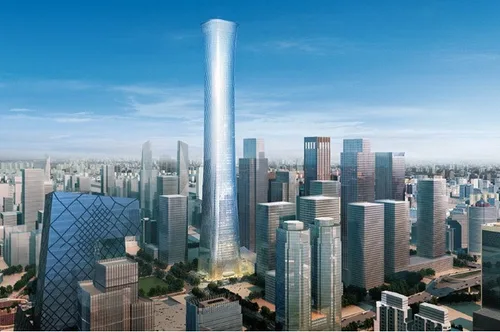
Zhang Qiuyu works in Beijing’s Central Business District (CBD). Every day, she passes by the under-construction “tallest building in Beijing,” known as China Zun. The speed of construction in China is truly astonishing. “After just a few days away on a business trip, I noticed that China had grown taller again,” Zhang remarked. What was once a large excavation pit quickly transformed into a towering skyscraper.
The rapid pace of construction in China has amazed many. Take China Zun as an example: it is the world’s first high-rise building over 500 meters tall constructed in an earthquake-prone zone with an 8-degree seismic fortification. Despite its complex structure and high-quality standards, the building, with 115 floors above and below ground, was designed within just 62 months.
Many people, like Zhang Qiuyu, wonder: how can buildings be constructed so quickly? To find out, I visited the China Zun construction site.
Innovative ‘Building Artifact’ Enables Construction of One Floor in Six Days
The China Zun construction site is noticeably different from traditional sites. Instead of erecting scaffolding around the building, a work platform is built directly on the roof, surrounded by chest-high steel protective nets on all sides.
Upgrading from a traditional apron to a roof-top platform has greatly improved site stability. Even when faced with winds of force 4 or 5, the platform—nearly 200 meters above ground—remains perfectly steady, giving workers the feeling of standing on solid ground.
“Beneath your feet is our ‘building artifact,’ the key to our rapid construction,” said Jiang Kai, technical manager and engineer of the China Zun Project. “This is our independently developed integrated intelligent formwork system—the largest and highest load-bearing platform in the global housing construction sector. Among the four tower cranes on the platform, two are integrated directly with the platform, a world-first innovation.”
By integrating the tower cranes with the platform and lifting them together, work doesn’t need to stop for crane lifts, saving 56 days of construction time. This integration also reduced embedded parts by 400 tons, cutting both labor and material costs. On this “tower building artifact,” workers can simultaneously operate on four floors—for example, pouring concrete on the first floor, installing mechanical and electrical equipment on the second, and tying steel bars on the third—greatly boosting efficiency.
China leads the world in high-rise construction, which offers ample opportunities to innovate. “Through practical experience, we’ve developed many advanced tools, processes, and technologies,” said Xu Lishan, Technical Director of the China Zun Project. “Overall, China’s housing construction technology has reached an advanced global level.”
For example, pumping concrete up to great heights is a challenge. Foreign companies typically pump concrete up to 300–400 meters, requiring intermediate pumps for buildings over 500 meters like China Zun. However, China has developed concrete pumping technology capable of reaching up to 600 meters, and lab tests indicate it can pump nearly one kilometer, allowing concrete to be delivered directly to the top floor, accelerating construction speed.
Simulating Construction on Computers Before Building On-site
At the China Zun site, engineers frequently use tablets to guide construction—not for show, but because these devices run the BIM (Building Information Modeling) system, the intelligent brain of the building and a vital tool for efficient project execution, explained He Xiaofei, Deputy Manager of the Engineering Coordination Department.
The BIM system stores and processes all accessory data using high-performance computers, simulating the entire construction process in a 4D model before actual building begins. This simulation predicts potential problems, proposes solutions, and formulates detailed scheduling and command plans. Each department follows these plans on-site, resulting in smoother construction.
This technology proved invaluable during the pouring of China Zun’s massive base plate. Located in Beijing’s congested CBD, surrounded by other construction sites and high-rises, the project had to meet seismic resistance requirements of level 8. The base plate is large and thick, requiring a single continuous pour of 56,000 cubic meters of concrete over four days and nights. Concrete had to be delivered within two hours of mixing, without interruption. Using BIM technology, six contingency plans were developed, ensuring smooth operation.
“Thanks to careful planning, we finished pouring the base plate seven hours ahead of schedule,” said Chen Feng, head of the China Zun Project Planning Department. During the 93-hour continuous pour, a concrete truck entered or exited the site every minute without significantly impacting surrounding traffic. Zhang Qiuyu, who works nearby, didn’t even notice the extra activity. “I didn’t feel the area was more congested than usual,” she commented.
To build quickly, every detail must be meticulously managed. The China Zun project schedule is refined daily and optimized based on progress. For example, at 4 pm each day, the team schedules tower crane usage for the next 24 hours. Dedicated personnel record and analyze daily crane usage, proposing efficiency improvements. When it was discovered that all four tower cranes were idle during lunch breaks, the project department staggered lunch times, raising crane utilization rates to over 85% consistently.
Fine management extends to long-term design. The construction elevators and site fire protection systems were designed for reuse or easy conversion after completion to save materials and shorten construction time. “We used four loft elevators, a world-first for ultra-high projects,” explained Chen Feng. “Once the machine rooms are completed, these elevators convert to permanent building elevators. Temporary fire pipes and water tanks above the 18th floor use formal fire protection systems, another first in international super high-rise projects.”
Hardworking Chinese Workers Tie One Ton of Steel Bars Per Day
Currently, Beijing is in the grip of a harsh winter. Even on cold nights, the China Zun site shines brightly, with welding sparks flying hundreds of meters above like fireworks.
China Zun rises at a pace of one floor every six days, largely thanks to the remarkable efficiency of its workers. At peak times, they tied 20,000 tons of steel bars in just 50 days. These bars, connected end-to-end, stretch beyond the length of the railway from Beijing to Guangzhou. On average, each worker ties one ton of steel bars daily. The base plate concrete pour was completed in one continuous 93-hour operation. Over 100 vibrators worked two shifts nonstop, squatting and bending in less than a meter of steel reinforcement to compact the concrete with hammers.
“Without these dedicated workers, China wouldn’t have repeatedly achieved these speed milestones in world architectural history,” said Liu Xiaolin, Deputy Secretary of the Party Committee for the China Zun Project.
Not only the workers but also management staff often work overtime. “We usually have only one day off on weekends. There are few women on-site, and young men barely have time for dating. Organizing social events has become an important task for the party committee,” Liu Xiaolin said with a smile.
He Xiaofei, whose family lives in Beijing, has little time to spend with them. “My child thinks I’m always on business trips. I wish I could work just 40 hours a week and take beach vacations during holidays. But I know if everyone did that, our construction industry couldn’t keep up,” he shared. “My country is developing so fast, and I’m proud to contribute to that progress.”












Must log in before commenting!
Sign Up