
Abstract: The renovation, reconstruction, and expansion project of Shanghai Jade Buddha Temple aims to rebuild and expand the temple based on the integrated relocation, jacking, and protection of the Heavenly King Hall and the Shakya Mani Hall. The project addresses existing safety hazards related to fire, traffic, structural integrity, and high-density crowds within the temple.
1. Project Background
1. Project Name: Shanghai Jade Buddha Temple Renovation and Reconstruction Project
2. Project Design Unit: Shanghai Modern Architectural Design Group Engineering Construction Consulting Co., Ltd.
Shanghai Modern Architectural Design Group Engineering Construction Consulting Co., Ltd. (referred to as “Modern Construction Consulting”) is a wholly-owned subsidiary of Shanghai Modern Architectural Design (Group) Co., Ltd. It specializes in architectural design, engineering consulting, and general contracting, holding 15 qualifications including first-class construction general contracting, design, and engineering consulting. The company covers the entire project construction process, leveraging technological and brand advantages to integrate extensive experience and achievements in consulting, design, and construction. It has established a unique EPC brand that spans all project phases and aims to be a leading engineering consulting company in China’s construction industry.
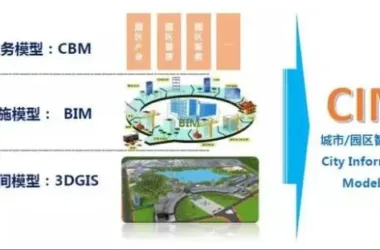
Modern Construction Consulting is recognized for its comprehensive services in consulting, design, and construction. In recent years, it has diversified its practices in BIM technology application, collaborative professional design, 3D laser scanning, and 3DGIS (three-dimensional spatial geographic information system) for complex architectural projects. BIM technology has been applied in notable projects such as the German and Austrian Pavilions at the 2009 Shanghai World Expo, the historic building renovation on Sinan Road, Shanghai, a food store renovation in Shanghai, and the Pearl International Hotel at Taihu Lake in Jiangsu. The company integrates BIM with 3D laser scanning, 3DGIS, and 3D printing technologies to develop innovative methods, aiming to provide efficient and cost-effective solutions throughout the building lifecycle—from design to construction—in the Jade Buddha Temple renovation project.
3. Related Software Applications:
- Autodesk Revit Architecture
- Autodesk Revit Structure
- Autodesk Revit MEP
- Autodesk Navisworks
- Autodesk Maya
- Autodesk 3ds Max
- AutoCAD
4. BIM Application Evaluation and Feedback:
The integration of BIM with Cloud GIS, along with other information technologies such as scanning and 3D printing, opens up broader prospects for efficient project management.
— Liang Shiyi, Chief Consultant Engineer, Shanghai Modern Architectural Design Group Engineering Construction Consulting Co., Ltd.
BIM technology is expected to become a key tool in building digital cities soon, potentially transforming traditional urban management. Platforms for managing land resources, planning and construction, transportation, disaster prevention, and environmental protection will be unified, significantly impacting work practices and lifestyles.
— Zeng Xian’an, Director of Technical Quality Department, Shanghai Modern Architectural Design Group Engineering Construction Consulting Co., Ltd.
2. Main Text
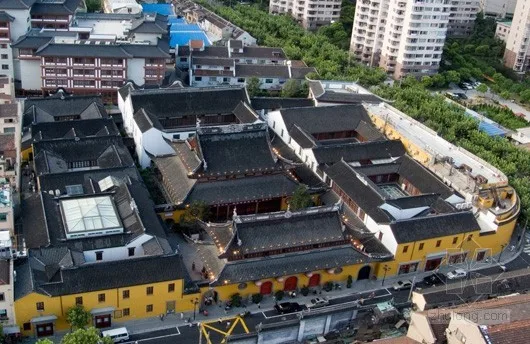
Figure 1: Aerial Photo of the Current Shanghai Jade Buddha Temple
Project Overview
Jade Buddha Temple is a premier temple in Shanghai, located at 170 Anyuan Road, Putuo District. It is an outstanding historical building divided into two parts: the front yard and the back yard. The front yard, which is the focus of this project, serves as the main open area for worship and visitation. Key structures include the Heavenly King Hall, the Shakya Mani Hall (a historic building), and the Jade Buddha Tower, with a total construction area of 31,566 square meters.
The rise of BIM technology has significantly influenced and transformed the way designers work and live.
The renovation and expansion project involves reconstructing and enlarging the temple while integrating relocation, jacking, and protection of the Heavenly King Hall and the Shakya Mani Hall. It also aims to eliminate existing safety hazards related to fire, traffic, structural integrity, and overcrowding. The project will raise the ground floor to create public safety reserve spaces for crowd evacuation and traffic management. The primary Buddha worship buildings will be elevated, while the Heavenly King Hall and Shakya Mani Hall along the central axis will be preserved. The Jade Buddha Tower will be constructed anew. Buildings on the east and west sides will be fully demolished and rebuilt following the classical Jiangnan palace architectural style, including two new basement levels to accommodate growing spiritual and functional needs.
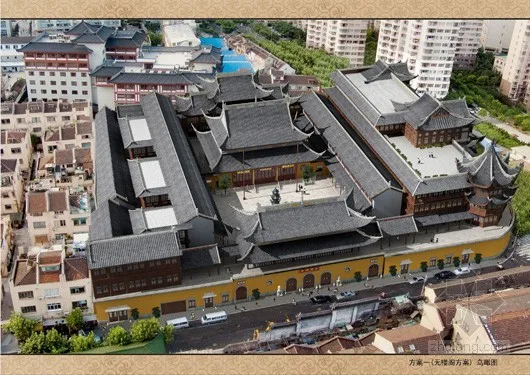
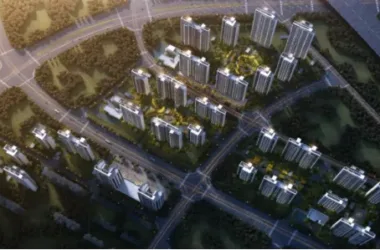
Figure 2: Aerial View of Shanghai Jade Buddha Temple after Restoration
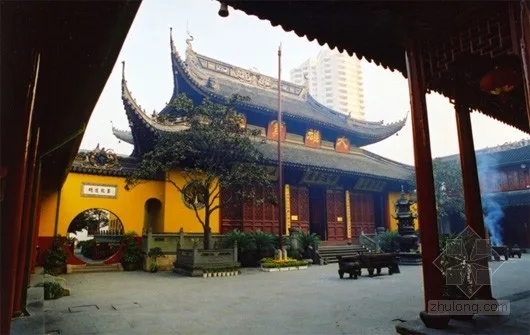
Figure 3: Current Photo of the Square in Front of the Shakya Mani Hall
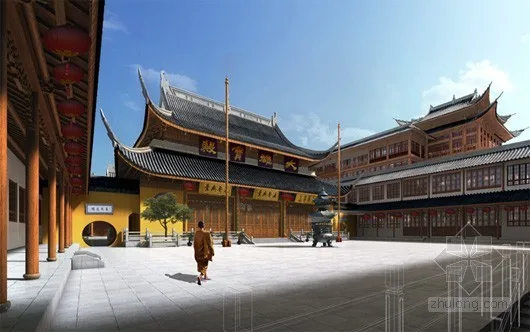
Figure 4: Design Sketch of the Square in Front of the Restored Shakya Mani Hall
Preservation and Repair Value
1. Religious and Cultural Value
Jade Buddha Temple is a key religious site in China and the most prominent temple in Shanghai. In 1942, the fifth abbot, Venerable Yuanchen, founded the Shanghai Buddhist Academy within the temple grounds. Recognized as a national key cultural relic protection unit, the temple has received multiple government maintenance funds. During the Cultural Revolution, with protection from local authorities and cooperation from government units, monks, and the community, the temple was preserved intact along with valuable Buddhist scriptures, statues, artifacts, and the two jade Buddhas. Religious activities were halted temporarily but resumed gradually after 1979 under the leadership of Master Zhenchan. In 1983, the State Council officially recognized the temple as a key Buddhist site in Han areas.
2. Historical Value
The temple has a rich history spanning over a century, documenting the development of Buddhism in Shanghai. Over the past 50 years, it has hosted more than 250 foreign heads of state and leaders, serving as a bridge for international Buddhist exchanges. It remains a vital center for Buddhist research and communication in eastern China and nationwide.
3. Architectural Value
The temple’s architectural layout is well preserved as a large-scale wooden temple complex in traditional Jiangnan style. Its intricate construction, exquisite carvings, and well-maintained wooden, stone, and brick elements possess significant architectural and artistic value.
Project Challenges
1. Restoration of Ancient Buildings
As a district-level cultural relic protection unit and an excellent historical building, the Jade Buddha Temple entails raising the mountain gate and main hall by five meters and shifting them eight meters north from their original locations. Some structures require demolition and reconstruction. Structural reinforcement and renovation are key parts of the project. Unlike new construction, restoration must ensure recognizability and reversibility while preserving the building’s historic traces.
2. BIM Technology Application in Ancient Architecture
The temple’s complex ancient architecture demands specialized knowledge from BIM engineers in repair, design, construction, and management of historic buildings. Challenges include:
(1) Complexity — The architectural complexity and diverse components make BIM platform application difficult, testing both engineers’ skills and software capabilities.
(2) Modeling — Traditional Chinese wooden-frame structures feature columns on foundations, beams, layered melon columns, ridge melon columns forming roof trusses, and rafters that create the roof skeleton. A distinctive element, Dougong brackets, stack in layers to support beams and eaves. These intricate components require advanced spatial modeling, posing a significant challenge for BIM engineers.
(3) Family Files — Ornate roof decorations, such as swallowtail ridges and glazed beasts, along with complex coffered ceilings composed of intersecting wooden frames and painted panels, demand versatile and detailed BIM “family” modeling, as supported by Autodesk Revit software.
Integration of BIM, 3D Laser Scanning, and 3DGIS in Restoration
3D Laser Scanning Application
3D laser scanning technology has become widely used in ancient building preservation, industrial pipeline installation, and ship machinery. It captures three-dimensional coordinate data of object surfaces through high-speed laser scanning, rapidly collecting extensive spatial point information with high resolution. This technology provides a new, efficient method for creating accurate 3D image models of objects. The scanning instruments can capture up to one million points per second with an overall accuracy of 1-2 mm.













Must log in before commenting!
Sign Up