
Abstract: The direction for BIM application was established during the conceptual phase of this project. From the perspectives of resource conservation, efficiency improvement, and overall time reduction, basic requirements were set for transferring BIM models from the design stage to the construction stage.
1. Project Overview
Shanghai Zhengda Real Estate is the flagship real estate company of Zhengda Group and is publicly listed on the Hong Kong Main Board. The company specializes in developing and managing high-quality residential and commercial real estate projects, with successful developments including the Shanghai Himalayas Center and Thumb Plaza.
The Nanjing Zhengda Thumb Project represents a continuation and upgrade of Zhengda Real Estate’s Thumb Commercial Real Estate brand in Nanjing. The site is located southeast of Nanjing South Station, covering a total area of 93,526.4m2, with a planned total construction area of approximately 628,835.4m2. This project marks the company’s first large-scale commercial complex to implement BIM technology.

Rendering of Nanjing Zhengda Thumb Project
2. BIM Application Practice
The BIM implementation in this project is structured across three levels: planning, execution, and assurance.
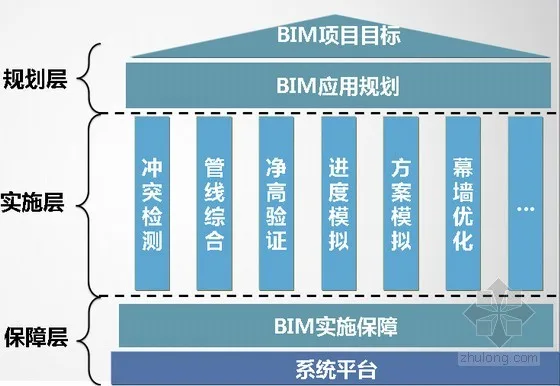
Nanjing Zhengda Thumb Project BIM Third Floor Framework Diagram
The planning level focuses on setting project application goals and defining the direction of BIM implementation. It establishes the necessary steps to achieve these goals and requires unanimous approval from the company or project management.
The execution level outlines the methods and approaches for BIM application during project execution. This is typically developed by the BIM execution team and submitted for approval by the company or project management.
The assurance level specifies the conditions needed during the BIM application process, with its content reviewed by company or project management teams.
2.1 Objectives of BIM Application
Setting clear application goals is essential for BIM success, as it underpins the overall value assessment. Goals must adhere to the SMART criteria and guide all BIM activities, including application development, service provider selection, and contract formulation. These goals should also consider project challenges and company management processes.
After goal definition, personnel at both company and project levels clarify the BIM objectives. For this project, design, construction, and cost management targets were developed based on the company’s characteristics and the project’s key challenges, leveraging BIM technology.
2.2 BIM Application Planning
BIM planning involves creating practical, stepwise plans aligned with project timelines and company requirements. Each step’s conditions and goals must be clearly defined.
For organizations new to BIM, establishing BIM-based workflows is a priority. These workflows clarify when and how specific tasks should be performed, integrating with existing company processes and aligning with project objectives.
The Nanjing Zhengda Thumb Project, being the company’s first large-scale commercial complex BIM application, tasked its BIM consultant with producing a project-level consulting report. This report, based on Zhengda’s internal management and current state, was developed following thorough research and interviews. Additionally, reference standards for BIM application were created to align with headquarters’ control mechanisms.
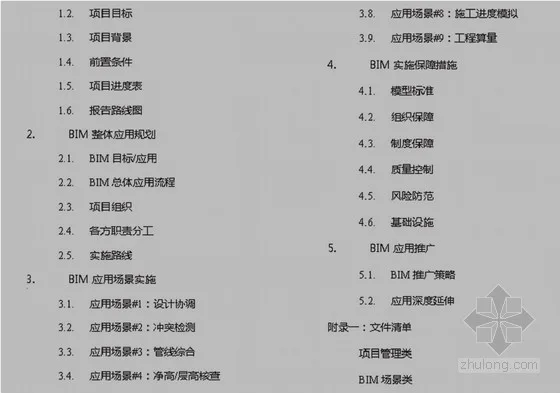
BIM Consulting Report Catalog
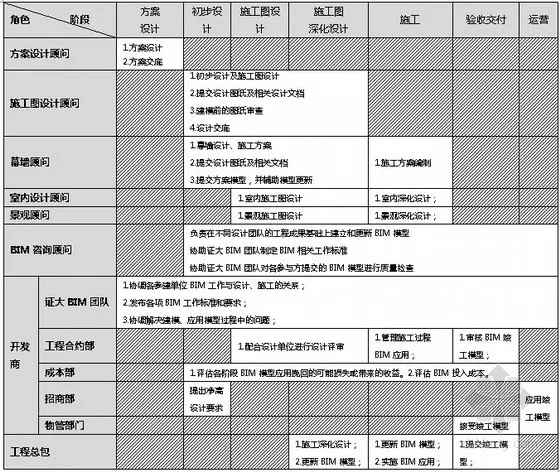
Division of Responsibilities and Flowchart
2.3 BIM-Assisted Design
During design, BIM applications are developed according to project features and challenges at each stage. BIM modeling is foundational, but its true value lies in flexible application.
Due to the Nanjing Thumb Square project’s large scale and frequent layout changes, an area model was created early on to dynamically monitor the building area of each structure and floor, as shown below.
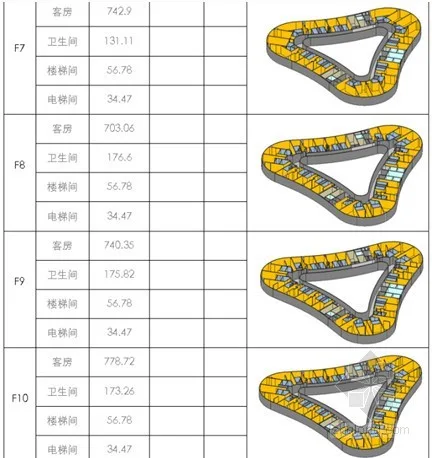
Area Statistics Report
Given the relatively low floor heights (3 basement floors, with B2 at 3.5m, B3 at 3.7m, and the lowest above-ground floor at 3.15m), space constraints are significant. Beyond collision detection and pipeline integration, a critical BIM task throughout design is verifying net height.
BIM models are rapidly developed and updated to check net height during various stages, from initial routing to construction drawing stages where sprinkler heads and maintenance spaces are considered. These findings are promptly communicated to the construction drawing design team.
During early expansion and construction drawing phases, BIM teams present high-risk net height areas to designers, enabling quick issue identification and coordinated resolutions that prevent isolated problem-solving.
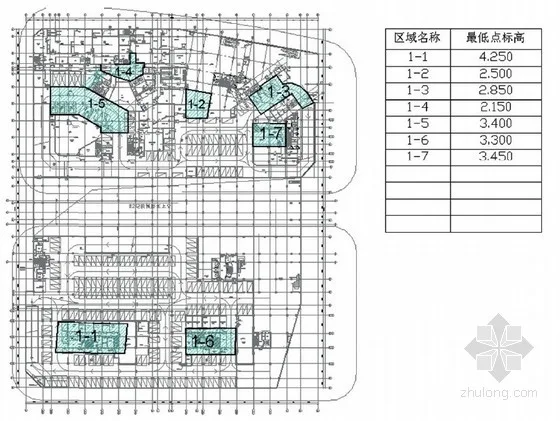
Clear Height Area Analysis and Positioning Map
In the construction drawing phase, BIM and the general contractor’s M&E installation teams collaborate on pipeline integration. They propose mechanical and electrical installation requirements that the BIM team incorporates into the model. Feedback is provided to construction drawing designers for iterative adjustments.
After multiple rounds of modeling, review, and adjustments, net heights in complex basement areas and public walkways met requirements. The following image shows local net height improvement from 3.0m to 3.1m following BIM-assisted optimization of pipelines and routing.
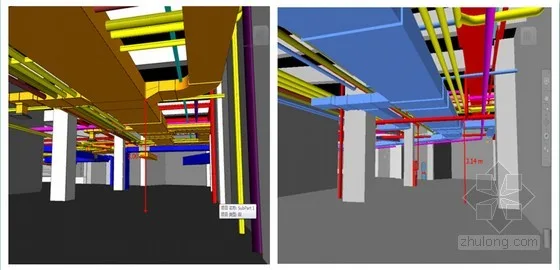
Net Height Analysis and Comparison Chart Before and After Adjustment
Another challenging aspect is the curtain wall design. Its complex shape and optimization requirements must address collisions between the curtain wall, main structure, and roof electromechanical systems. The following collision report illustrates conflicts between the curtain wall glass wing and the top floor slab.
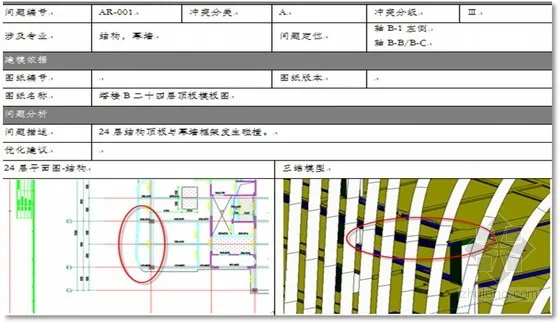
Collision Report Between Curtain Wall and Main Structure
The overall BIM model for Phase I of the Thumb Project is shown below:

Screenshot of the external roaming video of the first phase BIM model
2.4 BIM Collaboration in Bidding and Tendering
The bidding phase is a major milestone in the project, but due to a tight schedule, the entire process lasts about one month. Requiring bidding parties to submit BIM construction phase reports within this timeframe presents challenges.
Firstly, it is difficult to gauge actual BIM implementation effectiveness in such a short period. Bidders typically rely on internal and external resources to meet requirements, which may not reflect their usual work standards.
Secondly, this increases the workload and complexity for the owner’s evaluation team. To address this, the project BIM team proposed conducting two rounds of pre-bidding assessments.
(1) Round 1: BIM Open-ended Questionnaire and Survey
At this stage, bidders answer open-ended questions based on key BIM challenges relevant to the project and company management system. Answers must be supported by project cases rather than generic online sources.
Following submissions, representative projects are selected for site visits. Inspections focus on BIM work quality and actual pipeline layouts, which relate to BIM application outcomes.
(2) Round 2: Assessment of BIM Practical Application Capability
This stage involves a practical evaluation method tailored to the project’s BIM application, considering the current drawing status.
Assessment methods include modeling, earthwork simulation, concrete quantity calculation, and basement net height evaluation based on initial stage drawings.
Assessment standards and procedures are internally approved, emphasizing fairness and impartiality. The goal is to identify competent bidders, with results producing a relative ranking prior to the formal bidding.
This approach highlights BIM expertise without affecting bidding timelines, allowing bidders to focus on construction technology and business conditions.
Comparing bids reveals each company’s BIM capabilities from multiple perspectives, such as basement concrete quantity calculation.
An investment consulting company calculated concrete quantities from the same 2D CAD drawings using traditional methods as a benchmark.
The benchmark, recognized by the company’s cost control department, was used to assess each bidder’s model-based calculations.
Surprisingly, the concrete quantities from two bidders’ basements were within 1% of the benchmark, exceeding expectations.
This accuracy, with three bidders’ calculations within a 5% error range, greatly increased internal confidence in BIM-based quantity calculations.
2.5 Reflections on BIM Application in Design and Construction Phases
The BIM application direction was set during project conceptualization. To save resources, improve efficiency, and shorten timelines, requirements were established for transferring BIM models from design to construction.
Model planning in the design phase must consider construction factors carefully. Modeling is divided by floors and specialties to ensure models can be extracted accordingly during construction.
Component modeling methods are unified based on construction needs, such as walls and columns by floor, beams by span, and slabs by segmented areas.
These unified rules ensure that design models can be effectively transitioned to construction models.
During implementation, construction factors are fully integrated in the design phase, with the general contractor’s BIM team regularly reviewing design models to address pipeline and installation requirements.
Owners may request adoption or modifications of design models based on the general contractor’s rational suggestions.
3. Summary
The construction drawing phase is nearing completion, and BIM activities for the construction phase are progressing smoothly, though official construction phase BIM application has not yet started.
Based on six months of BIM practice, the authors summarize key insights for commercial real estate projects as follows:
- BIM applications should be tailored to the specific characteristics of each project.
- BIM technology must support core design and construction tasks, generating tangible value to maximize its potential.
- Modeling is a means, not an end; the focus is on leveraging models to create value. Model accuracy must align with application goals and is fundamental to all BIM uses.
- Process reengineering and optimization enabled by BIM are critical and challenging aspects of BIM implementation.
Author: Wan Zuyong, Wu Yaolong















Must log in before commenting!
Sign Up