
On November 10th, China and the United States reached a joint declaration to strengthen climate action. This agreement is based on the principles of common but differentiated responsibilities and respective capabilities, while considering the national conditions of each country. The goal is to effectively confront the climate crisis through cooperation in various areas aimed at reducing carbon dioxide emissions. Both nations appreciate the progress made so far and commit to continuing their joint efforts to enhance the implementation of the Paris Agreement with all parties involved.
Both sides agreed to establish a “Working Group on Climate Action for the 2020s” to promote cooperation and advance multilateral processes on climate change between the two countries.
The following is the full text of the Glasgow Joint Declaration between China and the United States on Strengthening Climate Action in the 2020s:
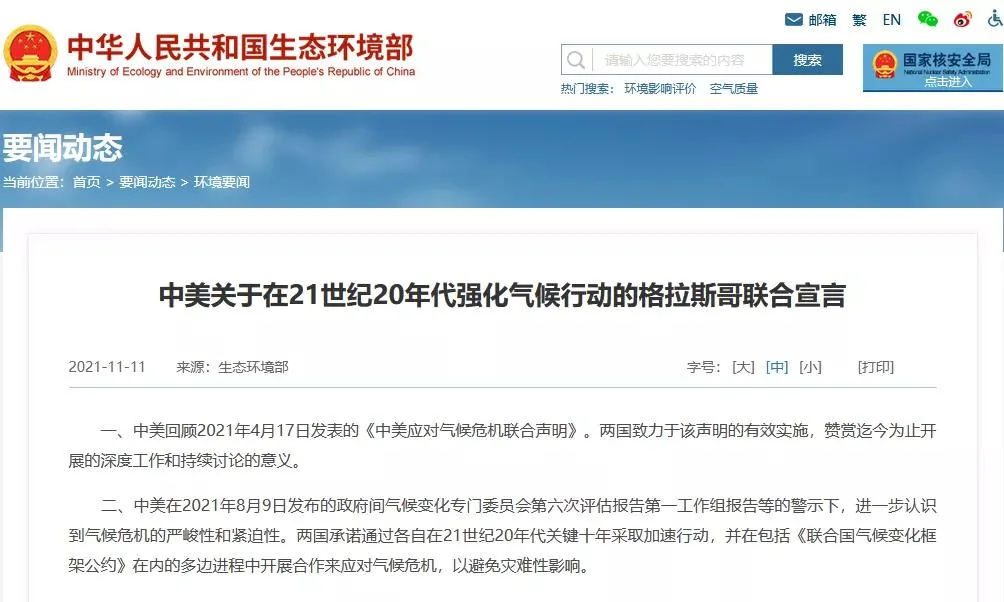
- Review of Previous Commitment: China and the United States reaffirm the Joint Statement on Addressing the Climate Crisis issued on April 17, 2021. Both countries are dedicated to effectively implementing this statement and acknowledge the significance of ongoing in-depth work and discussions.
- Urgency of the Climate Crisis: Following the first working group report of the Intergovernmental Panel on Climate Change’s Sixth Assessment Report released on August 9, 2021, both nations recognize the severity and urgency of the climate crisis. They pledge to accelerate action during this critical decade and cooperate in multilateral frameworks, including the United Nations Framework Convention on Climate Change (UNFCCC), to avoid catastrophic consequences.
- Commitment to the Paris Agreement: Both countries recommit to working together and with other parties to strengthen the Paris Agreement’s implementation. They recall its goal to limit the global temperature rise to well below 2 °C, striving to keep it under 1.5 °C, as outlined in Article 2. They agree to intensify climate actions during the 2020s and cooperate in identifying and overcoming related challenges and opportunities.
- Closing the Gap in Climate Efforts: While welcoming global efforts addressing the climate crisis, both sides acknowledge a significant gap between current actions and what is needed to meet the Paris Agreement goals. They emphasize the urgency of closing this gap through enhanced and accelerated climate action, tailored to national circumstances, individually, jointly, and with other countries. This includes advancing green and low-carbon transitions and promoting climate technology innovation.
- Accelerating the Global Net-Zero Transition: Both parties commit to leveraging this critical moment to expand their individual and joint efforts toward a global net-zero economy.
- Emission Reduction Discussions: The two countries intend to continue discussing specific emission reduction measures for the 2020s before and after the 26th UNFCCC Conference of the Parties (COP26). The goal is to ensure temperature targets consistent with the Paris Agreement are met by adopting clear cooperation frameworks, including specific goals, indicators, policies, and measures to significantly enhance emission reductions.
- Areas of Cooperation: Cooperation will focus on:
- Regulatory frameworks and environmental standards for reducing greenhouse gases during the 2020s;
- Maximizing social benefits from the clean energy transition;
- Policies encouraging decarbonization and electrification in end-use industries;
- Key circular economy areas, such as green design and renewable resource utilization;
- Deployment and application of technologies like carbon capture, utilization, storage, and direct air capture.
- Methane Emissions Control: Both countries recognize methane’s significant warming impact and agree that increased action on methane is essential in this decade. They plan to:
- Cooperate to improve methane emission measurements and share information on policies and control plans;
- Promote joint research on methane reduction challenges and solutions;
- The United States has announced its methane emission reduction action plan;
- Develop additional methane control measures at national and subnational levels;
- China will formulate a comprehensive national methane action plan, supplementing its nationally determined contributions, aiming for impactful methane reduction in the 2020s;
- Hold a joint meeting in the first half of 2022 to strengthen methane measurement and reduction, targeting fossil energy, waste industries, and agricultural emissions through standards, incentives, and projects.
- Reducing Carbon Dioxide Emissions: The two countries plan to collaborate on:
- Supporting policies that integrate a high share of low-cost, intermittent renewable energy;
- Encouraging transmission policies to balance electricity supply and demand across large regions;
- Promoting distributed generation policies integrating solar, energy storage, and other clean energy closer to end users;
- Advancing energy efficiency policies and standards to minimize electricity waste.
The United States aims to achieve 100% zero-carbon electricity by 2035.
China plans to gradually reduce coal consumption during its 15th Five-Year Plan period and accelerate these efforts.
- Eliminating Illegal Deforestation: Both countries recognize that ending global illegal deforestation is crucial for meeting Paris Agreement targets. They welcome the Glasgow Leaders’ Declaration on Forests and Land Use and commit to jointly supporting the elimination of illegal deforestation by enforcing respective laws prohibiting illegal imports.
- Ending International Coal Power Support: The two parties review their commitments to phase out international support for coal power projects lacking installed emission reduction facilities.
- Support for COP26 Outcomes: Regarding COP26, both countries support achieving strong, balanced, and inclusive outcomes across mitigation, adaptation, and financial support. They emphasize:
- Commitment to addressing the climate crisis by strengthening Paris Agreement implementation, respecting common but differentiated responsibilities, respective capabilities, and national circumstances;
- The goal to limit global temperature rise below 2 °C and strive for 1.5 °C, with strong actions during this critical decade, including updating 2030 Nationally Determined Contributions (NDCs) and long-term strategies as needed;
- Recognition of adaptation’s importance, including advancing global adaptation goals and expanding funding and capacity-building for developing countries;
- Commitment to basing efforts on the best available science.
- Climate Finance Commitment: Both nations stress the importance of developed countries fulfilling their pledge to collectively mobilize $100 billion annually from 2020 through 2025, supporting meaningful mitigation actions and transparency, in response to developing countries’ needs.
- Finalizing Paris Agreement Implementation: They will cooperate at COP26 to finalize the implementation details of Articles 6 and 13 of the Paris Agreement, as well as establish a common timeframe for nationally determined contributions.
- Future Reporting: Both countries plan to submit their 2035 nationally determined contributions by 2025.
- Establishment of a Working Group: The two sides intend to create a “Working Group on Strengthening Climate Action in the 2020s.” This group will hold regular meetings to tackle the climate crisis and promote multilateral processes, focusing on concrete actions throughout this decade. Activities may include policy and technical exchanges, identifying joint projects, hosting expert meetings, encouraging participation from local governments, businesses, think tanks, scholars, and other experts, exchanging updates on national efforts, assessing the need for further action, and reviewing the implementation of this Joint Declaration.
















Must log in before commenting!
Sign Up