

This platform leverages BIM technology to establish a comprehensive railway engineering information model, creating a BIM-based construction management system that supports every phase of railway engineering projects.
Railway engineering construction involves large-scale operations, stringent standards, complex management coordination, and extended timelines. Traditional management methods often result in information silos and data barriers among different organizational units and construction stages, hindering data sharing, analysis, and the availability of effective management tools during construction.
Construction management is a critical component of railway engineering, directly impacting project quality and safety. Conventional management relies heavily on manual processes, leading to fragmented data, lack of integrated information resources, and challenges in meeting the diverse informational needs of railway construction projects.
By establishing a railway engineering information model based on BIM, the platform creates a BIM-driven construction management environment that integrates various construction phases. It enables data correlation from the outset, encapsulating information within BIM models and dynamically updating data volumes throughout the construction process. Through a closed-loop system encompassing data generation, collection, transmission, analysis, application, and feedback, the BIM models facilitate visualization and transparent information flow. This platform enhances data sharing among project participants, improving management efficiency in quality, safety, cost, and scheduling, and enabling more informed decision-making.
Platform Overview
Introduction
The BIM+construction management platform utilizes a browser-server (B/S) architecture with cloud-based deployment. It integrates the railway engineering entity structure breakdown (EBS) and work breakdown structure (WBS) requirements, using integrated BIM models from detailed construction design as the core. Automatically generated engineering and plan trees link progress, cost, quality, safety, and other construction data. Leveraging the visual and computational strengths of BIM, the platform supports project progress tracking, quality and safety oversight, resource allocation, change management, and more. Additionally, GIS technology integration aids managers in spatial analysis and regional management, facilitating informed decisions, reducing construction changes, shortening timelines, controlling costs, and improving overall quality.
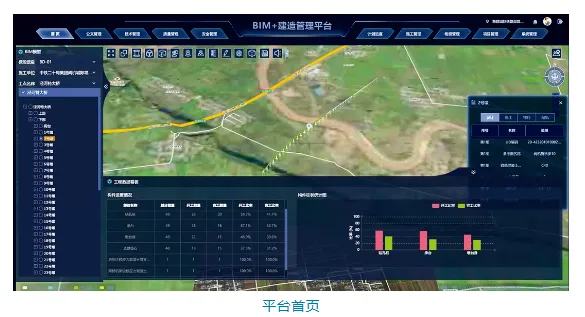
Platform Positioning
Led by the construction unit, this platform primarily serves the construction team while also accommodating design, supervision, and consulting units involved in the project. It offers macro-level oversight of progress, quality, and safety for construction units, provides detailed business modules for comprehensive online construction management, and grants access permissions to other stakeholders as needed.
The platform operates on two management levels: the construction management level and the construction execution level. The construction management level handles high-level oversight by importing specific business data without directly managing construction tasks. The construction execution level offers online tools for managing day-to-day construction operations. The BIM+platform functions at the construction execution level, with data usable for internal applications or integrated into higher-level management systems.
Key Technologies
BIM and GIS Integration
BIM offers visualization, coordination, simulation, optimization, graphical representation, integration, parameterization, and comprehensive information management. Applied to railway construction, it supports design visualization, construction management, progress simulation, and cost estimation.
Combining BIM with GIS spatial analysis creates a 3D engineering construction model embedded within spatial contexts, enhancing supervision and management of construction sites and environments. This integration provides managers with tools for both overall control and detailed spatial management.
Model Lightweighting Technology
The platform uses a pure web lightweight engine based on WebGL technology, which maintains BIM data integrity while optimizing model loading speed. This approach enables BIM models to be accessed quickly on web and mobile devices without the need for specialized software like Revit, Bentley, or Dassault.
WebGL operates plugin-free by leveraging GPU hardware acceleration for rendering. The BIM lightweight engine processes models through digital-analog separation, geometric data optimization, and real-time 3D rendering. For large models, Level of Detail (LOD) techniques prioritize rendering based on spatial positioning, ensuring users initially see the model’s overall contours efficiently.
Virtual Reality (VR) Technology
VR technology creates immersive, interactive 3D environments by simulating dynamic scenes and physical interactions. It enhances user experience by closely matching real and virtual scenes in real-time. The BIM+construction platform integrates VR to allow dynamic site walkthroughs and detailed visualizations of complex construction areas via VR devices or mobile applications.
QR Code Technology
QR codes encode data in black-and-white geometric patterns for easy scanning and interaction. The platform employs QR codes for personnel management, providing access to personal data, roles, and qualifications dynamically, enabling real-time monitoring of workforce deployment and site access.
Additionally, QR codes streamline material management processes—including procurement, warehousing, inspection, and dispatch—replacing manual documentation with efficient, real-time data transmission.
Platform Architecture
Overall Structure
Supported by BIM+, project management, and document management engines, the platform delivers conventional BIM functionalities alongside project management tools. This integration supports intelligent data analysis, comprehensive project oversight, and systematic data accumulation.
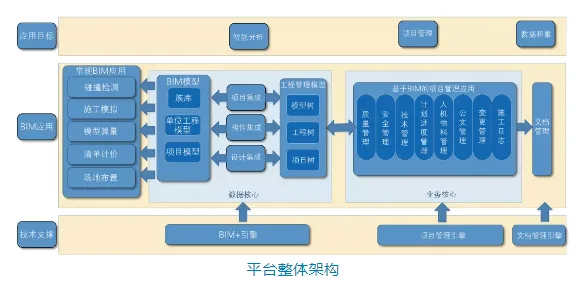
Functional Architecture
The platform aligns closely with existing construction management frameworks, offering robust and diverse management features tailored to site requirements. It supports multi-project oversight and independent management across various sections and construction units within a project.
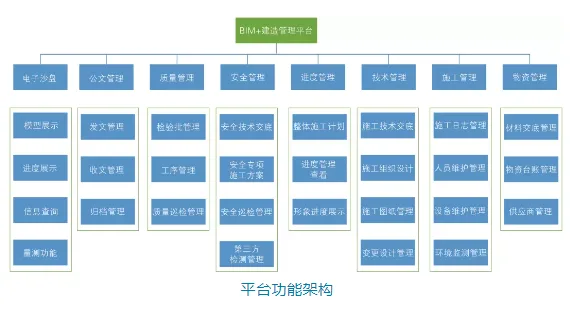
Main Platform Features
Electronic Sand Table
This 3D electronic sand table, based on BIM and GIS technologies, integrates detailed 3D terrain and railway design models from the survey and design phase. It supports digital construction, schedule management, and safety monitoring through various 3D software platforms.
Features include displaying project unit introductions, section details, construction unit and site data, model hierarchies, overall progress, safety and quality issue summaries, news updates, dynamic models, and construction documents. Tools for measurement, positioning, transparency settings, and construction simulation are also provided.
Document Management
The document management system facilitates transmission and archiving of project documents, notifications, and forms, enabling efficient management of communication within and between project units.
Quality Management
Quality management is fundamental to achieving cost, schedule, and quality objectives in railway projects. This module monitors whether each quality control unit meets established standards through inspection batch management, process controls, and quality inspection records.
Functions include unit engineering breakdown, process and material inspection records, defect and accident reporting, quality acceptance, and evaluation—all linked to the BIM model. The system tracks quality assessments and acceptance results, providing timely and accurate project quality information to owners and supervisors.
Below is an example illustrating the quality inspection management process.
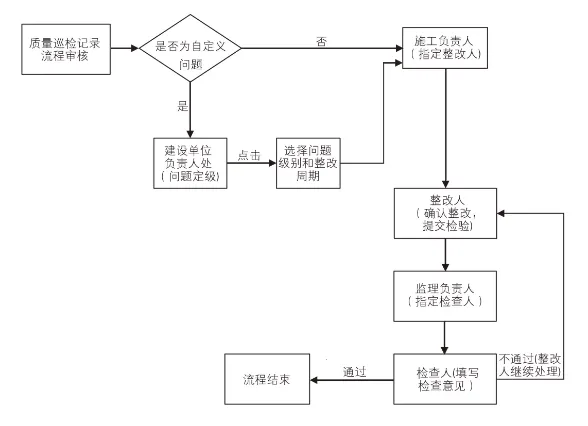
Safety Management
Safety management focuses on controlling unsafe behaviors and conditions to ensure safe construction operations. The platform employs advanced management techniques supported by network and computer technologies to enhance safety supervision.
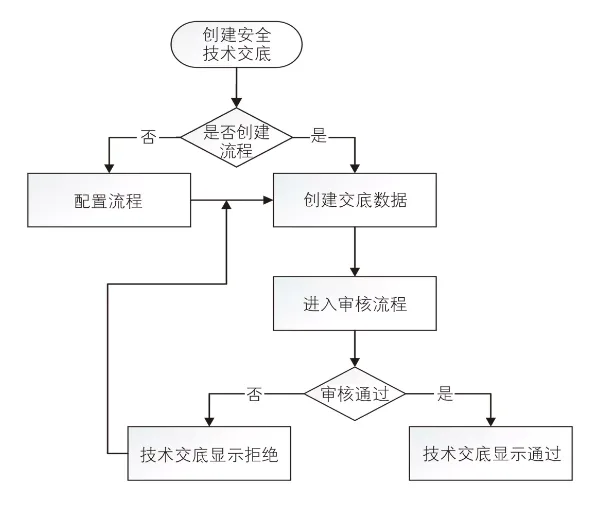
Key modules include special safety construction plans, technical disclosures, safety inspection records, third-party testing management, and video surveillance, all integrated with BIM models. Safety plans are developed for high-risk subprojects; managers provide safety instructions before operations; inspection issues are logged as rectification notices; third-party monitoring data are imported and reported; and on-site video feeds are integrated for real-time monitoring and risk control.
The figure below illustrates the safety technical disclosure review process.
Schedule Management
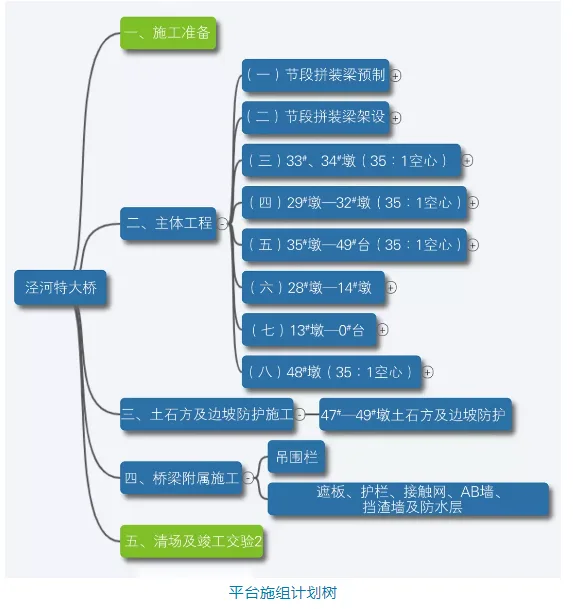
Project schedule management involves creating and managing construction organization plans for each section, aligned with on-site management plans of construction units. Through the platform, management objectives are assigned to specific work points, with real-time progress feedback from each unit.
A construction plan tree is created and linked with the BIM engineering tree for resource allocation, while actual progress is recorded via process management. BIM models visually indicate completed, ongoing, and pending construction phases in different colors, providing clear insights into project status.
Modules include overall construction planning, progress monitoring, progress visualization, quantity tracking, and output value viewing.
Technical Management
Technical management refers to the scientific oversight of all technical activities during project construction. It encompasses basic construction technology, process management, and documentation of technical development and summaries.
The platform includes modules for commencement reporting, construction planning, special construction schemes, operation manuals, technical disclosures, and drawing management, all linked to BIM models to streamline technical oversight.
Construction Management
Construction management includes modules such as construction log entries, operation team management (personnel and equipment), and environmental monitoring. The construction log records work details, weather, inspections, safety and environmental measures, personnel, and machinery usage.
Operation team management employs QR code technology for dynamic tracking of personnel and equipment. Environmental monitoring records weather and environmental conditions to support sustainable construction practices.
Material Management
Materials and machinery typically account for over 60% of railway project costs, making material management critical. The platform strengthens information network systems to connect material management with various construction phases, facilitating accurate transmission of material data, cost control, and centralized procurement through efficient information sharing.
Key material management modules include material disclosure, material information, supplier management, ledger management, and inventory control. Material disclosure and ledger management are integrated with BIM models.
Mobile App Features
The mobile app allows users to access construction materials data, perform inspections, collect evidence, and record concealed works anytime, anywhere. This reduces communication workload and minimizes human errors compared to manual methods.
The app covers essential management services such as process inspection, quality and safety checks, drawing centers, news updates, document management, technical disclosures, and VR project previews. It supports data synchronization with the PC platform, enabling seamless on-site business operations. Through the BIM center combined with VR technology, users can browse project BIM models on mobile devices, viewing design and construction information.
Engineering Applications
The BIM+construction management platform has been successfully implemented in projects including the Yanliang Airport Intercity Railway Jinghe Extra Large Bridge, Kuge Railway Qianruo Station, Xi’an Famen Temple Intercity Railway Hanzhongcun Extra Large Bridge, and Xi’an Hancheng Intercity Railway Weipu Expressway Overpass Extra Large Bridge. It has also been piloted in highway projects like the Dahengqinshan Tunnel (Phase I) and the Black and White Faced Jiangjunshan Tunnel, and is currently being promoted on the Sichuan-Tibet Railway and the Xicheng Railway.
By using an integrated BIM model as the core, the platform links progress, cost, quality, and safety data throughout construction. Its visual and computable BIM features support project progress, quality and safety management, while GIS integration enhances spatial data analysis and decision-making. This results in reduced construction changes, shortened schedules, cost control, and improved quality.
As a hierarchical construction management platform led and dominated by the construction unit, the BIM-based railway engineering construction management platform delivers refined management across construction processes, quality and safety, scheduling, and site monitoring. It combines BIM data with 3D geographic information for integrated management and analysis, significantly elevating construction management standards.
















Must log in before commenting!
Sign Up