
Abstract The Shaoxing Sports Convention and Exhibition Center Stadium is situated in Kebei New City, northwest of Shaoxing City. It covers a total construction area of 77,500 square meters and accommodates 40,000 spectators. The stadium features a retractable roof with an opening area of 12,350 square meters, making it currently the largest open-and-closed sports stadium in China.
1. Project Background
Project Name: Shaoxing Sports Center Stadium
Design Unit: Beijing Institute of Architectural Design and Research Co., Ltd.
The Beijing Institute of Architectural Design and Research Co., Ltd. (BIAD) specializes in urban planning, investment planning, large-scale public building design, civil building design, interior decoration, landscape design, intelligent building system engineering design, project budgeting, supervision, and general contracting. Since its founding in 1949, BIAD has completed architectural designs totaling over 150 million square meters. From 1977 to the present, its projects have received 1,166 awards. The Beijing Municipal Government honored BIAD as a “Capital Architectural Design Outstanding Contribution Design Research Unit.” With 12 branch offices nationwide, its architectural projects span 31 provinces, municipalities, and autonomous regions.
Related Software and Solution:
Autodesk Revit Architecture
Autodesk Revit Structure
Autodesk Revit MEP
Autodesk Navisworks
AutoCAD
BIM Application Evaluation and Feedback:
“BIM technology represents a revolutionary trend in global architectural design. As a leading Chinese construction firm in the 21st century, it is essential for us to learn, master, and apply it for the benefit of humanity.”
— Xu Quansheng, General Manager, Beijing Institute of Architectural Design and Research Co., Ltd.
“Autodesk BIM software integrates visual modeling, information technology, and parametric design. We will continue to enhance the integration of these aspects in our future work.”
— Gan Ming, Deputy Chief Engineer and Professor-level Senior Engineer, Beijing Institute of Architectural Design and Research
“Every structural engineer must keep pace with the times. In the 21st century, Chinese structural engineers should master BIM technology alongside their current design tasks to stay competitive.”
— Gan Ming, Deputy Chief Engineer and Professor-level Senior Engineer, Beijing Institute of Architectural Design and Research
2. Main Text
BIM Application in Shaoxing Sports Center Stadium
Project Overview
The Shaoxing Sports Convention and Exhibition Center Stadium, located in Kebei New City northwest of Shaoxing City, spans 77,500 square meters and seats 40,000 spectators. Its retractable roof covers an opening area of 12,350 square meters, currently the largest of its kind in China. The roof’s elliptical projection measures 260 meters along the major axis and 200 meters along the minor axis. The roof consists of fixed and movable parts: the movable roof uses a flat truss system, while the fixed roof features a spatial truss system with four main trusses, secondary trusses, and ring trusses arranged in a “well” shape. The lower structure is made of reinforced concrete frames and cylinders, divided into four independent units by structural joints at the main entrance.
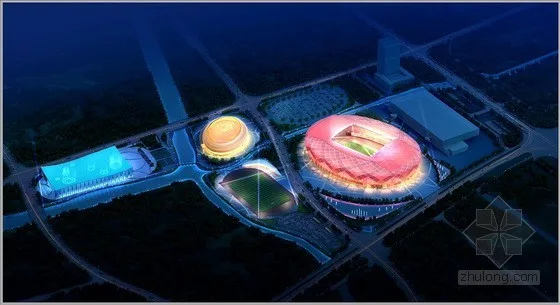
Figure 1: Aerial view of Shaoxing Sports Stadium
Project Challenges
The project had a compressed design cycle, with only three months from initial design to completion of construction drawings. The stadium’s large retractable roof covers 12,350 square meters. Additionally, the client required the steel roof to weigh no more than 300 kg/m². Typically, seamless data exchange between different software is difficult, resulting in excessive repetitive work.
Solution
Parametric Design of Roof System
Parameterization is a core principle of BIM technology. It transforms models from static objects into dynamic entities defined by parameters, rules, geometries, and other attributes. These parameters enable automatic updates based on user input or environmental changes. The stadium’s exterior was modeled using Rhino/Grasshopper parametric tools, with the roof steel structure geometry further parameterized. This foundation allowed for rapid optimization of the steel structure design.
Using parametric models greatly simplified roof system revisions. The initial design required 23,000 tons of steel. In the second iteration, the main truss arch height was raised, reducing steel to 12,000 tons. The architect considered this arch height too high, so the third iteration reverted to the original height with an optimized structure using 13,000 tons of steel. Although the arch height was satisfactory, the fixed roof displacement was excessive, hindering the movable roof’s operation. The fourth iteration increased main component sections and slightly raised the arch height, maintaining steel usage at 13,000 tons while meeting displacement requirements.
Application of Database Technology
Project design involves the flow and exchange of building information across various software, but data exchange is often limited, causing redundant “secondary modeling.” This project introduced database technology as a medium facilitating free data exchange between multiple software tools.
Multiple BIM models were created for the Shaoxing Sports Center Stadium using databases and software interfaces, as illustrated in Figures 2–8.
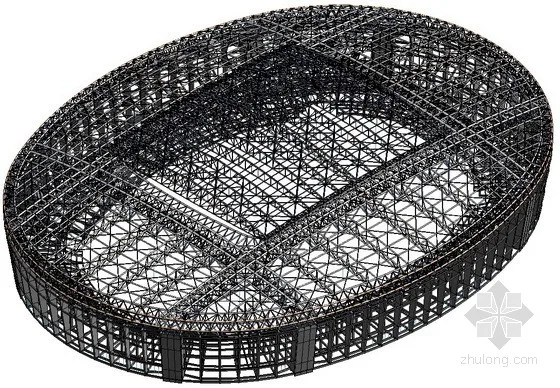
Figure 2: Revit structural model
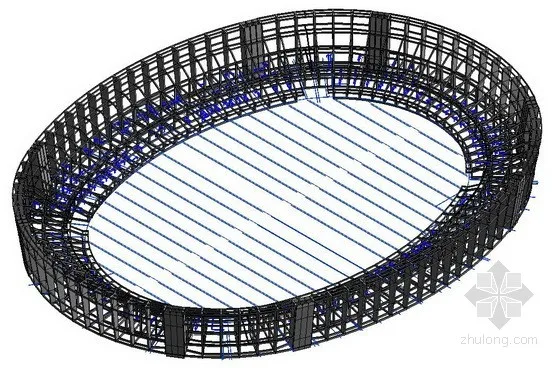
Figure 3: Lower structure and Revit MEP system model
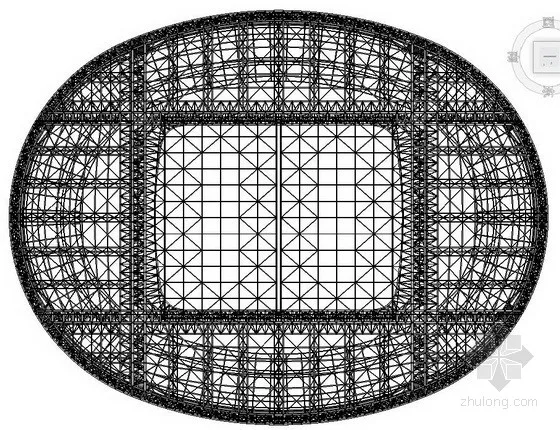
Figure 4: Revit model plan
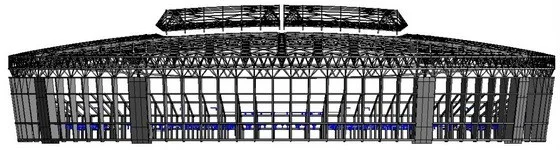
Figure 5: Revit model elevation view
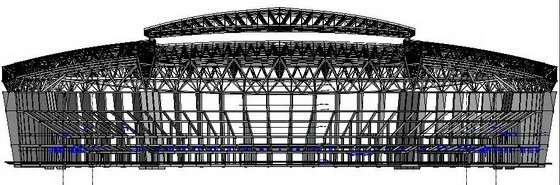
Figure 6: Revit model section
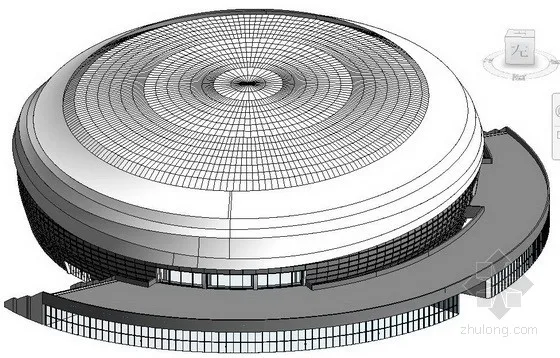
Figure 7: Revit building model
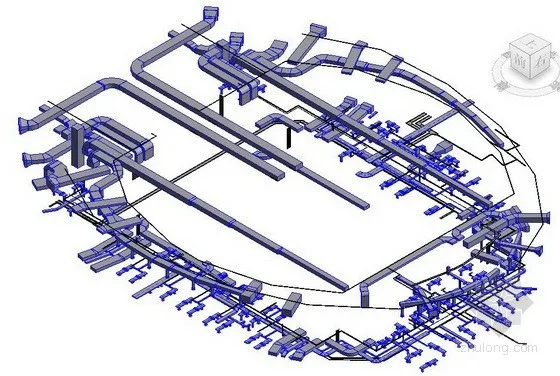
Figure 8: Revit MEP model
Finite Element Analysis and Dynamic Elastoplastic Modeling
The CATIA node models can be directly imported into ABAQUS for finite element analysis. Stress results for typical nodes were obtained, and database information was used to generate input files for dynamic elastoplastic analysis in ABAQUS.
Wind Tunnel Simulation
Using Fluent, numerical wind tunnel simulations were performed by importing nodes and surface elements from the structural database into Gambit for preprocessing. Seven states of the movable roof were simulated, analyzing eight wind direction angles per state. For the semi-open roof, the wind direction angle was set at 45 degrees.
Automated Node Modeling
A steel structure node modeling system was developed for automated batch creation of steel node models. Using databases and custom programs, various node models were generated automatically. Detailed BIM steel structure models were assembled by combining node models with steel components.
Construction Drawings
Although 3D modeling is widely used, final design submissions still rely on 2D drawings. Complex modern architecture cannot be easily represented through traditional drawings alone. However, 3D models enable automated generation of 2D plans, elevations, and sections. After slight adjustments to meet drawing requirements and manual annotation, the system produces highly accurate and consistent drawings, greatly enhancing design quality and efficiency.
Material Quantity Calculation
Traditionally, steel weight estimates rely on structural analysis data, with node weights estimated between 5% and 15% based on experience. With a complete BIM structural model including all steel nodes for Shaoxing Sports Stadium, accurate steel consumption statistics can be easily generated.
Autodesk Navisworks Collision Detection and Roaming
1) Collision Detection
Autodesk Navisworks integrates design documents from various formats into compact model files, allowing comprehensive multi-disciplinary analysis.
Collision detection was used to avoid major errors. Initially, the main truss lower chord was designed as a single 500mm diameter steel rod. The architect found this cross-section too large and proposed two rows totaling eight thinner steel bars. Collision detection revealed conflicts with the upper row, leading to a final solution of four 310mm diameter steel bars.
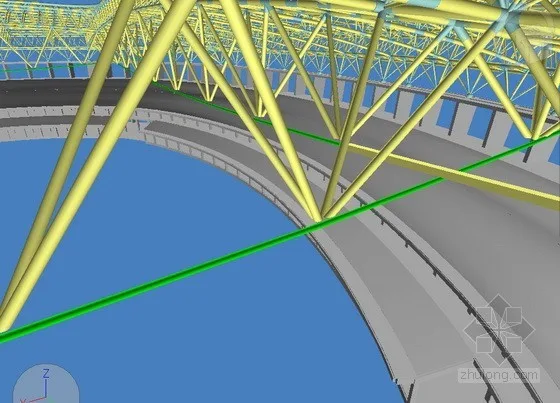
Figure 9: Lower chord with a single thick steel rod
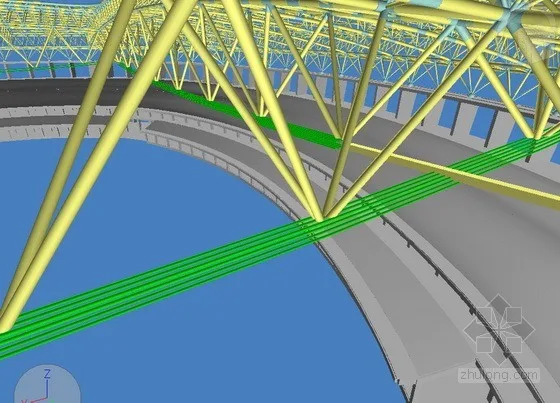
Figure 10: Lower chord with eight thinner steel bars
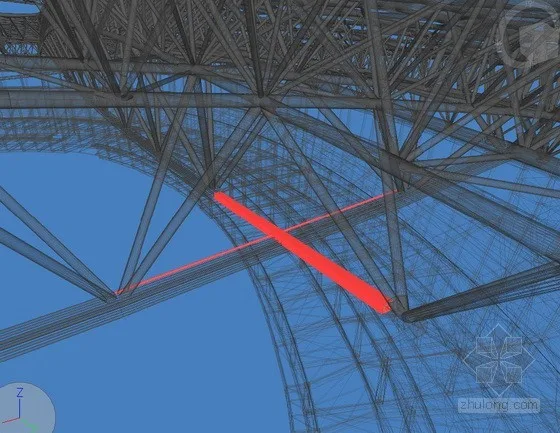
Figure 11: Collision detection results
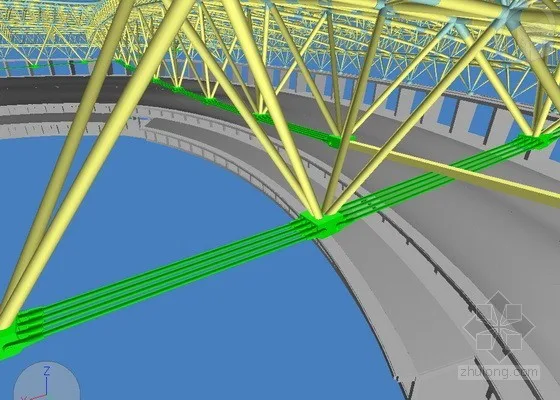
Figure 12: Final lower chord with four steel bars
2) Roaming
Roaming applies virtual technology to urban planning and architectural design, enabling immersive, interactive 3D visualization of future buildings. Early use of Autodesk Navisworks’ 3D model roaming helps identify design issues promptly, preventing costly late-stage changes.
Conclusion
A crucial goal of BIM implementation is seamless information exchange between diverse software. This project introduced a BIM database to facilitate software data interface development, achieving efficient data exchange, reducing redundant work, and enhancing project quality and efficiency. Autodesk products were instrumental in green building analysis, BIM model creation, and construction drawing guidance. The bidirectional interface between Autodesk Revit and the database greatly improved information transfer efficiency. Using CATIA/DP secondary development, a comprehensive structural model including all nodes was created via the BIM database, streamlining communication with architects and significantly reducing drawing workload. This project represents an early, proactive exploration of BIM technology by the Beijing Institute, providing important guidance for future applications.
















Must log in before commenting!
Sign Up