
Abstract: Building Information Modeling (BIM) is increasingly being adopted in architectural design due to its intuitive interface, collaborative capabilities, and versatile application of parameters and information. Using a specific airport terminal building as a case study, this article presents the application of BIM in comprehensive pipeline design. It explores and evaluates the design outcomes and future directions for BIM application, summarizes existing challenges and difficulties, and proposes corresponding solutions.

1. Project Introduction
The airport terminal building under study features few floors, a large single-floor area, and high ceilings, with no uniform layers for the pipelines. Each square meter varies, with large main pipelines serving both departure and arrival floors located beneath the second-floor slab. Inaccurate or unreasonable pipeline integration can reduce ceiling height in passenger public areas and cause costly demolition and renovation during construction, resulting in economic losses and schedule delays. Consequently, the comprehensive design of terminal pipelines is more complex, challenging, and critical compared to typical civil buildings.
This article focuses on the comprehensive pipeline design of a southern airport terminal to explore BIM applications in this field. The goal is to deepen understanding of new design methods, applicable areas, and the advantages and disadvantages of various software through practical project experience. The terminal consists of three main parts: the main building, the west pier, and the connecting pier. The plan is L-shaped, covering a total construction area of 72,097 square meters. The main terminal building has two above-ground floors, with concrete frame structures below the second floor and steel structures above.
2. BIM Application Status in This Project
2.1 BIM Software Used
AutoCAD (2010-2013, 64-bit), MagicCAD (for AutoCAD, version 2012.11, 64-bit), and Navisworks Manage (2012, 64-bit) were employed for this project.
2.2 Objectives for Using BIM Technology
BIM technology guided the adjustment and optimization during the project design phase, producing a sustainable BIM model and corresponding construction drawings. This model was directly utilized during construction for further optimization and detailed design development (see Figure 1).
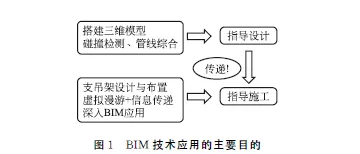
This project implemented continuous BIM model usage throughout design and construction phases, moving beyond the traditional “design-first, model-second” approach. This enabled new BIM applications such as comprehensive pipeline support and hanger design, along with installation process simulations.
2.3 BIM Design Workflow
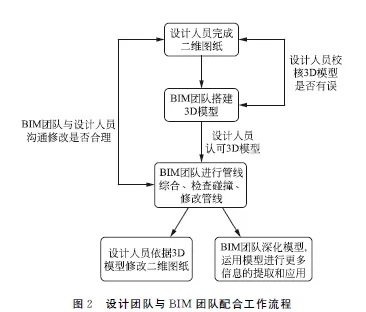
Given this institute’s first comprehensive BIM application and considering the designers’ limited familiarity with the software alongside tight schedules, an organized collaboration was established between a professional design team and a dedicated BIM technology team (see Figure 2). The advantages of this approach include the BIM team’s software expertise and rapid modeling speed, reduced workload for collision detection due to relatively complete 2D drawings and preliminary main pipe integration, and efficient model optimization.
However, drawbacks include some repetitive work during 2D-to-3D conversion and occasional difficulties by the BIM team in fully understanding 2D drawings, requiring designers to spend significant time on proofreading.
3. Results
3.1 Comprehensive Pipeline Integration and Clash Detection
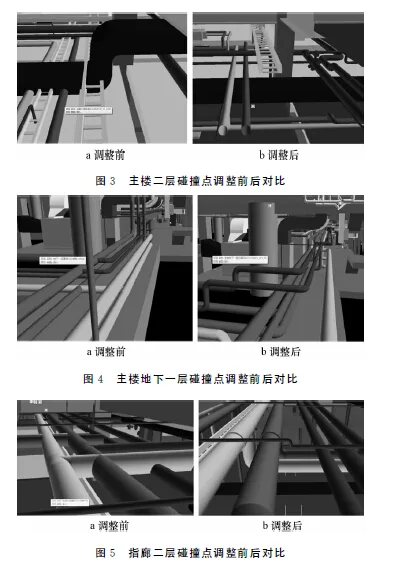
The BIM team developed a model based on graphic drawings, performed clash detection and pipeline synthesis, and automatically generated numerous sectional views that update in real time during the process. Issues identified during these steps were promptly communicated to the design team, enabling collaborative optimization of the workflow drawings. BIM technology greatly aided the design team’s understanding of the terminal’s complex spatial layout and three-dimensional node relationships, opening opportunities for further optimization such as maximizing space utilization.
In traditional 2D design, pipeline collision adjustments during construction typically account for at least 10% of the total project quantity, with some individual modifications reaching 15-20%. With BIM, collisions were detected and resolved promptly, achieving zero clashes. Figures 3 to 5 illustrate examples of typical collision adjustments.
3.2 Material List Comparison
Traditional 2D design relies on semi-manual material list compilation, subject to varying accuracy based on equipment and pipeline characteristics. Smaller pipes and components are often underestimated. The process requires significant labor and time; for this project, four professionals typically spend 3-5 days compiling the list. In contrast, BIM automatically generates accurate material lists upon model completion, eliminating manual efforts.
This project compared material lists generated from BIM models and traditional methods, revealing:
(1) Differences in main pipe quantities were minor (±5-15%), while branch pipes showed larger discrepancies (±20-40%), sometimes exceeding 50%, due to traditional methods relying more on estimation for smaller pipes.
(2) The BIM software used supports automatic counting for water pipes and cable trays but lacks accurate statistics for rectangular ducts, requiring manual calculation or estimation.
(3) BIM models enable separate counting of individual components like elbows, reducers, and tees, but unmodeled items such as cables, pressure gauges, thermometers, water dispensers, and switches are excluded.
(4) Traditional methods account for material loss but cannot predict increases from bending; BIM accurately calculates total quantities but not loss.
(5) BIM material statistics differ from current Chinese engineering quantity rules but provide valuable reference for construction bidding and preparation.
(6) Early modeling errors propagate to material list inaccuracies.
3.3 System Pressure Verification
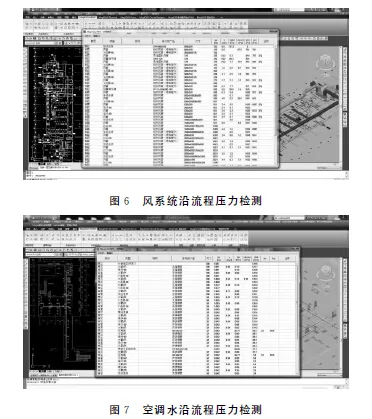
Pressure verification calculations are vital during design and construction phases for equipment selection and pipeline review. This project performed pressure verification on adjusted systems using BIM models to assess whether originally selected equipment such as fans and pumps required modifications. Results are shown in Figures 6 and 7.
3.4 Installation Process Simulation
Using Navisworks, the installation process was simulated in the basement computer room area to assist the construction team in planning subcontracting workflows and avoiding rework. The construction party can further simulate complex pipeline areas independently using the BIM model provided.
3.5 Comprehensive Support and Hanger Design
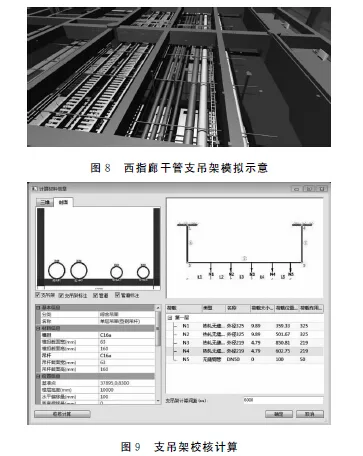
This project explored the design of comprehensive pipeline supports and hangers, including layout, selection, and verification calculations. BIM greatly enhanced practical model applications by validating selection results to ensure safety and practicality while reserving appropriate margins. This approach reduces material waste caused by excessive allowances in traditional experience-based designs (see Figures 8 and 9).
3.6 Walkthrough Animations and Rendering
3D models enable creation of walkthrough animations and installation process simulations, which are highly effective for owner communication, construction guidance, and project presentation.
4. Performance Evaluation
4.1 Key Benefits of BIM Design and Application
The value and application of BIM vary among design, construction, and operational stakeholders. This section evaluates BIM’s impact mainly from the design perspective.
4.1.1 Intuitive BIM Models
3D models visually represent relationships among mechanical and electrical equipment, pipelines, and structural elements, simulating post-construction effects. Benefits include:
- Helping MEP designers understand complex architectural spaces;
- Optimizing building space utilization for pipeline integration;
- Ensuring adequate installation space to avoid construction-stage shortages;
- Detecting and resolving pipeline collisions to achieve zero clashes;
- Simulating processes to reduce rework and optimize material and labor scheduling.
4.1.2 Collaborative BIM Design
Traditional coordination relies on continuous data exchanges among disciplines, which can lead to unclear responsibilities, version confusion, content loss, and increased workload for base map updates, especially in large projects. Collaborative BIM design enables real-time adjustments on a unified platform, significantly improving design efficiency.
4.1.3 Multidimensional Parameters and Information
BIM’s greatest value lies not just in 3D visualization but the rich information attached to each model element. This includes:
- One-to-one correspondence between objects and their parameters, enabling automatic updates;
- Extraction and processing of data such as material quantities and system performance calculations.
BIM models evolve from design through construction to final operation, with each stakeholder adding or extracting information to meet their needs, making BIM a versatile, multidimensional platform.
4.2 Challenges and Solutions in BIM Design and Application
Several issues emerged during BIM implementation. After discussions between design and BIM teams, preliminary countermeasures were identified.
4.2.1 Extended Design Timeline
Developing comprehensive 3D models with detailed parameters and information demands more effort than traditional design. Additionally, recurring collision detection necessitates frequent model and drawing updates, lengthening the BIM design cycle.
4.2.2 Complex Modifications and Higher Error Risk
BIM objects require more parameters, making design changes more complex and error-prone than in 2D. Mechanical and electrical designs are sensitive to cross-disciplinary changes. Experience from this project suggests starting 3D BIM modeling only after core designs are substantially complete.
4.2.3 Impact of BIM Model Scope on Design Duration
If BIM use is limited to pipeline integration, clash detection, and spatial visualization—mainly 3D functions—the model can be roughly constructed with relaxed accuracy and fewer parameters, focusing on main equipment and pipes. This approach supports design assistance with shorter timelines but limits BIM’s full potential.
In contrast, detailed BIM modeling for advanced data extraction (e.g., material quantities, pressure verification) requires accurate, comprehensive models. Early attribute errors affect downstream outputs and can be difficult to correct. For operational handover, models must include final equipment data, further increasing time and effort.
4.2.4 Recommended Responses
- Establish long-term collaboration with BIM teams to align design intent and improve drawing interpretation;
- Provide BIM software training to designers, transitioning from collaboration to direct BIM-based drawing production;
- Simplify BIM models according to final application depth to reduce modeling time and revision workload.
5. Conclusion
BIM’s significance in construction engineering is clear and represents an industry trend. For this project, both the design institute and construction party recognized the value of the BIM outputs. However, the design institute invested more resources compared to traditional methods. From a design perspective, selecting software should balance leveraging BIM’s multidimensional data benefits without compromising design efficiency.
(Authors: Tian Jing, Ge Weijiang, China Civil Aviation Airport Construction Group Corporation)














Must log in before commenting!
Sign Up