
Since the onset of winter, many regions in China have been plagued by severe haze, with PM2.5 levels far exceeding safety standards. The capital city has even issued its first-ever red haze warning. In a CCTV interview, Mr. Zhong Nanshan from the Chinese Academy of Engineering emphasized that air pollution is far more alarming than SARS. Unlike SARS, which can be contained, no one can escape the pervasive effects of air pollution. Indeed, personal improvement is impossible without breathing in such an environment.
Currently, opinions differ on how best to tackle this smog—an issue arguably more terrifying than SARS itself. With rising living standards, household waste generation has increased dramatically. Relying solely on landfills for waste disposal not only consumes vast land areas but also exacerbates pollution. This has led to the emergence of waste-to-energy (WTE) technologies.
Waste-to-energy processes transform garbage into valuable energy. They fully harness the heat value of waste while uniformly treating harmful combustion byproducts via flue gas treatment systems, thereby reducing environmental pollution. This method offers a feasible solution to alleviate haze problems. Recognizing this, the government places increasing emphasis on the sustainable development of household waste-to-energy plants, with various projects poised for launch.
However, designing these plants presents challenges, including managing extensive pipelines and meeting complex equipment layout requirements. Relying on traditional design schemes often results in repeated revisions and wasted resources, counteracting green and emission-reduction goals. The construction industry is thus making significant efforts to combat smog.
Among these efforts, the Shanghai Laogang Renewable Energy Utilization Center stands out, attracting widespread attention. This project utilized Building Information Modeling (BIM) technology for its construction design, achieving green building practices along with energy conservation and emissions reduction. It has earned high praise from Shanghai’s relevant leadership departments.
We call for more sustainable development projects like this to secure cleaner air for future generations.
Below, we explore how the Laogang project leverages BIM technology to achieve energy savings and reduce emissions.
Project Overview
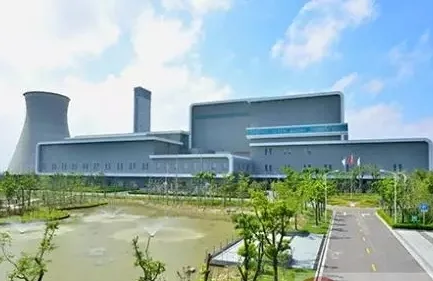
The Laogang Renewable Energy Utilization Center is situated in the southeast corner of the Laogang Solid Waste Comprehensive Utilization Base, west of Embankment 0 in Pudong New Area, Shanghai, and north of Xuanhuang Highway. It occupies a construction land area of 159,898 square meters, with a total built-up area of 49,805 square meters. The facility’s waste treatment capacity is 1 million tons annually, with a designed annual power generation of 325.2 million kWh. The total investment amounts to approximately 1.48 billion yuan. In terms of investment, construction size, and power output, the Laogang Center is currently the largest waste-to-energy plant in Asia.
Project Challenges
The domestic waste power plant must meet stringent power generation industry standards, facing several challenges:
1. Factory Design and Equipment Layout: The layout demands centralized, reasonable equipment distribution within a complex spatial environment. Key design requirements include:
- Maximizing process efficiency and equipment maintenance accessibility;
- Optimizing the building’s area and volume;
- Allowing flexibility for future expansion;
- Ensuring compliance with labor safety and industrial hygiene regulations.
2. Complex Pipeline Systems: The plant involves numerous systems with large-diameter pipelines, diverse pipe types, intricate routing, and dense equipment placement. The site features a dense and tall layout, with the highest point exceeding 20 meters. The air duct system covers 180,000 square meters, with the largest ducts measuring 1200mm by 800mm, posing significant installation challenges.
3. High Project Standards: As a flagship project in Shanghai, the plant is set to be Asia’s largest domestic waste-to-energy facility, establishing a benchmark for similar future projects. Consequently, quality standards are exceptionally high.
BIM Implementation Process
1. Software Selection
For the mechanical and electrical design, the BIM team evaluated several leading BIM software options. After comparing features against project needs, the final comparison was between Autodesk Revit and Guanglianda Software Co., Ltd.’s MagiCAD for AutoCAD (see Table 1), selecting the most suitable software.
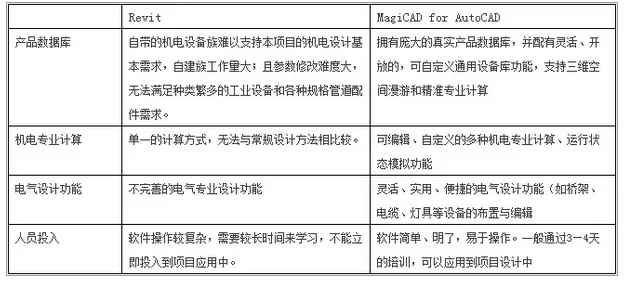
Table 1: Comparison between Revit and MagiCAD for AutoCAD
Guanglianda’s MagiCAD for AutoCAD was chosen for mechanical and electrical engineering BIM design. A dedicated BIM team was formed to focus on this work. The software trainer from Guanglianda conducted an intensive three-day training session covering MagiCAD operation. Given the high standards for mechanical, electrical installation, and process equipment design, the team aimed not only to resolve typical BIM issues like pipeline collisions and layout coordination but also to perform hydraulic calculations, simulate system operation, and produce construction drawings from the BIM models.
Training emphasized not only basic modeling and mechanical-electrical design applications but also the extensive database of mechanical and electrical equipment components within MagiCAD. This resource supports advanced functionalities such as equipment selection and system verification—streamlining work and enhancing efficiency for future BIM projects.
2. Project Application
1) 3D Modeling
At the project’s early stages, the BIM team used MagiCAD to carry out intuitive and efficient 3D design (see Figure 1). Teams were organized by specialty—HVAC, electrical, plumbing, thermal engineering, and others. Initial coordination determined elevation ranges per discipline. Then, each specialty modeled their components separately using MagiCAD, followed by collaborative integration and clash detection.
Due to the unique size and characteristics of equipment across industries, standard 3D product libraries lacked suitable components. MagiCAD’s extensive library, containing millions of product parts, allowed the team to accurately place real equipment models within the 3D environment. This ensured that the dense equipment and pipeline layout met both spatial constraints and design requirements.
2) Clash Detection
Clash detection followed a systematic approach:
- First, detect clashes within each specialty and resolve them;
- Next, detect clashes in the combined electromechanical model and resolve these;
- Finally, detect clashes between electromechanical systems and building structures.
MagiCAD offers one-click report generation for internal clashes, external references, and AutoCAD entity collisions (see Figure 2). Based on these reports, design adjustments were made through comprehensive review, greatly enhancing model quality.
3) Resolving Critical Issues
Collision detection generated detailed reports, which the BIM team reviewed through group discussions to prioritize issues. Due to numerous intersecting pipelines, especially water-related ones, many detected clashes were minor. Without prioritization, adjusting minor issues first often left major clashes unresolved. MagiCAD’s ability to filter water system pipes by diameter enabled the team to classify collision importance effectively, focusing on key conflicts for timely resolution.
4) System Simulation and Debugging
After finalizing pipeline layouts, the BIM team simulated system operation using MagiCAD’s calculation functions. Real product components within the model allowed for accurate simulation of equipment behavior, such as valve positions. This process helped optimize the system design, achieving energy-saving and environmentally friendly outcomes beyond traditional detailed design methods.
Project Outcomes
The Laogang Renewable Energy Utilization Center project demanded significant effort from the BIM team but yielded impressive results. With Guanglianda MagiCAD software, the design phase was shortened by nine months. The detailed model design saved millions in costs while promoting energy efficiency, emissions reduction, and environmental protection. This project effectively responded to national initiatives and demonstrated the value of advanced BIM applications.
Author: Zhang Xinsheng / China Wuzhou Engineering Design Group Co., Ltd.














Must log in before commenting!
Sign Up