
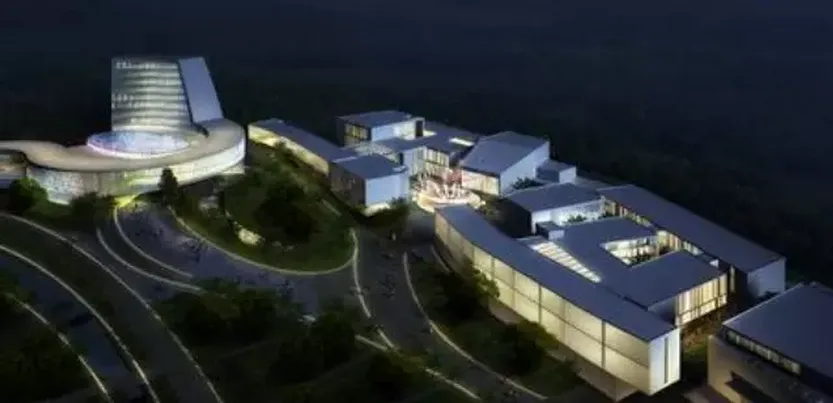
Constructing a world-class modern music hall in China has long been a dream for the people of Zhejiang. However, the project’s initiation, site selection, and design process were notably rushed. When the general contracting contract was signed on August 15, 2013, only two years remained before the hall was scheduled to open in autumn 2015. Transforming 602 acres of old land into a new cultural landmark with 20 individual buildings covering a total area of 320,000 square meters was undeniably a race against time. The construction journey promised to be both challenging and demanding.
Racing Against Time with Scientific Organization
The Zhejiang Conservatory of Music campus comprises 20 separate projects, all under a tight two-year construction schedule. This timeframe was further constrained by the ongoing operation of a driving school on-site during the early stages. The project’s complexity was increased by its frequent use of irregular structures to achieve artistic effects, leading to numerous design changes. The overall project involved multiple parties: 14 specialized subcontractors handling architecture, structure, installation, electrical systems, stage design, decoration, landscaping, and municipal engineering.
Faced with these challenges, the construction group and project department seized the opportunity to prepare early. Planning and deployment began during the bidding phase, including repeated on-site surveys and detailed discussions addressing the project’s specific difficulties. After securing the contract, the construction team promptly mobilized, coinciding with the relocation of the existing driving test center—marking the official start of the construction effort.
Meeting the demands for high-level planning, superior design, and outstanding construction quality, Lu Youmin personally oversaw the design and building of a garden-style residential area and an elegant office space. He also perfected five auxiliary facilities, setting a benchmark for excellence. At first glance, one can immediately sense the remarkable capability and strength of Zhejiang Construction Engineering.
Strong On-Site Leadership and Management
To efficiently manage this large-scale project, key leaders including Lu Youmin, Xu Xiping, Zhang Haibo, Jiang Lianghai, and Wang Hancheng remained on-site throughout the construction to direct operations. Recognizing the complexity of group engineering, the project department focused on establishing a solid organizational structure and enhancing project management.
This involved concentrating on institutional management and refining project workflow. Innovative and detailed general contracting management rules were developed, introducing a three-tiered management system. The general contracting management department acted as the command center; the comprehensive engineering departments of the South and North regions handled on-site production management; and construction labor teams along with various specialized subcontractors formed the operational base.
Leveraging information management tools, the project standardized management processes, implemented thorough responsibility assessments, and established reward and penalty mechanisms. This approach motivated every management member to take ownership and innovate, creating an environment conducive to seamless coordination and command throughout the entire project.
Mobilizing for Construction and Labor Competition
In early September 2013, following the complete handover of the site from the driving school to the project team, a construction mobilization meeting was held. Management was urged to “understand overall objectives, prioritize key tasks, resolve critical conflicts, clarify responsibilities, boost efficiency, and foster a spirit of dedication.” They were also instructed to “prepare thoroughly in advance, maintain pace consistency, act decisively, strictly monitor and refine processes, and synchronize progress and settlement.” This marked the official launch of the construction battle.
Beginning in January 2014, a “three comparisons” labor competition was initiated, focusing on progress, quality, and safety. Over two years, construction workers sacrificed holidays and remained on-site, driving continuous production peaks. Despite facing extreme weather — including an unusually hot summer in 2013, a harsh winter in early 2014, and persistent rains in spring 2015 — the project met all phased construction goals.
In recognition of its achievements, the project was honored with the title “Zhejiang Province Key Merit Competition Demonstration Project” by the Provincial Federation of Trade Unions.
Commitment to Outstanding Quality
Quality is paramount for a first-class music hall. From the outset, the project department set ambitious targets: winning the Qianjiang Cup and striving for the prestigious Luban Award. Through the use of BIM technology and QC management methods, quality control was integrated throughout every stage — from design optimization and material procurement to construction organization and finished product protection.
Led by chief engineer Zhang Haibo, the technical quality management team meticulously studied design drawings, resolved design issues, and optimized key structural elements including roofs, parapets, basements, equipment foundations, drainage, and eaves. They developed and refined detailed construction plans for high-risk and complex tasks like deep foundation pit excavation and formwork support beyond standard limits.
From temporary facilities and utilities to large-scale challenges such as high formwork and deep foundation pits, the team prepared 58 construction plans and 123 technical disclosures, ensuring smooth, high-quality project execution. Their efforts earned them first prize for excellent QC achievements in Zhejiang Province.
Engineering Complexity and Innovation
The project involved complex structural challenges, including deep foundation pit excavation, large-span prestressed structures, and installation of an ultra-high load-bearing formwork system reaching 44 meters in height. Additionally, large cast-in-place concrete truss beams were constructed.
The “Curved Wood Grain Clear Water Concrete Finish” was a pioneering feature. To maintain concrete quality, the project employed a patented digital rebound tester developed by the group for real-time monitoring. Since its introduction in June 2014, 1,834 effective rebound tests were conducted, achieving a concrete strength pass rate of 99.3%.
To preserve the natural ecological aesthetic, clear water concrete walls were designed. Over 10 samples were created to perfect the effect. During construction of the elevator shaft and the Music Valley cloud corridor, initial wood grain patterns were unsatisfactory. Nearly a hundred experimental samples were produced before achieving a breakthrough that perfectly realized the design vision and delivered a seamless, flowing visual experience.
Comprehensive Safety Measures
The uneven terrain and complex design posed significant safety challenges. To ensure safe construction, the project manager personally led efforts to create a “double standardized” construction site — a provincial safety model. A management policy emphasizing “high standards, strict requirements, and scientific methods” was implemented.
In collaboration with the owner, supervisor, and subcontractors, key personnel formed a leadership group dedicated to maintaining a safe and civilized site. Comprehensive safety rules and regulations were established, clearly defining roles and responsibilities. A robust safety production guarantee and emergency response system was put in place, covering all levels of operation. Furthermore, building-specific safety measures were developed to ensure foolproof protection.
The project strictly adhered to safety organization designs and leveraged the “three comparisons” labor competition to conduct monthly safety and civility inspections. A “Demonstration Migrant Workers’ School” was established to provide pre-job training, technical assessments, and safety awareness for all staff entering the site.
Safety podiums and propaganda walls were installed to promote ongoing safety education, embedding a culture of safe and civilized construction among all workers. Regular safety briefings, lectures, and electrician inspections were conducted, with detailed records maintained. A volunteer fire brigade was organized on-site to perform routine fire drills.
Site Organization and Recognition
Additionally, a one-kilometer-long landscape fence was erected around main visible areas such as National Highway 320 and Meiyuan North Road. This fence incorporated themes of corporate branding, project image, the Chinese Dream, safety, and fire prevention.
Within the site, lightweight walls clearly divided construction zones. Existing roads were upgraded and leveled to create a well-organized layout with defined primary and secondary routes, ensuring smooth traffic flow. Clear signage at key entrances and exits, along with separate pedestrian and vehicle pathways, further enhanced safety.
In July 2014, the project department received commendation from the Quality and Safety Supervision Station of the Zhijiang National Tourism Resort Construction Project. By December 2014, it was recognized by the company as both a “Beautiful Construction Site” and a “Standardized Construction Site.” The project also successfully gained approval as a “Green Construction” demonstration project by the Ministry of Housing and Urban-Rural Development.
Over the two-year construction period, the project maintained an impeccable safety record with no major accidents, achieving a dual success in safety and productivity.
















Must log in before commenting!
Sign Up