
Project Overview
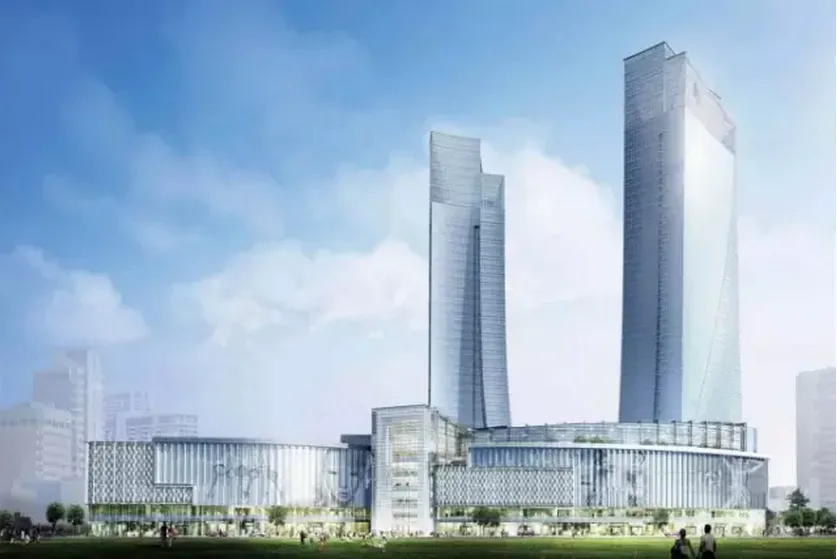
The Wuxi Henglong Plaza Comprehensive Development Project is a modern urban complex integrating boutique retail, upscale dining, five-star hotels, and Grade A office spaces. It serves as a major commercial landmark in the Chong’an District CBD of Wuxi and plays a key role in promoting the city’s high-end service industry.
Located at Dongdajie plot in the heart of Chong’an District, the project covers 37,300 square meters. The above-ground building area spans approximately 242,000 square meters, with an additional 132,000 square meters underground. The complex features a large premium shopping center and two high-rise office towers, both equipped with parking garages.
The shopping center rises 7 floors above ground, reaching about 44 meters in height. Office Building 1 consists of 44 floors (including the podium) and stands approximately 250 meters tall, while Office Building 2 has 33 floors (including the podium) with a height of roughly 200 meters. All three structures share four basement levels plus a partial basement mezzanine, with an excavation depth of about 23 meters.
A distinctive design element of the shopping center is its three triangular light corridors that surround the building, creating an immersive pedestrian street experience for visitors. Upon completion, this world-class shopping center will enhance the vibrant urban landscape of central Wuxi.
Project Challenges
The project faced several significant challenges, including:
- Numerous errors, omissions, clashes, and deficiencies in contract drawings complicated the design development.
- Balancing structural floor heights, beam depths, and pipeline layouts proved highly complex.
- Recalculation of system equipment parameters was required to ensure accuracy and efficiency.
- Ongoing design changes during construction made deepening design and construction management difficult.
- Coordination across multiple disciplines was challenging due to dense mechanical and electrical pipeline distribution.
- The project’s large scale and tight schedule left limited time for mechanical and electrical installation.
- The complex building shape made controlling material consumption rates challenging.
Software Platform Selection
The project utilized the AUTODESK Revit software suite, including AutoCAD Revit Architecture, Revit Structure Suite, Revit MEP Suite, and AutoCAD Navisworks Manage for integration and analysis. This BIM-based platform has been successfully applied in major projects such as the 2008 Beijing Olympic Village spatial planning, the South-to-North Water Diversion Project, and the Hong Kong Metro system.
Application of BIM Technology
The project was led by the Design Center of China Construction Fifth Engineering Bureau Industrial Equipment Installation Co., Ltd., in partnership with Beijing North Wei Huayuan Software Technology Co., Ltd., Autodesk’s general agent in China. This collaboration provided technical support and software development for BIM model construction and application.
Together, they completed an informatization demonstration project for the Ministry of Housing and Urban-Rural Development titled “Research and Application of BIM Technology in Mechanical and Electrical Installation Engineering.” The scope included BIM deepening design, material and cost management, construction management, and system development.
1. Project Implementation Preparation
During the preparation phase, the project implementation plan was defined, the project organization established, and BIM application training provided to the team.
2. Deepening the Design
(1) Using 3D Visualization for Detailed Design
Initially, engineers developed 2D detailed designs for mechanical and electrical disciplines based on contract drawings, performing preliminary pipeline layout and balance. Concurrently, the BIM team analyzed design drawings, created Revit project templates, developed family files, and constructed architectural and structural models.
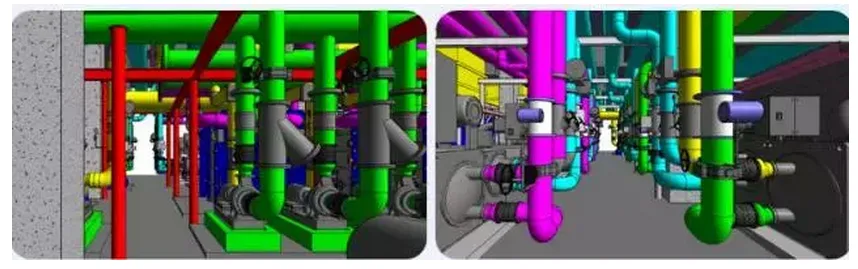
Once backup power system drawings were approved, modeling of various equipment pipelines began. These were integrated with architectural and structural models. The comprehensive model was then imported into Navisworks for clash detection, allowing pipeline adjustments and conflict resolution to produce a construction-ready model. The processes of modeling, adjusting, and avoiding conflicts were often iterative and intertwined.
(2) Collision Detection for Pipeline Coordination
The project’s second underground level serves as a public garage, requiring careful pipeline arrangement to raise net height and enhance spatial aesthetics. At a lane intersection with a beam bottom height of 3.02 meters, the pipeline configuration was highly complex, including:
- Two vertical DN500 chilled water pipes
- Two DN250 cold water pipes
- Two DN150 chilled water pipes
- One 1600×300 air supply duct
- Three DN150 fire water pipes
- One DN150 non-pressure sewage pipe
- Six horizontal DN250 chilled water pipes
- Four DN125 chilled water pipes
- Multiple bridge pipes of varying sizes
- Additional domestic water pipes and fire water pipes
After extensive coordination with the owner, general contractor, and consultants, two DN500 chilled water pipes were relocated from the lane to the parking area to increase clearance above the lane. The bridge was adjusted to avoid clustered chilled water pipes, while the air duct was routed through beam space with a flipped design to accommodate chilled water pipes below. A DN150 fire water pipe was routed through the beam to avoid collisions. This solution balanced spatial requirements with aesthetic and functional considerations.
(3) Net Height Control Technology Research
To manage net height requirements, an elevation check filter was created to set minimum pipeline elevations and display pipelines below this threshold in a distinct color. Alternatively, ceiling plans with defined elevations were used alongside clash detection to identify conflicts between ceilings and mechanical and electrical pipelines. These methods significantly reduced manual troubleshooting and improved layout efficiency.
(4) Assistance in Developing Deepening Design Software
Revit was selected as the comprehensive design platform for pipeline modeling. During this process, custom plugins such as “Pick up centerline generated pipeline,” “Pipeline elevation,” and “Pipeline elevation hierarchy” were developed by architects without professional programming, demonstrating Revit’s accessible API and flexibility to meet tailored design needs.
BIM-Based Material, Equipment, and Cost Management
To reduce manual input of size parameters in traditional quantity calculations while maintaining accuracy, the company developed the China Construction Fifth Engineering Bureau Installation Material Code Calculation Quantity Statistics Software (CS5DT). This system uses an associated database to quickly and accurately retrieve engineering data and breakdown physical quantities throughout the project.
CS5DT supports timely and precise data for procurement planning and material requisition, standardizes material management, and reduces waste. It enables accurate material demand forecasting and precise layout and cutting to minimize loss. For example, steel plate production and warm ventilation duct installation typically see waste rates above 11%, but with BIM processing on this project, loss was controlled under 4%.
Development of BIM Technology Systems
The company implemented the Dongjing Tianyuan Clan Library Management System to centralize and unify storage of clan files for easy project access. It also manages family file parameters through templates, allowing different parameter combinations to generate diverse family types. This greatly enhances the reusability and variety of family files through parameter management and modularization.
Construction Management Based on BIM
BIM technology combined with iPads enabled efficient on-site process control, including comprehensive visual disclosure, establishing a perspective management system, on-site verification, quality rectification issuance, model adjustments, progress tracking, quantity statistics, third-party acceptance, and model consistency control.
This approach not only expands BIM’s application scope but also streamlines construction management by making problem identification, recording, and resolution clearer and more convenient. It enables full-process control of project information viewing, model adjustments, and clash detection across desktop, mobile, and network platforms, ensuring BIM supports the entire design-to-construction workflow.
Enterprise-Level BIM Model Construction Standards
Based on the Wuxi Henglong Plaza project, the company summarized rules and methods for model creation. To promote BIM adoption and raise company-wide BIM standards, China Construction Fifth Engineering Bureau Industrial Equipment Installation Co., Ltd. established the enterprise standard “Building Information Modeling Construction Standard.” This standard governs BIM application principles and requirements during deepening design in building construction, ensuring consistent quality and effective BIM implementation.
















Must log in before commenting!
Sign Up