
At the 2018 National People’s Congress and Chinese People’s Political Consultative Conference, Premier Li Keqiang highlighted the importance of vigorously developing steel structures and prefabricated buildings. He called for accelerating standardized construction and enhancing building technology and engineering quality in the Government Work Report.
A spokesperson from the Ministry of Housing and Urban-Rural Development stated that China’s future focus will be on the three major urban agglomerations: Beijing-Tianjin-Hebei, the Yangtze River Delta, and the Pearl River Delta. The government aims to promote prefabricated buildings aggressively, targeting a 30% share of prefabricated buildings in new construction within about 10 years.
Currently, prefabricated buildings account for less than 5% of China’s new construction, which lags behind developed countries. Industry experts predict that the cumulative market size for prefabricated buildings in China will reach 2.5 trillion yuan over the next decade, indicating vast potential for growth.
From both policy and market perspectives, prefabricated buildings are set to become a key development direction in new construction. This presents a significant opportunity fueled by supportive policies.
Tracing the term “prefabricated building” from obscurity to widespread recognition reveals that it has been nearly two years since the government designated it as a national priority.
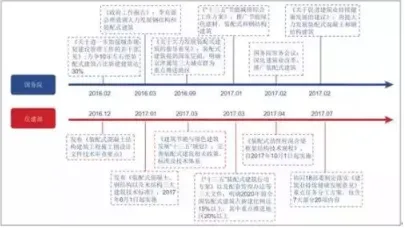
National Policy Developments on Building Industrialization Since 2016
In February 2016, the State Council issued the “Several Opinions on Further Strengthening the Management of Urban Planning (Integrated Decoration) Construction,” setting a goal to achieve a 30% proportion of prefabricated buildings in new construction within 10 years.
In March 2016, Premier Li Keqiang reiterated the need to vigorously develop steel structures and prefabricated buildings. Later that year in September, the State Council released the “Guiding Opinions on Vigorously Developing Prefabricated Buildings,” which elevated prefabricated construction to a national-level focus and identified the Beijing-Tianjin-Hebei region as a key promotion area.
By January 2017, the Beijing Municipal Commission of Housing and Urban-Rural Development announced plans to accelerate prefabricated building development. Beijing aims for prefabricated buildings to account for 30% of new construction by 2020, making this method a primary construction approach.
In March 2017, the Ministry of Housing and Urban-Rural Development issued the “Action Plan for Prefabricated Buildings in the 13th Five Year Plan” along with three supporting management measures. The plan set clear targets: by 2020, prefabricated buildings should constitute over 15% of new construction nationally, with key areas reaching 20%. This remains the most explicit policy guideline to date.
During the 2017 Two Sessions, the national government emphasized “promoting reform and development in the construction industry.”
Furthermore, over 30 provinces and cities—including Henan, Hunan, Guangdong, Guangxi, and Hainan—have stressed accelerating the development of prefabricated and green buildings during their 2018 local sessions.
Why has national promotion of prefabricated buildings become a trend? Several key reasons explain this development:
1. Advantages Over Traditional Building Methods
Prefabricated buildings offer modularity, customization, efficiency, and environmental benefits. Compared to traditional construction techniques, their advantages include:
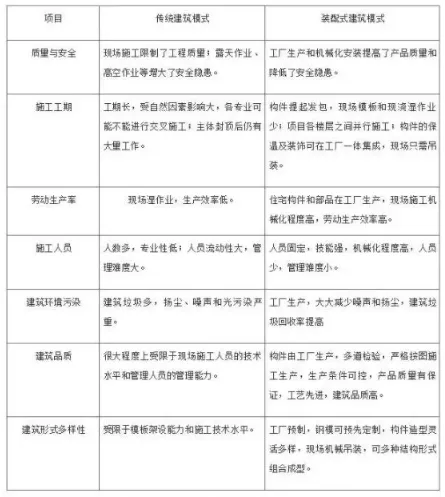
Data source: Compilation of public information
Prefabricated buildings are already widely used in developed countries such as Japan and are gaining traction in China’s first- and second-tier cities. With supportive policies and environmental concerns, acceptance of prefabricated buildings is expected to grow steadily.
2. Significant Gap with Developed Countries and Rapid Industrialization Potential
The concept of prefabricated buildings dates back to early 20th-century British engineer John Alexander Brodie, though it only gained prominence after World War II when war-torn countries like Britain and France promoted it extensively.
Currently, countries like Japan, the United States, and Sweden have construction industrialization rates between 70% and 80%, while China’s rate stands at just 5%. Despite this low industrialization, China’s urbanization rate is under 60%, compared to over 80% in the US and UK, and 90% in Japan. This ongoing urbanization trend means China’s construction industry is poised for rapid growth, including a swift increase in industrialization rates.
Construction Industrialization Rates by Country
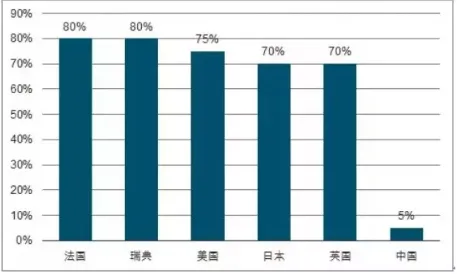
Data source: Compilation of public information
3. Comprehensive Top-Level Design and Local Implementation
Since the 2013 release of the “Green Building Action Plan” by the Development and Reform Commission and the Ministry of Housing and Urban-Rural Development, China has introduced numerous policies to promote prefabricated buildings. These policies cover development planning, standard systems, industrial chain management, and engineering quality.
In February 2016, the State Council officially elevated prefabricated building promotion to a national development strategy through the “Several Opinions on Further Strengthening the Management of Urban Planning and Construction.” The document called for vigorous promotion of prefabricated buildings, establishing national-level production bases, and aiming for a 30% share of prefabricated buildings in new construction within about 10 years.
In March 2017, the Ministry of Housing and Urban-Rural Development issued the “Action Plan for Prefabricated Buildings during the 13th Five Year Plan,” setting clear regional targets: over 20% in key areas, more than 15% in active promotion areas, and above 10% in encouraged areas by 2020.
Additionally, 31 provinces have introduced supportive policies, subsidy standards, and identified demonstration projects at national and provincial levels. Some have even set prefabricated building targets at county and city levels to ensure steady development.
Prefabricated Building Planning Proportions by Region (2020)
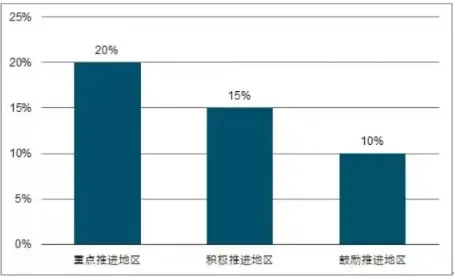
Data source: Compilation of public information
4. Demographic Dividend Decline and Rising Labor Costs
The traditional cast-in-place concrete construction method is labor-intensive. For decades, it thrived due to China’s abundant labor supply. However, as the demographic dividend fades and labor costs rise rapidly, this model is becoming unsustainable.
Increasing labor costs narrow the cost gap favoring prefabricated buildings. Prefabricated construction relies on mechanized, intensive production, significantly reducing labor needs. For example, a specialized factory producing 1.2 million square meters of composite floor slabs annually operates with fewer than 10 workers, whereas traditional manual production requires over 200 workers for the same output. Similarly, a 30-story building constructed using prefabrication requires only 12 workers working for 180 days—at least 30% faster than conventional methods.
5. Installation Costs Are Significantly Reduced
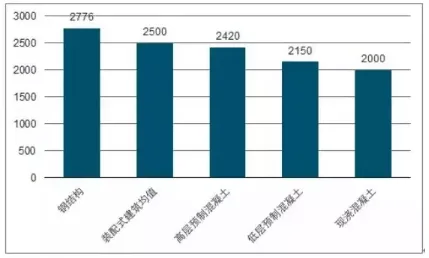
According to the latest “Consumption Quota for Prefabricated Building Projects” from the Ministry of Housing and Urban-Rural Development, the construction cost for prefabricated concrete low-rise residential buildings is approximately 2,150 yuan/m², and for high-rise residential buildings about 2,420 yuan/m². For prefabricated steel structure high-rise residential buildings, the cost is around 2,776 yuan/m². In comparison, cast-in-place concrete houses cost about 2,000 yuan/m². From a cost perspective, prefabricated building expenses are approaching those of traditional cast-in-place methods.
Cost Comparison: Prefabricated Buildings vs. Cast-in-Place Concrete
Data source: Compilation of public information
The cost premium for prefabricated construction mainly comes from prefabricated components. For example, a public rental housing project showed an incremental cost of about 695 yuan/m² for prefabricated concrete structures. In electrical and plumbing works, prefabricated concrete components also show clear advantages despite a unit price difference of 1,435 yuan/m².
Prefabricated component costs can be divided into variable costs—such as steel and concrete raw materials, accounting for about 42%—and costs reducible by large-scale production, including molds, labor, and management fees, making up about 58%.
The combination of large-scale production and rising labor costs will accelerate the economic viability of prefabricated construction. As production of prefabricated components increases and standardization improves, economies of scale will emerge. Coupled with rising labor costs, the cost of prefabricated construction will rapidly decline, eventually becoming much lower than traditional cast-in-place methods.
Responsible Editor: Shi Dandan














Must log in before commenting!
Sign Up