
Waterproofing is a crucial aspect of construction, directly impacting a building’s functionality, lifespan, and value. This is especially true for prefabricated buildings, where sealing and waterproofing of joints in exterior wall panels require particular attention.
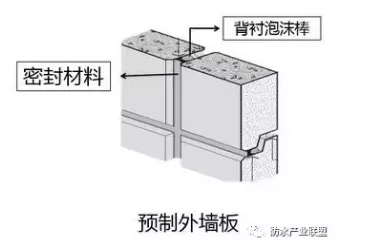
The proper selection and application of sealing materials are key factors for effective waterproofing. Below are several important considerations regarding waterproof sealing of prefabricated exterior wall panels:
1. Silicone sealants are not recommended for sealing joints of exterior wall panels.
Silicone sealants, derived from organic silicon polymer materials, cure into elastic rubber at room temperature without requiring heat or light, making them convenient to use. They offer excellent resistance to temperature extremes, weathering, electrical insulation, strong adhesion to various substrates, and flexibility to accommodate movement. Since their development in the 1960s in Europe and America, silicone sealants have been widely used, especially on aluminum alloys and glass in curtain walls, doors, and windows. China’s silicone sealant industry has grown rapidly since the 1990s alongside its construction boom, dominating the market over alternatives like polysulfide, polyurethane, and acrylic adhesives due to their cost-effectiveness and performance.
With the rise of prefabricated buildings in China, traditional sealant manufacturers have promoted silicone products aggressively. However, opinions differ on their suitability for prefabricated exterior wall panels.
In Japan, a country with a longer history in prefabricated construction, the philosophy is to select sealants based on their suitability for specific applications. For exterior wall panel joints, they recommend silane-modified sealants instead of silicone.
Silane-modified sealants incorporate silane functional groups into polymer ends, retaining the original polymer’s properties while curing via a moisture-activated crosslinking reaction without catalysts. During curing, only small alcohol molecules are released, making this an environmentally friendly system. Since their development in the 1980s, silane-modified sealants have been widely used in Japan for over 30 years with proven success in prefabricated building joints.
Additionally, silicone sealants have drawbacks such as susceptibility to plasticizer contamination and dust adhesion on porous concrete panels. Their low surface energy also inhibits paint adhesion, causing low shear strength issues. Therefore, silicone sealants are generally not recommended for prefabricated exterior wall panels according to the “suitable for the right place” principle.
2. Which is better for sealing prefabricated exterior wall panels: two-component or single-component silane-modified sealants?
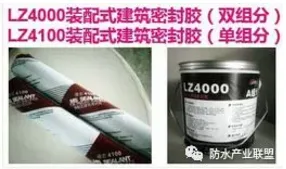
Two-component silane-modified sealants require mixing a main agent (4.4 kg) with a curing agent (400 g) on-site using specialized equipment, followed by application via a dedicated glue gun. Although slightly less convenient than single-component sealants, over 90% of silane-modified sealants used in Japan’s prefabricated exterior wall panels are two-component. Leading Chinese prefabricated construction companies like Vanke also adopt two-component products.
The advantages include high application efficiency and reduced waste once proper operating procedures are mastered. Japanese professionals have developed standardized techniques ensuring fast, high-quality application. Moreover, two-component sealants excel in performance tests such as Japan’s JISA 5758-2004 standard, which simulates real-world conditions by compressing and stretching the sealant repeatedly at extreme temperatures. Two-component products consistently surpass single-component ones in durability and elasticity.
Additionally, two-component sealants cure quickly, minimizing internal defects caused by joint movement during curing—a common issue with single-component sealants. This reduces risks of cracking or detachment, making two-component silane-modified sealants particularly advantageous.
3. Addressing paint cracking around joint areas.
Industrial production ensures exterior wall panels achieve millimeter-level dimensional accuracy. However, after installation, joint alignment can vary by centimeters vertically, causing uneven facade lines if sealant alone forms the joint line. To maintain visual uniformity, a common approach is to apply the sealant first, then paint over it to create continuous, straight lines.
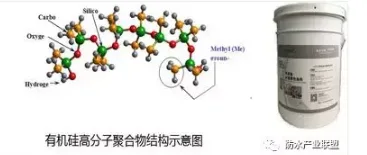
Typical exterior wall paints lack sufficient elasticity and cannot accommodate sealant movement, leading to cracking and peeling. We recommend organic silicon elastic exterior wall coatings, which use organic silicon as the film-forming agent, providing excellent aging resistance and elasticity comparable to the sealant. This effectively prevents cracking at joint locations, especially in prefabricated buildings.
4. Multiple factors influence the effectiveness of exterior wall waterproofing and sealing and must be considered holistically.
The manufacturing and installation accuracy of prefabricated wall panels significantly impact waterproofing performance. Issues such as slurry leakage or insufficient material during panel production, or deviations during installation, often require joint cutting or repairs. These can result in variable joint widths and difficulty in properly filling foam rods, causing poor adhesion or inconsistent sealant thickness. This creates hidden risks of sealant failure or leakage.
For example, rubber waterstops embedded inside wall panels are designed to provide a secondary waterproof barrier by compression. However, the effectiveness depends on precise panel alignment; even slight misalignments prevent the rubber strip from sealing properly, compromising waterproofing.
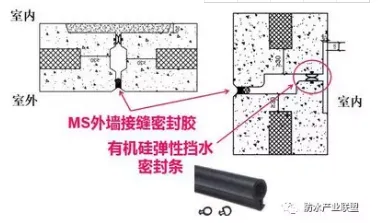
5. Combining water blocking and drainage is the most effective waterproofing strategy.
Water can infiltrate through countless paths, so relying solely on “water blocking”—the traditional waterproofing approach—is insufficient for prefabricated buildings with numerous joints. Expecting exterior wall sealants to completely stop rainwater penetration is unrealistic, costly, and wasteful.
The concept of “hydrophobicity” in design acknowledges that some water will penetrate but ensures it is safely directed through drainage systems to prevent interior damage. A waterproofing strategy combining blocking and drainage is therefore the most reliable solution for prefabricated buildings.
Given the current lack of comprehensive understanding of exterior wall panel sealants among domestic construction companies, it is advisable for sealant manufacturers to take full responsibility for adhesive application (including labor and materials) in prefabricated projects. As the saying goes, “Three parts materials, seven parts workmanship.” Professional teams applying professional materials can prevent many issues and help avoid blame-shifting between material suppliers and contractors when problems arise.
With strong support from national policies, the prefabricated construction industry has made significant progress. As research continues, more advanced waterproofing solutions will emerge, ready to be proven over time.
Responsible Editor: Shi Dandan













Must log in before commenting!
Sign Up