
Advantages of Large Space Buildings
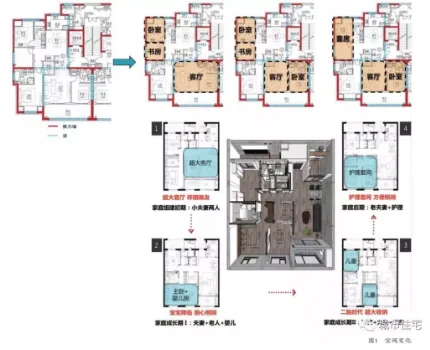
Large space buildings are highly valued for their flexible partitioning options. Homebuyers can adapt the interior layout without moving by rearranging bedrooms and living areas to suit changes in family size and needs. For instance, young couples initially enjoy a spacious living room, a master bedroom, a guest room for overnight visitors, and a study, creating an ideal environment for socializing and intimacy.
As the family grows, the layout can be modified to include a master bedroom, a child’s room, a nanny’s room, a study, and a simpler living area. Later, when children marry and parents move in for care, the child’s room and study can be combined into a senior suite, with a smaller living room and a study adjacent to it. This flexible design supports the evolving needs of a family from formation through growth and into old age (see Figure 1).
Approaches to Achieving Large Spaces in Prefabricated Buildings
2.1 External Load-Bearing Walls
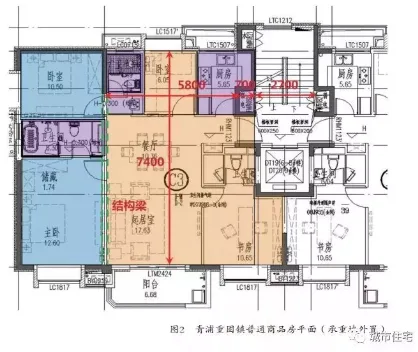
In the China Residential Dream Park model room project, load-bearing walls are arranged along the exterior and partition walls. This design allows flexible and adaptable layouts for large spaces, catering to varied family needs and personalities. The layout can be adjusted to accommodate two, three, or four-bedroom configurations. Figure 2 illustrates a typical floor plan from commercial housing in Chonggu Town, Qingpu.
2.2 External Equipment Pipe Wells
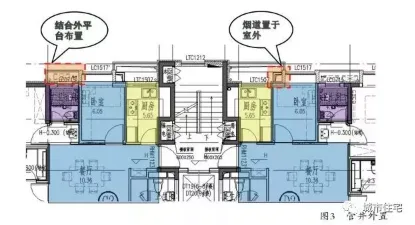
Positioning equipment pipe wells outside the building enhances the flexibility of creating large, open spaces. This approach saves interior space and facilitates easier renovation and decoration. When installing pipe wells externally, it is important to coordinate with the building’s facade design according to architectural standards (see Figure 3).
2.3 Bathroom Design with Large Slab Structures
1) No Floor Lowering
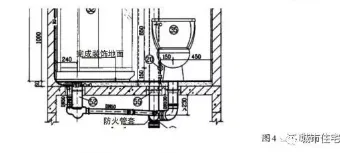
This method routes the drainage pipes through the floor slab, with horizontal drainage pipes placed above the bathroom of the lower unit, as shown in Figure 4. While this fixes the position of sanitary fixtures, it limits flexibility for future renovations or fixture replacements.
2) Full Floor Lowering
The entire structural floor is lowered by 150-180mm. Multi-channel special floor drains and joints are used in the bathroom, along with wall-drain toilets and closed sandwich walls behind them (see Figure 5). This design accommodates underfloor heating but requires specialized fixtures and limits the variety of equipment options.

3) Partial Floor Lowering
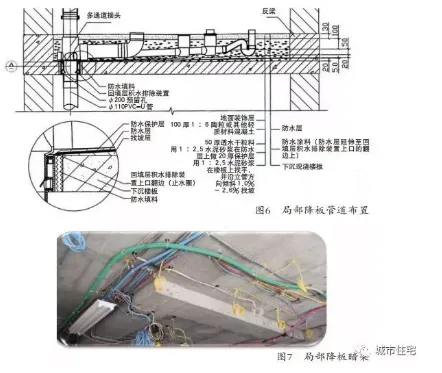
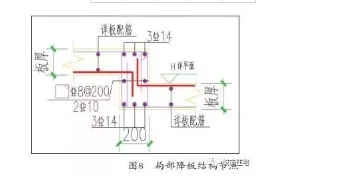
Typically, only the bathroom area’s structural floor slab is lowered by 300-350mm. Vertical pipes pass through the floor slab, while horizontal pipes run above the slab in the lowered section. This common method (see Figures 6-8) offers greater flexibility and does not interfere with maintenance or renovations. However, it results in hidden beams around the lowered slab, causing visible protrusions underneath.
3. Experimental Verification
A full-scale test was conducted at the Changzhou Dijing Building 36 project, featuring a span of 7200mm × 7800mm. The goal was to validate the theoretical design through testing and to systematically assess the structural performance of prefabricated large-span slabs. The study also evaluated the comfort and safety of the structure during regular use.
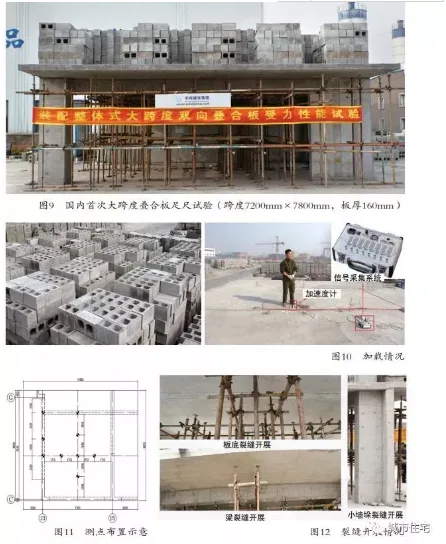
Figures 9 through 11 illustrate how deflection was measured under quasi-permanent, standard, and design load values. The experimental results aligned well with theoretical calculations. Comfort levels were tested under various loads, and the natural frequency of the floor slab exceeded the 5Hz code requirement. The lowest frequency recorded was 7.324Hz under standard loading, indicating no risk of resonance.
During testing, minor cracks appeared near small wall limbs and large-span beams around the slab, as shown in Figure 12. To address these, design modifications were made, including:
- Increasing the cross-sectional size of short leg walls and adding reinforcement along beam overlaps.
- Raising beam heights and adding additional stirrups and longitudinal reinforcement to beams.
- Adding extra reinforcement on the slab top with double-sided tension using Ø8 bars spaced at 150mm, especially near supports.
- Placing additional steel bars within influence zones, ensuring at least three Ø10 bars in each direction per side for prefabricated buildings.
Following these adjustments, no cracks were observed in the actual construction.
Responsible Editor: Shi Dandan
















Must log in before commenting!
Sign Up