
Continuing from the previous article: Smart Construction of Prefabricated Buildings Based on BIM Technology (Part 2)
4. Comprehensive Technology of Prefabricated Building Curtain Walls Using BIM
In curtain wall engineering, BIM technology enables the creation of a structural model that precisely matches the construction site. This model refines the curtain wall units and ensures the overall building shape is accurate. By simulating curtain wall installation, potential conflicts between prefabricated curtain walls and civil or steel structures can be identified and resolved early, ensuring smooth construction. Using optimized curtain wall units, a detailed list of components is generated. Cost control is achieved through computer-aided cutting and factory processing, maximizing efficiency.
4.1 Transition from Traditional to Prefabricated Curtain Walls
Currently, curtain walls have evolved from traditional to prefabricated models, which are characterized by:
- Utilizing specialized factory equipment and production processes to assemble large integrated panels combining structure, insulation, waterproofing, and exterior decoration.
- On-site installation involves simply connecting and securing large panel components to the main building structure.
- A regular grid structure with uniform panel modules.
- The modular glass curtain wall itself functions as a prefabricated building component.
Not only simple, regular curtain wall panels can be factory-produced and assembled. Complex curtain wall skins are also achievable. For instance, the Xiamen Tianyuzhou Radar Project employs numerous hyperbolic panels to create complex, ship-like shapes (see Figure 17).

Architectural rendering
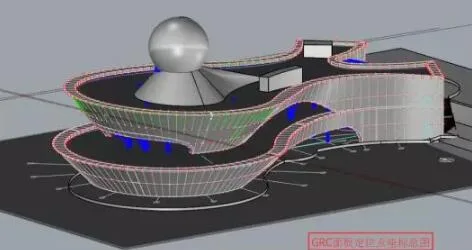
GRC panel positioning point coordinates
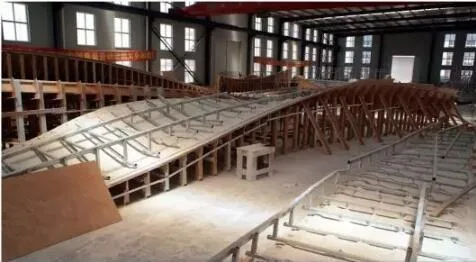
GRC panel factory processing
Figure 17: Xiamen Tianyuzhou Radar Project
4.2 Application of BIM Technology in Curtain Wall Design
- The curtain wall design team uses Revit software for solid modeling, enabling the owner and main building designers to visually review the building’s appearance. This facilitates rapid approval of the building plan (see Figure 18).
- BIM models provide precise grid divisions of curtain walls and decorative line sizes, which can be adjusted at any time according to the owner’s feedback.
- Collision detection helps identify conflicts between curtain walls and other structures or outdoor elements such as rainwater pipes, minimizing engineering changes and delays during construction (see Figure 19).
- Architectural details are refined through BIM’s virtual building construction, allowing architects to intuitively assess detail completion and confirm design intentions (see Figure 20).
- During construction, BIM enables quick and comprehensive drawing production, including horizontal and vertical sections, local details, and connection nodes.
- Material information is accurately submitted for budgeting purposes. BIM counts each component to generate detailed material lists, aligning precisely with project budgets.
- BIM supports complex surface modeling from design through construction. As irregular curtain walls become more common, BIM replaces traditional 2D drawings, facilitating a transition to 3D construction management.
- From design to material ordering, layout, and positioning, BIM models provide comprehensive control over curtain wall surface division, factory processing, and on-site installation.

Figure 18: Solid modeling effect of building curtain wall
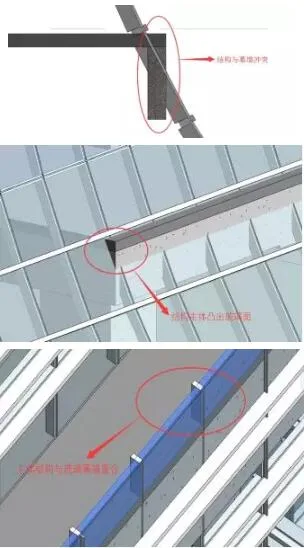
Figure 19: BIM-based Curtain Wall Collision Check
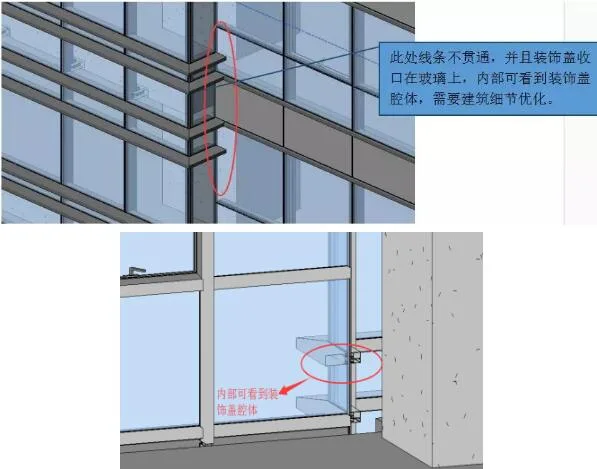
Figure 20: Confirmation of Curtain Wall Building Details Based on BIM Model
5. BIM-Based Smart Parking Garage Construction Technology
The Construction Method of Prefabricated Splicing Sinking Well Intelligent Underground Parking Garage leverages BIM technology as an innovative solution to urban parking challenges in older residential areas, commercial districts, office zones, and public transportation hubs (see Figure 21).
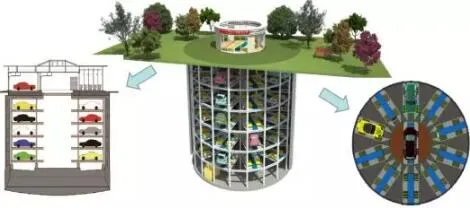
Figure 21: Prefabricated Splicing Caisson Intelligent Underground Parking Garage
The garage cylinder layout features a parking gate pavilion at ground level and one underground floor, with five parking levels below that each contain 10 parking spaces—totaling 50 spaces per garage. The inner diameter measures 20 meters, excavation depth is approximately 17 meters, and the net height of each parking level is 1.80 meters.
This fully prefabricated design divides the wellbore height into six layers: one blade foot layer at the bottom and five standard layers above. BIM technology facilitates integrated design, component disassembly, manufacturing, and hoisting. Each layer consists of 10 prefabricated pieces with double skin cavity components (inner and outer walls) manufactured in the factory, transported to the site, assembled, and then filled with reinforced concrete in the cavity, achieving a prefabrication rate of 36%.
The prefabricated standard section weighs 14 tons, with dimensions of 2.32 m in height and 1 m in width. The blade foot section weighs 30 tons, measuring 3.5 m in height and 1.1 m in width. Standard sections and blade foot pieces are assembled into rings to form the full garage structure (see Figure 22).
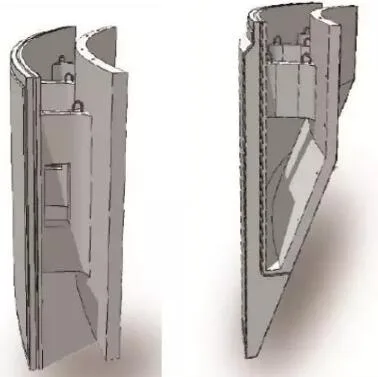
Prefabricated standard section and blade foot
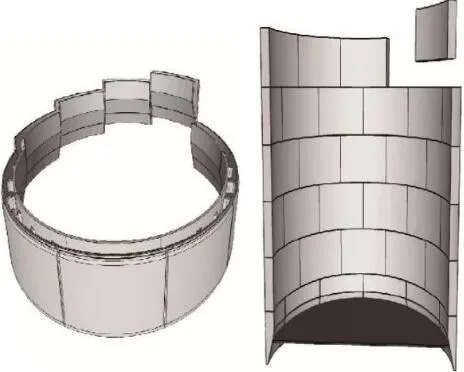
Assembly of blade foot and ring standard section
Figure 22: Schematic Diagram of Prefabricated Caisson Components
Project Highlights:
- Unlike typical sinking construction that results in small compartment areas, this underground parking garage features a large 20-meter diameter wellbore.
- The sinking well method integrates foundation pit support with the double walls of the structural exterior, employing a reverse construction technique that reduces steps and conserves materials.
- The cylindrical structure ensures uniform force distribution. The concrete poured into the cavity creates a structurally sound, self-supporting system that improves excavation efficiency and provides a safe working environment.
- The cylinder is divided into double skin cavity prefabricated blocks, assembled into rings and stacked in layers. Self-compacting concrete is poured in staggered layers within the cavity to ensure effective waterproofing.
The caisson sinking site is shown in Figure 23.
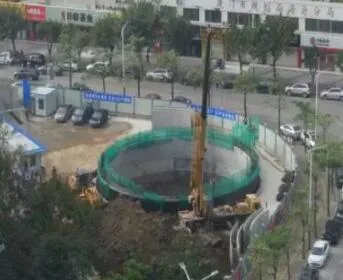
Figure 23: Prefabricated and Assembled Sinking Method for Caisson
The structural cross-section of the parking garage is presented in Figure 24.
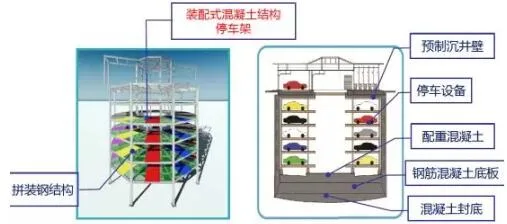
Figure 24: Structural Section of Parking Garage
At the center of the parking structure is an advanced parking system equipped with translation, lifting, and 360-degree rotation capabilities. Integrating Internet technologies, the system combines toll collection, access control, handling, and positioning into a unified intelligent management platform. This platform connects to regional parking information and dynamic traffic networks, enabling real-time control of parking data (see Figure 25).

Figure 25: Schematic Diagram of Parking Equipment
When parking, vehicles enter through the gate pavilion and are transported by a handling cart to the circular parking platform at the center of the well. The equipment automatically rotates downward for transport, and the intelligent control system parks the vehicle in an available underground space. To retrieve the vehicle, users enter their license plate number or swipe a card; the transport cart then automatically moves to the corresponding parking spot and delivers the vehicle to the exit area within approximately 90 seconds (see Figure 26).
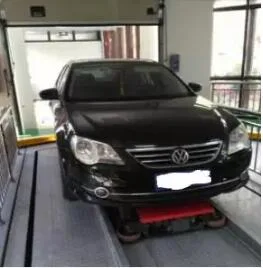
Figure 26: Parking Diagram
Advantages of the Prefabricated Splicing Caisson Intelligent Underground Parking Garage:
- Environmental sustainability: The garage’s main concrete structure and internal steel parking frame are fully prefabricated, minimizing on-site construction and reducing material waste. The sinking method occupies minimal space and has limited impact on surrounding buildings, promoting green, resource-efficient construction.
- Short construction period: The prefabricated cylinder walls are manufactured modularly and assembled quickly on-site, ensuring a fast, safe build process.
- Compact footprint and adaptability: Utilizing green and underground spaces, the above-ground building covers only about 120 square meters. This small footprint allows installation in scattered urban corners, old neighborhoods, commercial zones, and public facilities.
- Advanced automation and intelligent integration: The garage features robotic handling systems that replace manual parking, combined with intelligent software and license plate recognition to ensure secure, unmanned storage and easy vehicle access.














Must log in before commenting!
Sign Up