
(Continuing from the previous article: Smart Construction of Prefabricated Buildings Based on BIM Technology (Part 3))
The application of BIM technology in steel structure projects primarily focuses on the following areas:
1) Using BIM 3D models for spatial positioning and deviation verification of foundations.
2) Optimizing lifting plans, performing lifting simulations, and controlling lifting progress.
3) Refining steel structure models, generating component lists, and ensuring machining precision.
This article explores how BIM technology is applied in the steel structure construction process, illustrated by the Xiamen Central Building project. Contracted by China Construction Third Engineering Bureau, this project won the first prize for BIM technology application in China (Figure 27).

Figure 27: Rendering of Xiamen Central Building
6.1 Software Configuration
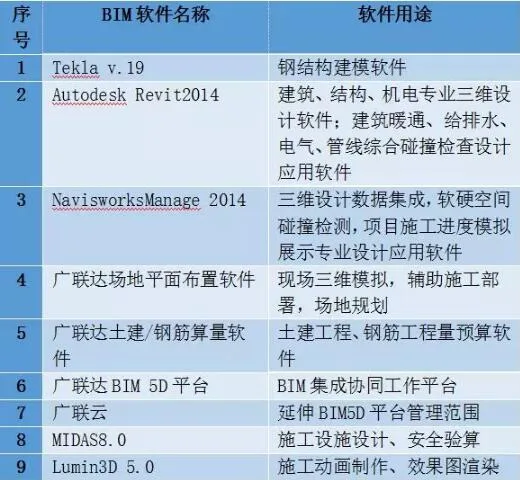
The BIM software setup for this project is detailed in Table 2.
Table 2: BIM Software Configuration of Xiamen Central Building
6.2 Highlights of BIM Technology Application
The project encompasses 21 core applications across three main disciplines: civil engineering, steel structure, and mechanical and electrical engineering, distributed among seven major sections (Figure 28).
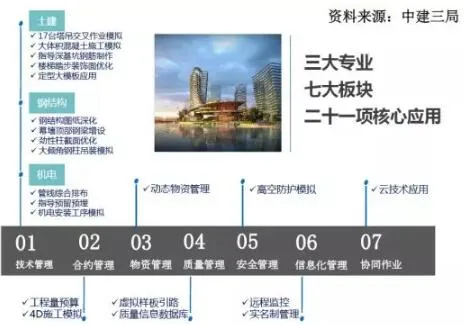
Figure 28: Highlights of BIM Technology Application in the Project
6.3 BIM-Based Tower Crane Operation Design
At the project’s peak, 17 tower crane groups operated simultaneously in intersecting traffic zones. BIM technology was effectively used to organize crane capacity, prevent collisions, and achieve efficient operations (Figure 29).
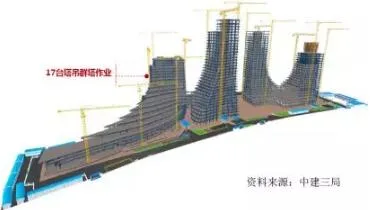
Figure 29: Tower Crane Operation
6.4 Simulation of Large Tilt Angle Steel Column Lifting
Professional BIM design software was used to create precise digital models, enabling intuitive 3D analysis and optimization. Construction positioning maps were generated for irregular components, and quantities were calculated based on the model. The steel column’s maximum tilt angle reached approximately 61°, leaning outward across three layers and multiple steps. Midas software simulated and analyzed the structure’s construction phase, ensuring safety and feasibility (Figure 30).
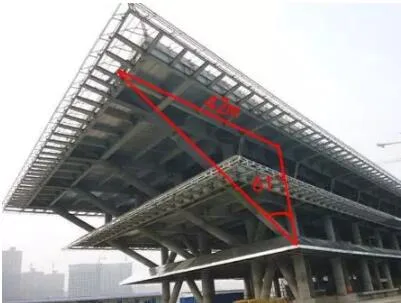
Figure 30: Steel Column with Large Tilt Angle
6.5 Comprehensive Pipeline Layout Based on BIM
Revit software was utilized to coordinate pipeline layouts across various disciplines, resolving hundreds of issues related to collisions and clearances. Pump rooms, corridors, and other spaces were arranged efficiently and aesthetically (Figure 31).
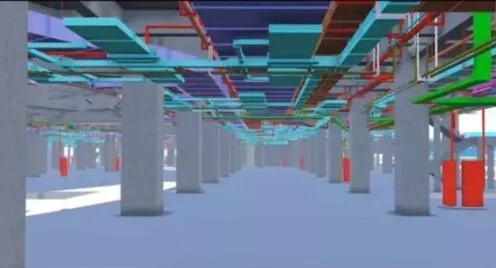
Figure 31: Comprehensive Pipeline Layout Based on BIM
6.6 BIM-Based Dynamic Material Management
By integrating BIM with construction scheduling, dynamic material lists required for the plan were exported efficiently (Figure 32).
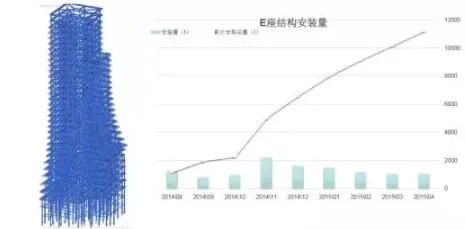
Figure 32: Dynamic Bill of Materials Based on BIM
6.7 General Layout and Remote Monitoring System
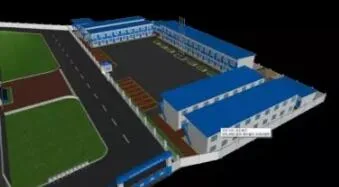
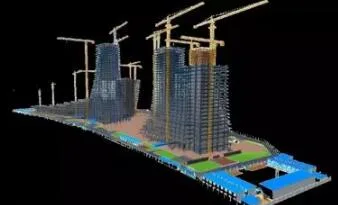

Figure 33: BIM-Based Overall Layout and Remote Monitoring System
6.8 Economic Benefits Analysis of BIM Technology in the Project
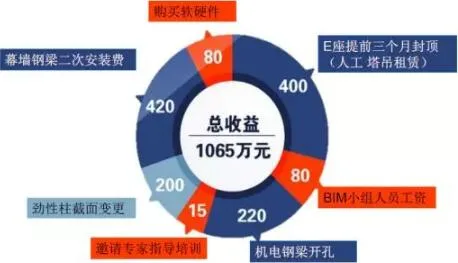
Figure 34: Economic Benefits Analysis of BIM Technology in the Project
6.9 Construction Site
The construction site is shown in Figure 35.
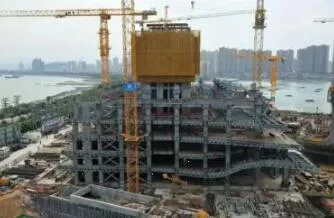
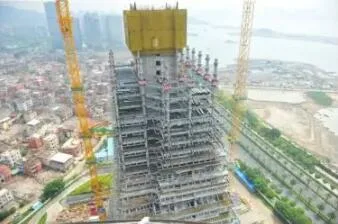
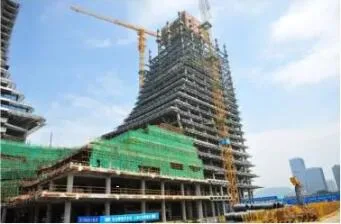
Figure 35: Construction Site
In 2016, super typhoon “Moranti” struck Xiamen while the Xiamen Central Building was still under construction. Because vertical transportation was ongoing, the glass curtain wall perimeter was not yet sealed. When the typhoon hit, strong winds passed through the building cavity, subjecting the glass to intense positive and negative wind pressures—effectively exposing it to wind forces from both sides. This was the most vulnerable state for the curtain wall, with highly unfavorable stress conditions, a scenario historically known to cause extensive damage during construction.
Remarkably, the Xiamen Central Building’s glass curtain wall withstood the storm almost intact, a rare feat. Several factors contributed to this resilience: first, a robust curtain wall framework; second, thick glass panels consisting of three layers, both laminated and insulated; third, a streamlined design that reduced wind resistance; and finally, the integration of curtain wall design and construction through BIM technology. This project’s willingness to invest and consider wind loads during design was key to this success.


Figure 36: Curtain Wall Effect of Xiamen Central Building
7. Promoting Prefabricated Construction Based on BIM Technology
The construction industry has fully entered the era of smart construction.
Taking architecture as an example, BIM technology’s application scope can be expanded both vertically and horizontally. Vertically, it spans the entire project lifecycle (Figure 37), while horizontally, it integrates BIM with green building concepts (Figure 38). This comprehensive approach significantly enhances construction quality.
Key aspects to consider include:
- Seismic analysis: buildings remain undamaged by minor earthquakes, repairable after moderate quakes, and avoid collapse during major events
- Building performance: analysis of acoustics, lighting, and thermal environment
- Energy consumption: monitoring operational energy use and carbon emissions
- Visibility analysis: assessing sightlines within building clusters
- Evacuation analysis: emergency evacuation planning for public buildings
- Comfort analysis: simulation of natural ventilation, HVAC airflow, and smoke extraction in areas such as computer rooms
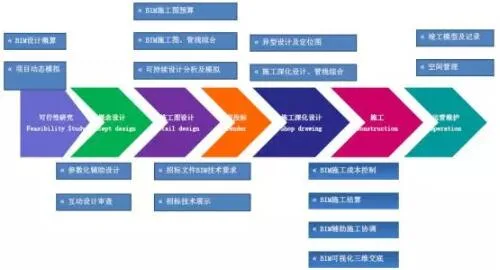
Figure 37: BIM Application Across the Building Lifecycle
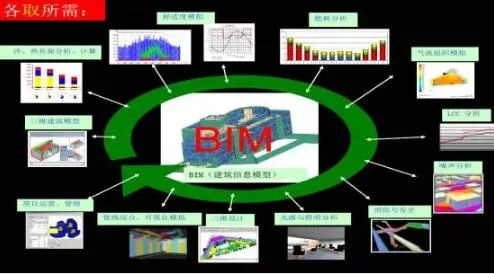
Figure 38: BIM + Green Building Integration
Within the prefabricated construction industry, BIM technology enables integration across the entire upstream and downstream industrial chain (Figure 39).
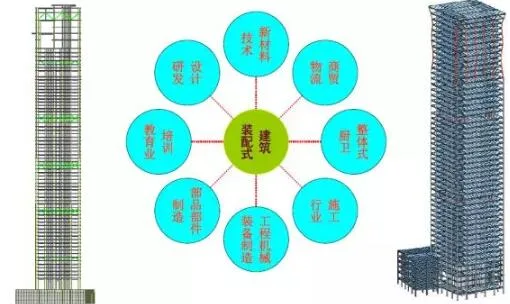
Figure 39: Integration of the Entire Prefabricated Building Industry Chain Based on BIM
BIM is set to revolutionize the entire industry. Its widespread adoption will transform operational models, optimizing and digitizing the industry chain to achieve modern factory-based production and refined management. Moreover, BIM enables full informatization throughout design and construction, significantly improving quality and labor productivity.
The “2016-2020 Outline for the Development of Information Technology in the Construction Industry,” issued by China’s Ministry of Housing and Urban-Rural Development, emphasizes comprehensive improvement of IT levels in construction during the 13th Five-Year Plan. It promotes integration and application of BIM, big data, artificial intelligence, mobile communications, cloud computing, and the Internet of Things. The goal is breakthroughs in digitization, networking, and intelligence, establishment of integrated industry supervision and service platforms, and formation of construction enterprises with strong IT innovation and internationally advanced applications, including key independent intellectual property rights.
China’s construction industry is thus entering an era of comprehensive smart construction.
The promising development of prefabricated buildings in China presents an opportunity to combine BIM technology to create a new industrialized construction model. Leveraging big data can disrupt traditional construction methods. Utilizing BIM and the Internet together will fundamentally transform the entire construction industry, driving it fully into the era of smart construction.














Must log in before commenting!
Sign Up