
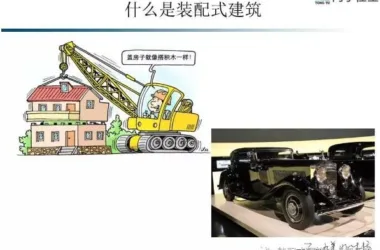
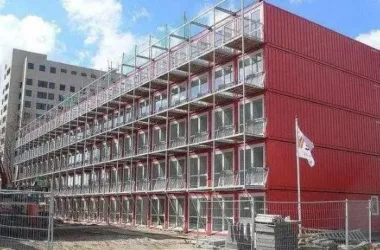
Prefabricated concrete buildings rely heavily on components that are pre-processed and manufactured in factories for on-site assembly. This approach offers several benefits, including labor savings, mitigation of weather-related delays, and the ability to maintain year-round construction schedules.
By adopting integrated architectural and decorative design, construction and decoration can proceed simultaneously. To achieve this, components must adhere to safety standards and meet standardization requirements. Factory-based operations significantly reduce on-site wet work, formwork, steel bar binding, scaffolding installation, electrical box placements, and manual labor. This aligns well with China’s current focus on energy conservation and environmental protection in the building industry. Consequently, prefabricated construction is actively promoted throughout China.
National policies encourage a “five-in-one” management model encompassing design standardization, factory production, integrated decoration, on-site assembly, and full-process informatization in prefabricated building projects. Higher standardization in component design increases mold utilization and factory production efficiency, thereby lowering component costs. With digital management in factories, the overall cost-effectiveness of prefabricated buildings continues to improve.
Currently, a major challenge is the lack of specialized training among some practitioners regarding prefabricated building design and implementation. This gap results in projects featuring an excessive variety of components, higher costs, chaotic on-site management, poor technical and economic efficiency, and occasional quality issues.
The author identifies two primary causes for these problems: design and management.
Design Challenges
First, prefabricated design must be integrated from the very beginning of a project. Standardized design originates at project initiation. However, some projects are designed traditionally first and later adapted into prefabricated schemes merely to comply with policy, without fully embracing prefabrication concepts from the outset. For such projects, prefabricated design principles should be incorporated during early planning to reorganize the technical framework; otherwise, achieving professional and standardized results becomes difficult.
Second, design must account for the challenges and costs related to production, storage, and transportation of components. Prefabrication emphasizes factory production of parts that are hard to manufacture on-site, which helps reduce on-site complexity and improves construction efficiency. However, designs must ensure structural safety and functionality while optimizing complex weak points and connection nodes to minimize production and installation costs. Due to the developing nature of the prefabricated component industry and the shortage of specialized design talent, many designers lack a full understanding of production processes. This results in thin structural elements and complex nodes that are difficult to produce and prone to damage during demolding, storage, and transport. To protect these fragile areas, additional measures in molds and handling are necessary, increasing costs.
Third, component designs often overlook installation processes, difficulties, and construction costs. Designers transitioning from traditional cast-in-place backgrounds may lack experience with prefabrication, leading to overly complex nodes and excessive reinforcement (e.g., closed hoops, thick steel bars) without considering installation feasibility. This can cause on-site installation challenges, delays, and increased costs due to mold modifications and design changes. Such practices contradict the design philosophy of a strong main structure with simpler components.
Fourth, prefabricated buildings should integrate structural, decorative, and electromechanical systems. Achieving this integration requires early coordination among architectural, structural, electrical, plumbing, and interior design teams. The design must incorporate all specialty requirements into the components. This collaborative approach distinguishes prefabricated construction from traditional methods and poses new challenges for both design and construction teams.
Fifth, the use of Building Information Modeling (BIM) technology in prefabricated projects should be practical and problem-solving, not just promotional. BIM should focus on addressing production and installation challenges and be gradually and effectively implemented.
Management Considerations
Effective on-site management requires experienced managers well-versed in prefabricated construction. Managers accustomed to traditional cast-in-place methods must adapt their mindset, prioritizing technology and proactive management rather than relying on conventional practices.
Common preventable issues include:
- Delays in subcontractor bidding and failure to timely coordinate detailed design work, leading to postponed component finalization and production schedules.
- Lack of technical disclosure and coordination with subcontractors before construction, resulting in out-of-sequence processes and rework during construction.
The efficiency of prefabricated structures is fundamental to project success. Close coordination among design, production, and construction teams is essential to significantly improve construction speed and quality.
Prefabricated concrete buildings require industrialized construction methods that avoid designing first and splitting later. By collaborating closely among owners, designers, constructors, and manufacturers, traditional construction practices can be transformed. Emphasizing design standardization, an integrated approach to construction and management is formed, covering design, production, assembly, decoration, components, and maintenance.
This integrated model supports sustainable development goals by delivering superior performance, consistent quality, cost control, and increased efficiency. It highlights the advantages of prefabricated buildings and promotes their steady and orderly growth in the construction industry.














Must log in before commenting!
Sign Up