
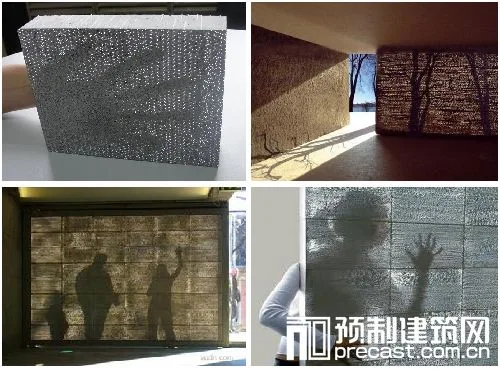
The introduction of translucent concrete was first featured in the German BFT magazine and publicly showcased at the 2007 BAUMA exhibition in Germany. Known as LiTraCon, this innovative translucent concrete was invented by Hungarian architects. However, until recently, this technology had not been developed in China. Beijing YuGou Co., Ltd., specializing in building industrialization, was the first to develop this product domestically, filling a significant gap in the Chinese market.
This translucent concrete consists of a large amount of optical fibers embedded within a fine concrete mix. It can be manufactured as prefabricated bricks or wall panels. When placed against the translucent concrete, objects cast shadows on the panels; shadows on the illuminated side appear as clear silhouettes on the dark side, while the colors remain unchanged. A concrete wall made from this material resembles a screen or scanner, creating the illusion that the wall’s thickness and weight have vanished.
The light-transmitting property of this concrete is achieved because the optical fibers are arranged in a parallel matrix between two layers of concrete. Since the optical fibers occupy minimal volume, the concrete’s mechanical strength remains essentially unaffected, allowing it to be used as a structural building material. This makes translucent concrete suitable even for load-bearing applications.
Moreover, this transparent concrete comes in various sizes and offers insulation properties. It can be produced with different textures and colors, enabling artistic effects under lighting conditions. Applications include garden structures, decorative panels, blocks, and curved wave shapes—providing architects with expanded creative possibilities and the ability to bring imaginative designs to life.













Must log in before commenting!
Sign Up