
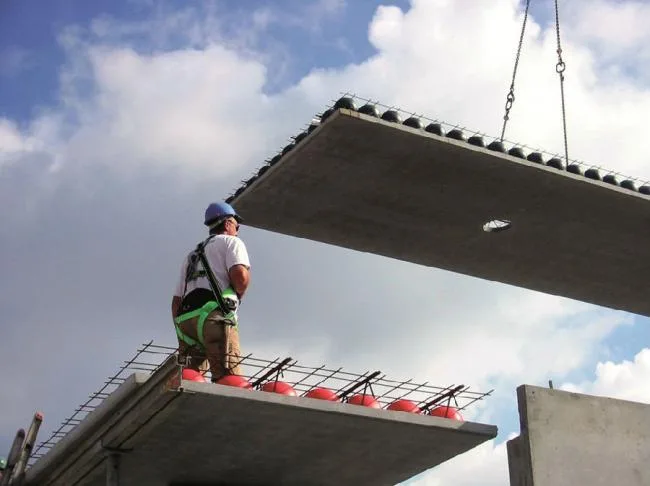
Plastic ball floor slabs represent a revolutionary advancement in construction technology. By incorporating recycled plastic balls to fill non-load-bearing floor slabs, this method significantly reduces concrete usage, decreases the structure’s self-weight, and extends the building’s service life. Integrating recycled plastic allows structural columns to span up to 50% farther. Additionally, this slab type connects concrete structures in two directions, eliminating the need for crossbeams. Key features include:
No design limitations—flexible forms adapt easily to various building designs.
Reduced self-weight greatly lowers foundation costs.
Column spans increase by 50% compared to traditional structures.
Eliminates the need for crossbeam construction, speeding up the build process and reducing costs.
Significantly decreases concrete consumption—1 kg of recycled plastic replaces 100 kg of concrete (ideal for industrialized building).
Energy-saving, eco-friendly, low-carbon technology that reduces carbon emissions.

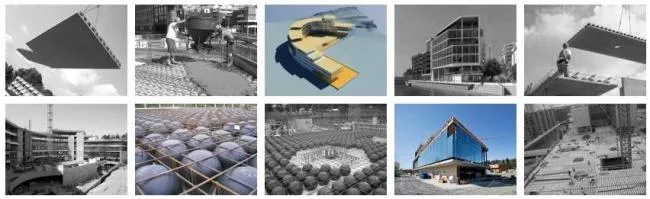
Plastic ball floor slabs have been successfully implemented in numerous European construction projects over the past decade. More than one million square meters of multi-story buildings in Denmark and the Netherlands utilize this innovative system.
Installation Overview
The installation process is straightforward and consists of the following steps:
1. Erect temporary supports before installation, placing horizontal beam supports at intervals of 1.8 to 2.4 meters.
2. Position the semi-finished components accurately within the structure.
3. After laying the upper layer and installing bottom fixing devices, secure the top layer with a mesh to connect all components.
4. Install shear reinforcement between columns.
5. Set up edge reinforcements.
6. Attach the pouring device to the original concrete and fix it to the horizontal mesh structure above.
7. Place polymer plate supports between components and columns as part of pouring device processing.
8. Prepare for pouring by sealing gaps between components and cleaning and wetting the original concrete surface.
9. Pour the concrete, apply vibration, and increase maximum capacity by 10 mm.
10. Remove unnecessary support structures 3 to 5 days after pouring.
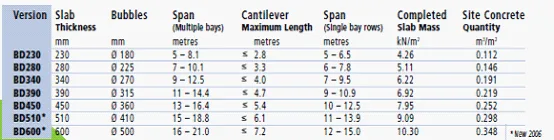
Technical Specifications
The plastic ball floor system can be adapted to various building structures by selecting different installation schemes, as illustrated below:
Three Application Schemes:
Scheme A: Precision prefabricated components. This scheme features a 70mm prefabricated concrete bottom layer in a three-layer component, acting as a permanent structure, which eliminates the need for prefabricated load-bearing molds. Components are placed on temporary supports and connected with pre-installed shear and edge reinforcements. Edge molds are then installed, followed by pouring the cover plate. This approach is ideal for new construction projects but requires crane assistance.
Scheme B: Prefabricated component molds are positioned on traditional structures, subjected to prestressing, and then directly poured into slabs. This scheme suits building renovations and upgrades.
Scheme C: Completed wooden components are installed directly into the building for use in non-load-bearing structures only.
This system has been successfully applied in projects such as the 32,000 square meter Media City, Millennium Building, and City Hall Office. Implementing this method greatly reduces construction time and increases design flexibility.
Summary of Advantages
Recognized as a benchmark in green energy conservation, the sandwich structure used during construction saves substantial amounts of concrete. Every 5,000 square meters of plastic ball floor slabs can save:
1,000 cubic meters of concrete
Transportation equivalent to 166 truckloads
A foundation load reduction of 1,798 tons, equivalent to 19 pile foundations
1,745 GJ of energy used in concrete production
278 tons of CO₂ emissions
The data above is based on a typical 4,500 square meter office building with column spacing of 7.5 x 7.5 meters.















Must log in before commenting!
Sign Up