
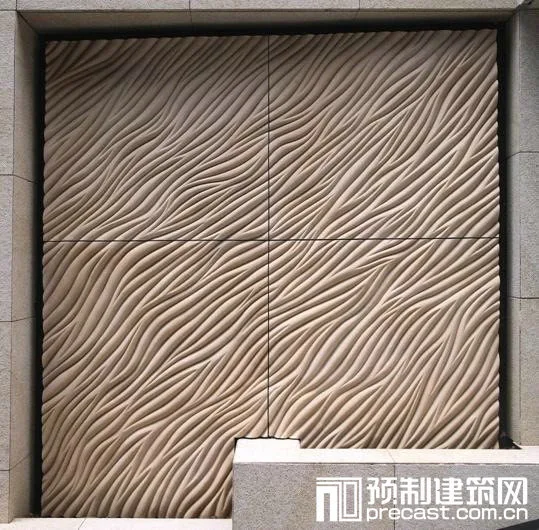
Introduction
Glass Fiber Reinforced Concrete (GFRC) is an inorganic composite material made by combining cement mortar with additives as the base and reinforcing it with glass fibers, processed through specialized techniques. In American English, it is referred to as GFRC, while in British English, it is called Glass Fiber Reinforced Cement (GRC). Both terms describe the same material.
Raw Material Specifications
The quality of GFRC depends on raw materials meeting strict standards:
- Cement: Portland cement conforming to ASTM C150 standards;
- Fiberglass: Must comply with PCI-MNL-130, containing at least 16% zirconia;
- Silica Sand: Should meet BSEN 812 Section 103:1985, with silica content above 96%, chloride ions ≤ 600 ppm, maximum loss on ignition of 0.5%. All particles must pass through a 1.2mm sieve, and fine particles passing through a 0.15mm sieve should not exceed 10%;
- Embedded Parts: Must comply with ASTM A1011 or A1008 standards;
- Admixtures: Should follow ASTM C494 types A, B, D, F, and G or ASTM C260. Metakaolin or other additives must meet ASTM C618 requirements. Colored and white pigments must comply with ASTM C979. Polymer curing agents may replace water curing and must comply with PCI-MNL-130 regulations.
Brief History
GFRC production began in the early 1970s with a collaborative development between a British architectural research institution and Pilkington Brothers, focusing on alkali-resistant glass fiber reinforced Portland cement products. Since then, its use has spread to over 40 countries, including Japan, the United States, Germany, the Netherlands, Spain, Italy, China, Singapore, and Romania. After decades of continuous improvement, GFRC now adheres to mature international standards such as BSEN, ASTM, and PCI.
However, in China, despite existing industry standards, lack of effective supervision has led to inconsistent quality. Many manufacturers prioritize appearance and cost over internal quality, often using substandard or counterfeit materials, including replacing alkali-resistant fiberglass with steel bars. This results in products with short service lives, sometimes posing safety risks, especially for decorative components on high-rise buildings. Properly produced GFRC products, following standard procedures, offer excellent physical properties and can last as long as the buildings themselves.
Distinguishing Genuine GFRC from Inferior GRC
GFRC, also known as GRC in China, has become popular for replicating European-style architecture nationwide. While demand has sparked a growth in GFRC component manufacturers, the industry remains immature and highly competitive, leading to widespread quality issues.
In cities like Shanghai, Beijing, and Guangdong, hundreds of GFRC manufacturers operate, many without proper standards, qualifications, or even basic knowledge of GFRC. Some use low-cost, non-alkali-resistant glass fibers such as high, medium, or alkali-free fiberglass mesh to cut costs. Although these products may initially meet performance requirements, they deteriorate rapidly—sometimes losing up to 90% of their strength within 10 months.
The State Economic and Trade Commission has twice banned the use of high-alkali fiberglass mesh made from recycled broken glass due to fraudulent practices. These cheaper materials cost only a fraction of genuine alkali-resistant fiberglass but result in unqualified products.
Alkali-resistant fiberglass is the key reinforcing material in GFRC, akin to steel reinforcement in traditional concrete. The optimal fiberglass content is between 4.8% and 5.2%. However, many domestic producers reduce this to less than 1% or replace it entirely with steel bars, turning GFRC into steel-reinforced mortar, which lacks uniform physical properties.
Many manufacturers operate like small workshops, competing on price by compromising quality, deceiving customers, and risking construction safety. Inferior components often crack and fall off within one to two years, causing damages that far exceed the cost savings. Customers, unaware of GFRC’s true nature, often select products based only on appearance and price, unknowingly installing hazardous materials on their buildings.
Installation quality is also a concern, with unqualified teams using improper methods like wooden plugs and bolts, leading to safety incidents such as falling components. During bidding, some general contractors prioritize cost over quality, neglecting long-term responsibility, resulting in frequent cracking, loosening, and peeling of GFRC components shortly after installation.
We urge industry experts to promote market standardization, crack down on counterfeit products, and help users select reliable GFRC materials with confidence.
Production Methods
GFRC is commonly produced using spray rolling forming (standard process) or hand lay-up forming (manual workshop method).
Physical Properties and Standards
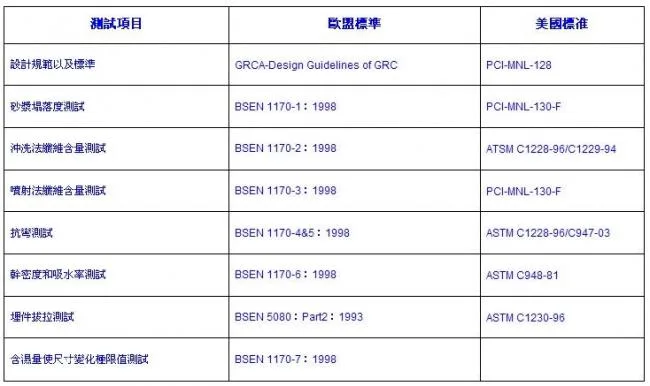
Execution Standards
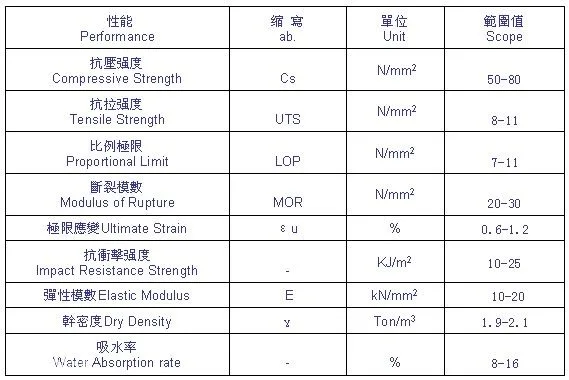
Outstanding Features
- Lightweight
A. GFRC panels are typically 10 to 20 mm thick, with a strength-to-weight ratio about one-fifth that of traditional concrete.
B. Their light weight allows for handling with lightweight lifting equipment, facilitating easy transport and quick installation. - High Design Flexibility
A. GFRC supports a variety of design methods and architectural styles, enhancing aesthetic appeal.
B. It can replicate natural materials such as granite, silica, limestone, wood grain, or metal.
C. Commonly used as decorative exterior wall material in industrial, commercial, and residential buildings. - Environmental Protection
A. GFRC is non-combustible, does not emit toxic gases, and offers UV resistance and sound insulation.
B. It is corrosion-resistant, safe, and easy to handle, reducing pollution risks during construction.
C. GFRC exhibits a low carbonation rate, effectively protecting embedded steel and resisting chloride corrosion. - Effective Sound Insulation
Since the 1970s, GFRC has been widely adopted globally, including for soundproof walls. Its noise reduction capabilities include:
A. A 10mm thick GFRC panel with a surface density of 20 kg/m² can reduce noise by 30 dB.
B. Doubling the thickness increases noise reduction to approximately 35 dB. - High Quality
A. GFRC is hard, low-permeability, non-combustible, requires minimal maintenance, and offers high elasticity, pressure resistance, and impact resistance.
B. Factory-controlled production ensures precise mixing, humidity, temperature, and processing time, guaranteeing durability and structural integrity.
C. Comprehensive quality control procedures maintain consistently high product standards. - Durability
GFRC resists moss growth, corrosion, decay, frost, snow, and vehicle exhaust. Without steel reinforcement, it avoids rust stains and detachment risks. It withstands strong winds, moisture, and heat effectively. - Quick Installation
A. Prefabricated GFRC components allow for rapid installation, accelerating construction timelines and increasing economic efficiency.
B. Factory-finished designs reduce on-site exterior wall treatment time.
Applications
GFRC products have evolved to offer high strength, durability, fire resistance, low maintenance, weather and UV resistance, lightweight properties, and diverse colors. They are ideal for:
- Door and window frames
- Decorative moldings
- Exterior wall panels
- Roofing
- Columns and railings
- Floral panels
- Wooden architectural arches
- Outdoor furniture
- Garden architecture
- Urban sculptures
- Rockeries
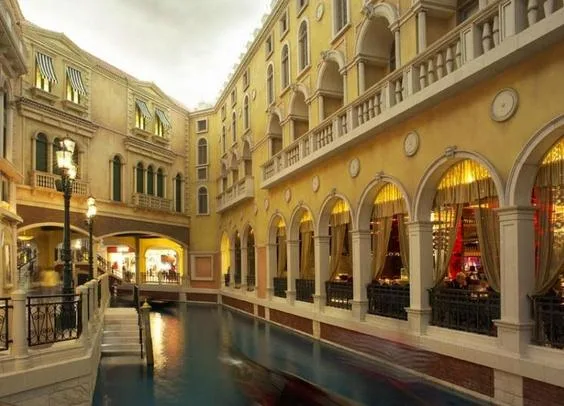
GFRC can mimic textures and finishes of natural materials such as stone, fossils, metal, wood grain, and sandstone. It serves as an excellent alternative to traditional marble exterior walls and decorative components, making it a preferred choice for architects and engineers.













Must log in before commenting!
Sign Up