
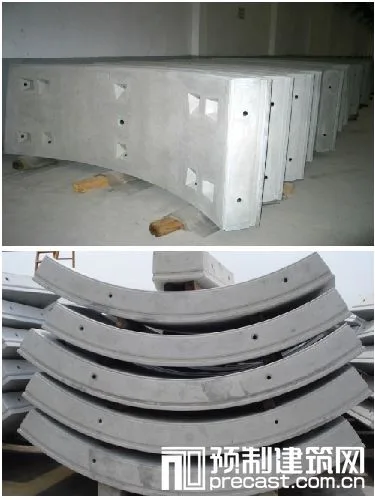
Shield tunnel segments are the primary structural components used in shield tunnel construction. They serve as the tunnel’s outermost barrier, designed to withstand soil pressure, groundwater pressure, and various special loads. As permanent lining structures, the quality of shield tunnel segments critically influences the overall tunnel safety, waterproofing, and durability.
Production of Shield Tunnel Segments
These segments are typically produced using high-strength, waterproof concrete to ensure both reliable load-bearing capacity and effective waterproofing. The manufacturing process involves casting concrete in finished pipe segment molds, which are sealed during pouring.
Assembly Methods for Shield Tunnel Segments
1. Ring Assembly Method
Once shield tunneling reaches a section, the pipe segments are quickly assembled into a ring. Most assemblies use a staggered joint pattern except in special cases, such as corrections or sharp curves, where through-seam assembly may be employed.
2. Assembly Sequence
The typical sequence starts with installing the lower standard segments (Type A), followed by alternating standard segments on both sides. Next, adjacent segments (Type B) are assembled, and finally, wedge-shaped segments (Type K) are installed.
3. Operation of Shield Tunneling Jacks
During assembly, retracting all shield jacks simultaneously can cause the shield to retreat due to soil pressure on the excavation face. This destabilizes the excavation surface and complicates segment installation. Therefore, retracting the shield jacks in coordination with the segment assembly sequence is essential for maintaining stability and working space.
4. Tightening Connecting Bolts
First, tighten the circumferential bolts that connect segments within the same ring. Then, tighten the axial bolts that connect consecutive rings. Bolt tightening is performed using a torque wrench, with torque values depending on bolt diameter and strength.
5. Installing Wedge-Shaped Segments
Wedge-shaped segments are installed between adjacent pipe segments. Careful insertion is crucial to avoid damaging the segments or peeling the seal strips. To facilitate insertion, a jack may be used to push adjacent segments radially outward, creating the necessary space.
When wedge-shaped segments are inserted radially, they tend to move inward; the shield jack’s thrust intensifies this inward movement. For axial insertion, the segment’s rear end tends to move inward while the front end tends to move outward.
6. Final Bolt Tightening
After assembling the first ring, the shield jacks apply even pressure to fully tighten the axial connecting bolts. As tunneling progresses, the lining may deform due to shield jack thrust and soil or water pressure after the shield tail is removed. This deformation can loosen the bolts initially tightened during assembly. To address this, the bolts are retightened once the shield advances to a position where jack thrust is no longer affected. The timing and location for retightening depend on factors such as tunnel diameter, shape, segment type, and geological conditions.















Must log in before commenting!
Sign Up