
Introduction
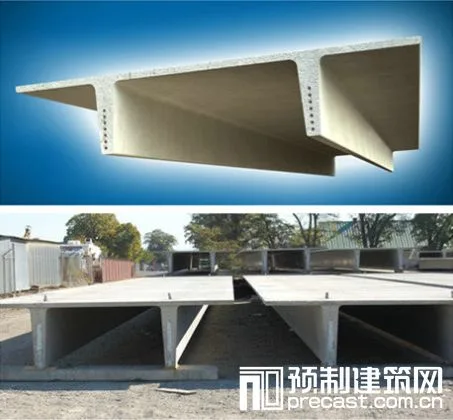
Prefabricated reinforced concrete load-bearing components that combine slabs and beams consist of wide panels with two narrow, tall ribs. The panel functions both as a transverse load-bearing structure and as the compression zone for the longitudinal load-bearing ribs. Its compression zone has a relatively large cross-section, with the neutral axis close to or within the panel itself. This design provides a large force arm for the tensile main steel bars.
As a result, the double T-plate offers excellent structural mechanical properties, clear force transmission paths, and simple geometric shapes. These features make it a cost-effective load-bearing component, suitable for large spans and extensive coverage areas. The development of double T-plates began worldwide in the late 1950s. In China, they have been used in factory roofs and floor systems since 1958. By the 1960s, the United States widely adopted them for constructing single-story multi-span industrial plants and multi-story public and civil buildings.
Other countries such as Canada, Germany, Finland, the United Kingdom, Japan, Poland, and Romania also use double T-plates extensively. Notably, Germany has developed a complete set of specialized equipment for their production.
Double T-plate Section Types
There are two main types of double T-shaped roof panels: equal section and double slope variable section. The equal section type can also be used as wall panels. Prestressed double T-plates can span over 20 meters, and when made with high-strength lightweight concrete, spans can exceed 30 meters.
The typical width of a double T-plate surface ranges from 1.2 to 3 meters, with rib spacing about half of the surface width. Rib base widths are at least 10 centimeters. For equal cross-sections, rib heights vary between 0.3 and 0.8 meters, while variable cross-sections at mid-span range from 1.0 to 1.5 meters.
Reinforced concrete double T-plates are usually prefabricated using concrete with compressive strengths of 30-40 megapascals. Prestressed versions commonly use precast concrete with 40-50 megapascals strength or lightweight concrete with 40 megapascals. Prestressing steel bars may include high-strength steel wires, steel strands, low-carbon cold-drawn steel wires, or threaded steel bars.
Production Process
Prefabrication of prestressed double T-plates typically takes place in factories using 60-150 meter long line pedestals and pre-tensioned production molds, which can be made of steel or concrete tire molds. The rib width, rib height, and overhanging sections of the plates are often adjustable.
Specialized formwork machines are employed for pouring, compacting, and finishing the concrete. Component curing is achieved through circulating heat mediums within the mold cavity. The same pedestal and formwork setup can produce both prestressed and non-prestressed double T-plates of various spans and sizes, trough plates, or even single T-plates by longitudinally separating the formwork. This flexibility allows for multi-purpose use during initial prototype testing.
Double T-plates typically weigh between 0.6 and 0.9 tons per meter. Appropriate flatbed trailers and cranes are used for transportation and lifting.
Applications
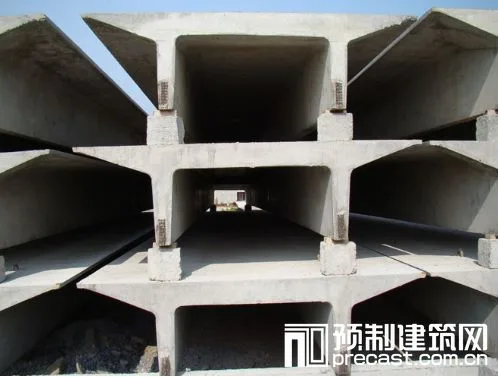
Double T-plates are versatile and can be placed directly on frames, beams, or load-bearing walls as floor or roof structures in single-story, multi-story, and high-rise buildings. In single-story industrial plants, they serve as roof panels, installed either horizontally on supporting beams or load-bearing walls, or vertically on roof truss beams.
Thanks to their capacity for larger spans, double T-plates allow factories to opt for wider spans or column grids, enhancing both technical performance and economic efficiency.
Double T-shaped panels can also be installed vertically on strip foundations as wall panels. In this setup, the ribs act as columns while the panels and attached insulation layers serve as the enclosure.
When used simultaneously as wall panels, roofs, and floor components in prefabricated residential buildings, the double T-plates should maintain consistent plate widths and rib spacing to ensure proper connection and support. Buildings constructed entirely with double T-plates benefit from reduced component variety and quantity, lighter structural weight, shorter construction times, and overall improved technical and economic outcomes.














Must log in before commenting!
Sign Up