
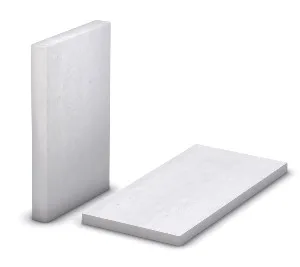
Lightweight partition boards represent a new generation of energy-efficient wall materials. Resembling hollow floor slabs, these boards feature male and female grooves on both sides for easy installation. Simply stand the board upright, apply a small amount of joint mortar to the grooves, and assemble them together. Made from industrial waste such as harmless phosphogypsum, lightweight steel slag, and fly ash, the boards are cured under variable frequency steam pressure.
These partition boards offer numerous benefits including low weight, high strength, environmental protection, thermal insulation, soundproofing, breathability with humidity control, fire resistance, fast installation, and cost savings. The inner layer incorporates inorganic foam profiles or other insulation materials strategically arranged for enhanced heat insulation and sound absorption. Manufactured on an automated assembly line, the panels are poured, leveled, and scientifically cured with a wide range of specifications available.
Advantages
Environmental Protection
The raw materials contain no harmful substances, are non-radioactive Class A products, and comply with the national G/T169-2005 standards.
Fire Resistance
These boards can withstand temperatures up to 1000°C for more than four hours without emitting toxic gases. Their fire resistance meets the national Class A non-combustible standards.
Space Expansion
Lightweight partition panels, suitable for both interior and exterior walls, enable efficient use of interior space by fully expanding room dimensions.
Structural Integrity
Thanks to prefabricated construction and an integrated three-in-one structure, the boards connect seamlessly, offering strong impact resistance. Anchored with steel structures, they provide high wall strength, making them suitable for partitions with high floors and large spans. Their seismic performance surpasses traditional masonry walls by several times. The Shunbang composite wall panel system delivers a tight structure, excellent overall integrity, and resistance to deformation and loosening.
Moisture and Waterproofing
Tests confirm that lightweight wall panels, when bonded with cement, can hold water without any waterproof coating. The backside remains dry without condensation, even in humid conditions. These panels are professional waterproof boards ideal for damp environments such as kitchens, bathrooms, and basements.
Sound Insulation
They provide excellent sound insulation that meets national residential standards and outperform traditional brick walls in noise reduction.
Simple and Fast Construction
Installation involves completely dry work with prefabricated construction. Panels can be freely cut and adjusted in width and length. Transport and stacking are simple and hygienic, eliminating the need to mix mortar on site, shortening construction time significantly. Material waste is also minimized.
Thermal Insulation
The manufacturing process ensures superior thermal insulation, creating a more comfortable indoor environment.
Strong Hanging Capacity
Composite wall panels support direct nailing or bolting with expansion bolts to hang heavy objects. Their smooth surface prevents dust production. Materials such as ceramic tiles, wallpaper, and wood panels can be applied directly for finishing.
Lightweight and Cost-Effective
Easy and convenient construction reduces labor intensity, accelerates progress, lowers overall project costs, and fulfills modern indoor and outdoor building requirements.
Lightweight partition boards weigh only one-eighth of solid brick walls but reach a strength level of C30. Their thermal conductivity is one-third, and acoustic conductivity is one-fourth that of solid bricks. They automatically regulate indoor humidity, conserve land by utilizing industrial waste, prevent pollution of air and water sources, reduce wall costs by 15–20%, and improve construction efficiency by three to five times. Additionally, using harmless treated phosphogypsum eliminates the need for dehydration and drying processes, avoiding expensive equipment investments. This technology marks a significant advancement in phosphogypsum recycling with notable environmental benefits.
Modified lightweight partition boards are high-strength, lightweight materials primarily composed of composite cementitious substances like lightly burned magnesium oxide, magnesium chloride, silicon, and calcium. Enhanced with Jinan Magnesium Jiatu GX-V series magnesite modifiers, industrial waste such as fly ash, and plant fibers like crop straw, the inner layer integrates inorganic foam profiles or other insulation materials for optimal heat and sound insulation. Manufactured with high automation on assembly lines, these panels offer diverse specifications.
This product is widely used for internal partition walls in office buildings, commercial spaces, and residences. Its ease of installation and operation makes it appealing to investors and entrepreneurs with broad market potential.
Traditional magnesium partition boards face issues such as moisture absorption and halogen release. Through advanced modification technologies and refined production processes, the physical and water resistance properties of modified magnesium composite insulation boards have been fundamentally improved. These boards are cost-effective, strong, durable, and provide excellent insulation and soundproofing while remaining lightweight. Importantly, they no longer require water soaking for curing. This technology has been successfully implemented and promoted across provinces including Shandong, Sichuan, Hubei, Hunan, Shanghai, Jiangsu, Zhejiang, Hebei, and Hainan.
Classification
Types of lightweight cement sandwich composite panels include:
- Cement rock wool sandwich panel
- Cement polystyrene particle mortar sandwich panel
- Foam cement sandwich panel
- Cement expanded perlite sandwich panel
Production Requirements
The engineering design team or construction contractor must provide the wall layout plan and relevant technical specifications for the partition walls to the installation company, including:
- Details on the types and axis distribution of partition walls, wall thickness, door and window placements and sizes, as well as pipeline locations and groove sizes.
- Functional requirements such as waterproofing, load-bearing for heavy objects, and corresponding measures.
- Fire resistance and sound insulation specifications.
- Impact resistance and seismic resistance requirements.
To ensure quality, the design unit should specify basic performance indicators based on building and usage functions to optimize partition wall performance.
Partition walls divide interior spaces without bearing loads. They are typically lightweight, thin, and soundproof. Different rooms have varied requirements—for example, kitchen partitions must be fire-resistant, and bathroom partitions require moisture resistance.
Economic Benefits
1. Cost breakdown for lightweight partition boards (using 8kg/m foam board): 25 yuan/m² for materials, 2 yuan/m² labor, 1 yuan/m² utilities, and 1 yuan/m² equipment depreciation, totaling 29 yuan/m².
2. Market price averages around 60 yuan/m².
3. Production Output and Profit (mechanized production):
- Production: 3 m/sheet × 500 sheets/day × 28 days/month × 10 months/year = 42,000 m²/year.
- Cost: 29 yuan/m² × 42,000 m² = 12.18 million yuan/year (1.218 million yuan/month).
- Output value: 60 yuan/m² × 42,000 m² = 25.2 million yuan/year.
- Profit: 25.2 million yuan/year − 12.18 million yuan/year = 13.02 million yuan/year (1.302 million yuan/month).
4. Taxation: At a 25% income tax rate, annual tax payable is 3.255 million yuan.
Applications
Lightweight partition boards are primarily used for insulating building walls (such as reinforced concrete, ceramic hollow blocks, concrete hollow blocks, clay porous bricks), roof insulation systems, steel plate roofs, ground insulation, warehouse insulation, and road foundations. They also find application in refrigerated trucks, airports, and other specialized fields.
They are widely utilized for partition walls in offices, commercial buildings, residences, corridors, and kitchens. The production and installation processes are straightforward and easy to master. These boards offer low cost, long service life, high strength, excellent insulation and soundproofing, and low weight per volume. After modification, they do not require water soaking for curing.
Construction Procedure
- Clean structural surfaces, floors, and mark layout lines, leaving openings for doors and windows.
- Install panels starting from one side of the main structure. For door and window openings, install from both sides moving towards the middle, cutting the final piece to fit smoothly.
- For water heating and electrical installations, first lay wiring points and drill holes for embedded parts or switches before panel installation. Horizontal grooves for wiring must be cut by the user and filled and finished afterwards.
- Installation temperature should be above -10°C.
- Treat panel seams properly after installation.
Key Installation and Construction Points
- Verify panel dimensions comply with standards.
- Pre-fix 40×50×90L iron pieces at designated locations according to layout.
- Install panels following the layout diagram, beginning at door and window openings, aligning with guide lines. Use pry bars and wooden wedges for tight fitting and reinforcement.
- Continuously check flatness, verticality, and other specifications during installation.
- Water and electrical pipes should be installed concurrently with panels. Drill holes (max 80×80mm) before installation for embedding; hanging loads must not exceed 80 kg unless anchored to fixed embedded parts.
- Smooth areas around electrical switches and sockets with filler material.
- Allow adhesive to dry fully (10–15 days) before proceeding with decoration.
- Ensure installed surfaces show no peeling, cracks, or hollowing. Prepare for intermediate plastering according to building standards.
Installation Structure Requirements
- Fix U-shaped iron pieces at top and bottom beams, secured with nails and wooden wedges, reinforced with L-shaped iron pieces.
- Hangings must be spaced at least 300 mm apart with a single-point load limit of 80 kg. Embed parts must be pre-opened.
- Electrical wiring may be concealed using flexible conduits passed through panel holes or visibly installed with open sockets.
- Design decorations to be moisture-resistant and waterproof, especially around water tanks and basins, using waterproof paints or tiles.
- Wall decoration can include plastering, spray finishes, or tiling. Surfaces should be cleaned and moistened before finishing according to standard procedures.













Must log in before commenting!
Sign Up