
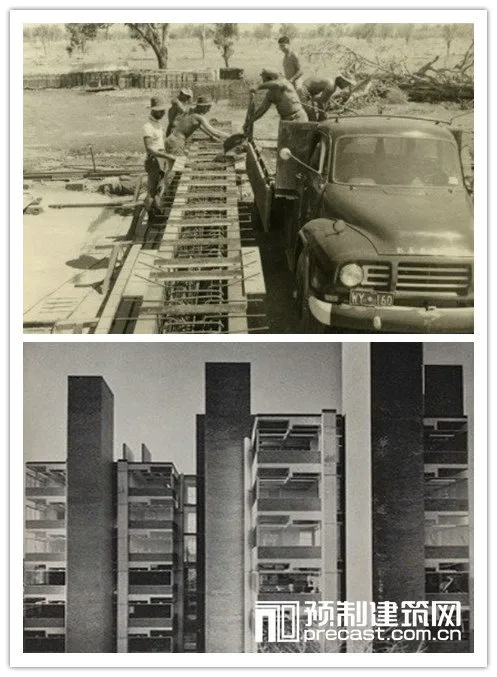
Prefabricated concrete and reinforced concrete emerged almost simultaneously overseas, but modern industrial precast concrete manufacturing truly advanced only about fifty years ago. The significant breakthroughs in precast concrete development occurred after World War II.
First Stage (1945–1960): The destruction caused by the war, rapid urbanization, and the influx of refugees and displaced people created an acute housing shortage across European countries. This urgent need provided fertile ground for the growth of precast concrete components.
During this period, various large-panel residential building systems appeared across Western Europe—for example, the Caus system and the Larsen & Nielsen system in France and Denmark. These systems could be designed with either frame or non-frame structures, with precast concrete floor slabs and wall panels as the primary structural elements. Germany also widely adopted large-panel residential construction. For instance, a dye factory in Germany used a slab system on its first and fourth floors, assembling T-shaped slabs with wall panels and floor slabs measuring 1.5 meters in width and floor spans reaching 15 meters.
In the United States, Japan, and Nordic countries, prefabricated box structures began to appear. These hexahedral prefabricated units consist of fully factory-fabricated rooms, complete with equipment and finishes, built to standardized designs and lifted into place on-site. Structurally, these boxes can be categorized as either skeleton structures or thin-walled units.
Second Stage (1960–1973): As living standards improved, demand for residential comfort in Europe and America surged. Inflation drove capital away from real estate, while shortages of skilled labor accelerated the mechanization of building component production. These factors directly contributed to a leap forward in prefabricated construction.
Beyond residential buildings, this period saw the widespread construction of primary and secondary schools, as well as universities, which advanced the use of columns, supports, and large-span floor slabs (7.2 to 8.4 meters) in frame systems. Industrial plants and sports facilities also adopted prefabricated columns, prestressed I-beams, beams, and roofing components.
Third Stage (Post-1973): The residential construction market in Europe and America faced a severe crisis. The rapid growth era of the construction industry faded, largely due to market saturation and high interest rates, which caused multi-family housing projects to stall.
During this time, demand from Middle Eastern oil-exporting countries provided European builders with a crucial lifeline. Large-scale construction of residential buildings, schools, and government offices in the Middle East ushered in a new era for prefabricated construction there. However, this prosperity was short-lived, as the three oil crises disrupted the industry’s momentum once again.
Many prefabrication factories struggled with underutilization or closure. This challenging period prompted the industry to reconsider the future direction of prefabricated components. Around the 1980s, companies and universities, such as Germany’s FILIGRAN, developed steel truss composite floor slabs. These slabs combined the benefits of full prefabrication and cast-in-place methods, aligning well with the evolving needs of the era. This innovation gained widespread adoption in residential and public buildings, especially throughout Europe. Subsequently, Japanese companies introduced similar systems, making steel truss composite floors a common feature in Japan from the 1980s to today.














Must log in before commenting!
Sign Up