
The issue of building industrialization in China was first raised in 1956. In February of that year, the National Construction Commission and the Ministry of Construction Engineering clearly stated at a relevant meeting that “industrialization of construction is the development direction of the construction industry.” They emphasized the need to “vigorously standardize building structures and components” and to “actively promote factory-based and mechanized construction.”
China began developing block buildings—using non-traditional clay bricks that are generally larger than conventional clay bricks—in 1953. By 1958, pilot projects for prefabricated wall panel buildings were underway. By the early 1960s, large residential areas featuring brick wall panels had already emerged.
By the end of 1978, block construction had become widely adopted across provinces and cities including Zhejiang, Shanghai, Fujian, Sichuan, Guizhou, Guangdong, and Guangxi. The primary raw materials for producing building blocks came from industrial waste such as fly ash, coal gangue, slag, and tailings powder. Additionally, blocks made from local materials like sandstone concrete and fine aggregate concrete were also produced.
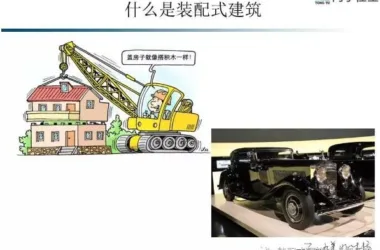
Prefabricated wall panel residential buildings were constructed in cities such as Beijing, Nanning, Kunming, Xi’an, and Shenyang. By the end of 1977, approximately one million square meters had been completed. The term “wall panel” refers to a new type of wall material that includes vibrating brick wall panels and concrete wall panels. Traditionally, walls are built one brick at a time, but with these panels, one panel can replace an entire wall—or two to three panels can be assembled to form one wall. Constructing a house with these panels is similar to assembling building blocks according to a design plan, making the process both fast and efficient.
Vibrating brick wall panels are produced by placing bricks into a frame mold, pouring mortar, and then vibrating the assembly with a vibrator. This vibration makes the mortar in the brick joints very dense, increasing the panel’s strength and allowing the wall thickness to be reduced. For example, interior brick walls are typically one brick thick, about 24 centimeters, whereas vibrating brick wall panels require only half a brick thickness (12 centimeters).
Concrete wall panels are made from cement, sand, and stone, sometimes reinforced with a small amount of steel. Due to concrete’s higher strength compared to bricks, the wall thickness can be reduced to about 10 centimeters. To further reduce weight and improve sound insulation, porous lightweight aggregates (such as ceramic particles) can replace stone, or many holes can be made along the panel surface to create concrete hollow wall panels. Using wall panels instead of traditional brick walls offers many advantages: fewer or no bricks are needed, reducing soil consumption and preserving farmland; labor intensity is lowered and efficiency increased due to mechanization; the flat surface of panels allows for direct spraying without plastering, accelerating construction and reducing costs; thinner panels reduce building weight and increase usable space by 8-12%; and transportation volume of materials is cut by about one third. Wall panels can also be prefabricated in factories and transported to construction sites, saving land use and speeding up construction. At the time, adopting this new wall material was significant for accelerating construction, saving materials, and reducing costs.
After the 1970s, experience was gained in cast-in-place formwork technologies. Efforts focused mainly on large formwork and sliding formwork residential buildings, alongside research and construction of frame light slab buildings.
Large template residential buildings are constructed on-site by casting with large formwork. This differs from large wall panel buildings mainly in construction techniques. Large formwork types are divided into integral and assembled templates. These include cast-in-place large formwork for interior and exterior walls, external hanging formwork, and cast-in-place large formwork for exterior brick walls. Large formwork construction is a new integrated decoration technology that emerged during wall reform, promoting building industrialization. It allows the use of industrial waste as part of the concrete raw materials, replaces manual brick-by-brick masonry, enhances mechanization, reduces labor intensity, and simplifies construction processes. The processing of large formworks is relatively straightforward, and the construction is not complicated, making installation easier. Although large formwork construction started relatively late, it developed rapidly. By the end of 1978, about 800,000 square meters of large template residential buildings had been built in cities such as Beijing, Shanghai, and Shenyang.
Sliding formwork is a method that uses a lifting device to raise formwork for pouring vertical concrete structures. Typically, a fixed steel template of considerable size is used. The system works by using a pre-installed round steel rod inside the building as support. A jack applies force to climb along the rod, gradually lifting the vertically positioned formwork mounted on a lifting frame. This creates wall or column grooves between the templates. During concrete pouring, the formwork slides upward powered by the jack, allowing concrete to slowly detach as it sets. This method dates back to the 1920s in the United States, where manual screw jacks were used to build silos. In the 1940s, hydraulic jacks and high-pressure oil pumps were developed in Sweden, improving the technique with pulse-controlled sliding. Since then, many countries have adopted sliding formwork to construct tall buildings. For example, Hong Kong’s 218-meter, 65-story Hopewell Building was built using this method. China initially used spiral jacks for silo construction, and since the 1960s has employed hydraulic jacks and automatic controls. In 1980, Beijing applied sliding formwork to construct a 20-story residential building by pouring concrete floor slabs layer by layer, achieving a construction speed of one floor every three days. The 52-story Shenzhen International Trade Center, completed in 1983, was also built using integral sliding of inner and outer tubes.
Frame light panel residential buildings are industrialized homes where the load-bearing structure consists of a frame, while the enclosure and partition walls use lightweight panels. This frame structure includes columns, longitudinal beams, and transverse beams that support roof and floor loads. A building made up of frames, wall panels, and floor slabs is called a frame panel building. The key characteristic is that the frame bears the load, while wall panels serve only as enclosures and separators. The walls between frames, called infill walls, are non-load-bearing. When frame buildings use lightweight panels as partitions, they are known as frame lightweight panel buildings.
Since China’s reform and opening-up policy began in 1978, significant progress has been made in urban and rural housing policies, improving living conditions and environments. During this large-scale construction, industrialized residential construction methods have evolved. Factory-assembled large panel housing systems gradually declined due to issues with transportation, factory land use, and operating costs. Since the 1990s, cast-in-place reinforced concrete structural systems, originating in southern China, have become popular. These systems involve on-site formwork production and concrete pouring, including cast-in-place frame and shear wall residential buildings, as well as combinations of both, which have seen considerable development.
However, cast-in-place concrete structures have inherent drawbacks, such as challenges in on-site quality control and inconsistent quality. Their widespread use in the commercial housing market has caused significant problems for both developers and residents. Since 2004, Vanke has been researching prefabricated concrete structure technology, known as PC technology, and has achieved significant breakthroughs. The arrival of a higher quality, better performing PC residential market is approaching.
In fact, prefabricated housing technology has been central to China’s “modernization of the housing industry” since 1995. That year, the former Ministry of Construction and the National Science and Technology Commission jointly launched the 2000 Xiaokang Urban and Rural Housing Technology Industry Project. Its goal was to use technology as a guide, promote demonstration community construction, advance housing industry modernization, and develop a new generation of housing industry. The project’s significance lies not only in building new types of residential products but also in creating a systematic approach covering planning, design, construction, research, development, and mass production. This forms a modern residential construction system supporting property management and profoundly influences China’s residential construction development.
In 1999, eight ministries and commissions issued the “Several Opinions on Promoting the Industrialization of Housing and Improving the Quality of Housing” (State Council Document No. AI_T_SC_0_72), which set clear goals for housing industrialization development across four areas:
(1) By 2005, resolve common issues with urban residential building quality and functionality, meeting residents’ basic living needs; by 2010, ensure urban residential buildings meet standards for usability, economy, and aesthetics, with significant improvements in living environments.
(2) By 2005, establish a preliminary industrial and standardized production system for residential buildings, materials, and components; by 2010, develop a series of residential building systems with widespread component standardization and socialized production and supply.
(3) By 2005, newly built heated urban residential buildings should reduce energy consumption by 50% compared to 1981 levels; by 2010, reduce energy use by an additional 30% over 2005 levels. Non-heated residential areas should also implement energy-saving policies, standards, and measures.
(4) By 2005, technology should contribute 30% to housing industry development; by 2010, this should increase to 35%.
Now, nearly ten years after implementing this document, it is time to evaluate, revise, and set new goals for modernizing the housing industry.














Must log in before commenting!
Sign Up