
Prefabricated parts production and application in China has a history spanning nearly 60 years, marked by significant fluctuations in development.
1. Phase One
Since the 1950s, during China’s first five-year plan aimed at economic recovery, the construction industry began adopting prefabricated assembly methods, inspired by the industrialized construction model of the former Soviet Union. The primary prefabricated components during this period included columns, crane beams, roof beams, roof panels, and skylight frames. Except for some roof panels, small crane beams, and small-span roof trusses, most components were prefabricated on-site. Even when factory prefabrication occurred, it was typically done in temporary yards established on construction sites, making prefabrication an extension of the construction enterprise itself.
2. Second Stage
In the late 1960s and early 1970s, the development of small and medium-sized prestressed components led to the emergence of numerous prefabricated component factories across urban and rural areas. These factories produced hollow slabs, flat slabs, purlins, and hanging tiles for residential buildings. For industrial and civil buildings, main products included roof panels, F-shaped panels, trough-shaped panels, V-shaped folded plates, and saddle-shaped panels. This marked the beginning of the prefabricated parts industry taking shape.
3. Third Stage
By the mid-1970s, government support fueled the rapid expansion of concrete slab and frame light slab factories, sparking a significant development wave. By the mid-1980s, tens of thousands of prefabricated component factories of varying scales had been established nationwide, marking the peak of China’s component industry growth.
The main types of prefabricated components during this stage included:
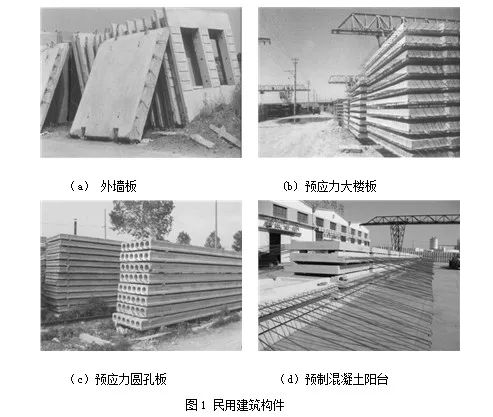
- Civil building components: exterior wall panels, prestressed building panels, prestressed circular hole panels, and prefabricated concrete balconies (see Figure 1).
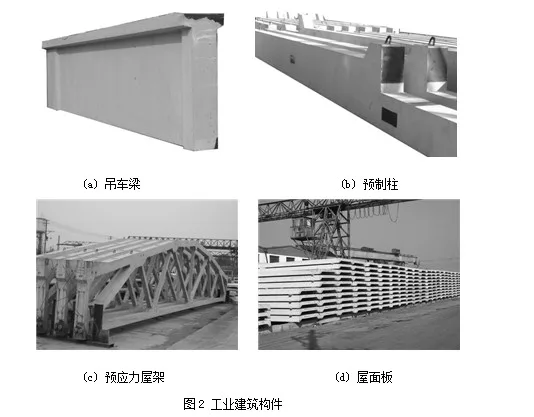
- Industrial building components: crane beams, prefabricated columns, prestressed roof trusses, roof panels, and roof beams (see Figure 2).
Technologically, the production process evolved from manual labor to mechanical mixing and forming, eventually advancing to highly mechanized assembly line production in factories.
4. Fourth Stage
Since the 1990s, many large and medium-sized component factories in cities became unprofitable and unsustainable. Production shifted to small component factories in towns and villages, especially for civil building parts. This period also saw an influx of low-quality hollow slabs produced by some township enterprises, which flooded the construction market and damaged the reputation of the prefabricated parts industry.
Starting in 1999, several cities banned the use of prefabricated hollow floor slabs, replacing them with cast-in-place concrete structures. This policy severely impacted the prefabricated parts sector, pushing it to a critical moment.
Entering the 21st century, it became clear that cast-in-place structural systems no longer met modern development demands. The drawbacks of these systems became increasingly evident in China’s rapidly growing construction market. Learning from successful industrialized residential projects abroad, China initiated a new wave of “construction industrialization” and “residential industrialization,” ushering in a new era for prefabricated parts development.
In recent years, supported by government policies, construction industrialization has progressed steadily. This has stimulated enthusiasm for prefabricated component research across various organizations, enterprises, universities, and research institutions, leading to notable achievements.














Must log in before commenting!
Sign Up