
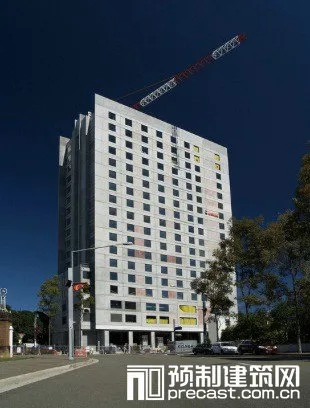
The “Cast in and Hang Out” method, also known as the “first mock examination and three plates,” involves pouring concrete for the inner walls using large formwork, reinforced with steel grids. Prefabricated concrete composite wall panels are then hung on the exterior walls, supported by structural columns and ring beams. This approach streamlines construction, accelerates progress, enhances factory processing of building components, ensures project quality, and reduces costs without compromising seismic resistance.
Main Construction Features:
1. High level of on-site mechanization combined with extensive factory production.
2. Exterior wall cladding with decorative finishes reduces wet work on site and shortens the decoration phase during construction.
3. Exterior wall cladding components have precise cross-sectional dimensions with sharp, square edges and corners. Strict protective measures are taken during transportation, stacking, and lifting.
4. Waterproofing at the joints of the exterior wall panels requires careful attention.
5. Support node welds must be secure during installation. The internal pouring and external hanging system is suitable for high-rise buildings up to 20 floors with seismic requirements. All horizontal and vertical shear walls are cast in place using large formwork, while non-load-bearing external wall panels and internal partition panels are made from prefabricated reinforced concrete or silicate concrete panels.
Key Areas for Success:
1. Prefabrication of exterior wall panels.
2. Installation techniques for exterior wall cladding.
3. Waterproofing of exterior wall joints.
4. Proper planning and sequencing of the construction process. For detailed guidance, please refer to the relevant construction process standards.













Must log in before commenting!
Sign Up