
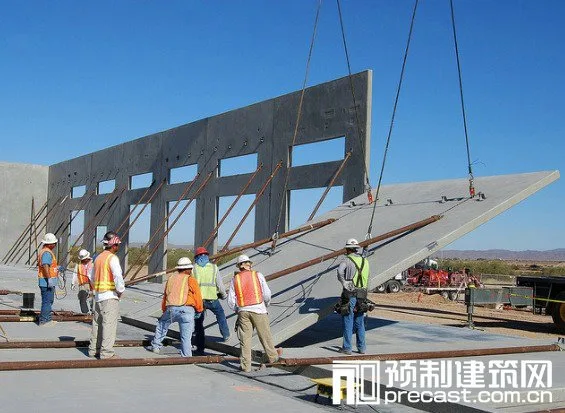
Definition: Prefabricated concrete structure
A prefabricated concrete structure is a concrete framework formed by assembling and connecting prefabricated components, which serve as the main load-bearing elements.
Introduction
Prefabricated reinforced concrete (RC) structures represent a significant development trend in China’s building industry. They promote construction industrialization, enhance production efficiency, conserve energy, support green and environmentally friendly buildings, and improve construction quality. Compared to traditional cast-in-place methods, prefabricated RC structures better align with green building principles by saving land, energy, materials, and water, reducing noise and dust pollution, minimizing environmental impact, enabling cleaner transportation, reducing site disturbances, conserving resources like water and electricity, and adhering to sustainable development principles.
Additionally, prefabricated structures allow for continuous, sequential completion of multiple or all construction processes. This reduces the variety and number of machinery needed onsite, eliminates downtime between processes, enables three-dimensional cross-operation, decreases labor requirements, improves efficiency, reduces material consumption, and minimizes environmental pollution—ultimately supporting green construction goals. They also significantly cut construction waste—which accounts for approximately 30% to 40% of urban waste—including scrap steel, iron wires, bamboo and wood debris, and surplus concrete.
Extensive research by domestic and international scholars has yielded various types of prefabricated RC structures, such as non-bonded prestressed prefabricated frames, hybrid connected prefabricated concrete frames, prefabricated steel fiber high-strength concrete frames, and assembled integral steel reinforced concrete frames. However, China’s understanding of the seismic performance of precast concrete structures remains limited, resulting in a gap between research and engineering applications compared to advanced international standards. Specifically, the use of precast concrete structures in seismic zones is restricted, highlighting an urgent need for systematic studies on their earthquake resistance.
Seismic Performance
According to the 2000 National Earthquake Hazard Reduction Program (NEHRP) specifications, precast concrete frame connections fall into two categories: equivalent cast-in-place connections and prefabricated connections. Equivalent cast-in-place connections must meet or exceed the seismic performance of traditional cast-in-place concrete connections. Due to differences in mechanical properties, NEHRP provides distinct seismic guidelines for prefabricated connections.
Common equivalent cast-in-place connection types include post-cast integral connections and prestressed splicing connections. Prefabricated connection types typically involve welded or bolted nodes.
1.1 Equivalent Cast-in-Place Connections
1.1.1 Non-bonded Prestressed Tendon Splicing Connections
Research by Priestley from the University of California examined partially bonded prestressed spliced joints. He noted that prestressed tendons, which do not bond with concrete within the joint and a certain range on either side, retain their elasticity even under significant joint deformation. These connections experience minimal loss of strength and stiffness, exhibit reduced residual deformation after large strain, and demonstrate strong recovery ability.
The prestressing clamp effect improves shear resistance within the node area and reduces the need for stirrups. Priestley’s low-cycle repeated loading tests on eight non-bonded prestressed beam-column joints revealed maximum interlayer deformations of 2.8% to 4%, with residual deformation around 2.2% of the maximum. Although large deformations caused plastic behavior at the beam-column interface reducing stiffness, damage was minor. Compared to cast-in-place joints, non-bonded prestressed splicing joints showed lower energy dissipation, less damage, and reduced strength loss and residual deformation.
1.1.2 Bonded Prestressed Steel Bar Joint Connections
In 2004, Liu Bingkang and colleagues from Hefei University of Technology performed low-cycle repeated loading tests on two prefabricated prestressed concrete frame beam-column assemblies. They found that the presence of dowels led to a lifting effect during reverse loading, reducing the bending capacity of the normal section. Shear friction at the beam end resisted shear forces effectively, and prestressing enhanced deformation recovery—beneficial for post-earthquake repair.
In 2005, Beijing University of Technology tested six mixed-connection assembled concrete frame internal node specimens under low-cycle repeated loads. Results showed that mixed-connection nodes had energy dissipation capacities comparable to integral cast-in-place nodes, with superior ductility and deformation recovery, yielding better overall seismic performance.
1.1.3 Post-Poured Integral Nodes
Vasconez’s 1998 repeated loading tests on 13 precast concrete nodes (including steel fiber reinforced, polyvinyl alcohol fiber reinforced, and ordinary concrete) demonstrated that steel fibers improved node performance more effectively than polyvinyl alcohol fibers. Post-poured steel fiber reinforced concrete enhanced bonding between steel bars and concrete, increasing node ductility, delaying failure, and improving shear strength.
Compared to ordinary cast-in-place nodes, steel fiber reinforced concrete nodes improved strength, energy dissipation, and deformation capacity by approximately 30%, 35%, and 65%, respectively. Using steel fiber reinforced concrete with 3% volume content reduced hoop reinforcement in the node area by 50% while enhancing seismic performance.
In 2004, Zhao Bin and colleagues at Tongji University conducted tests on high-strength concrete post-poured integral beam-column assemblies, including those reinforced with high-strength steel fiber concrete. They found that prefabricated high-strength concrete post-poured integral assemblies matched the seismic resistance of cast-in-place counterparts. Incorporating high-strength steel fiber concrete reduced stirrup requirements and improved node load-bearing capacity.
2. Prefabricated Connections
2.1 Bolt Connection Nodes
In 2004, Zhao Bin et al. at Tongji University compared cast-in-place high-strength concrete beam-column assemblies, prefabricated post-poured integral assemblies, and fully assembled prefabricated beam-column assemblies under low-cycle repeated loads using full-scale models. The fully assembled semi-rigid node precast assemblies showed increasing bearing capacity with loading displacement due to strengthened short beam joints. At ultimate displacement, their bearing capacity exceeded that of cast-in-place and post-poured integral assemblies.
However, their hysteresis curves indicated generally lower energy dissipation compared to cast-in-place and post-poured integral assemblies. It was recommended to implement measures to enhance energy dissipation in fully assembled semi-rigid nodes.
Overall Performance
In 2005, Liu Bingkang and colleagues from Hefei University of Technology studied two-span prefabricated prestressed concrete frames under low-cycle repeated loading. Results showed that beam-end sections relying solely on prestressed reinforcement for bending exhibited fuller hysteresis curves and good energy dissipation. When curvature ductility reached 4, there was no significant strength reduction, meeting moment modulation requirements. Residual deformation after unloading was minimal, and sections retained deformation recovery capacity after yielding. Symmetric and antisymmetric loading did not significantly affect stress performance or ductility at mid-span and beam ends but impacted the core stress state of middle column nodes.
In 2009, Han Jianqiang and colleagues at Beijing University of Technology tested a prestressed prefabricated frame (KJ2) under horizontal low-cycle repeated loads. To ensure concrete confinement at beam ends, carbon fiber cloth reinforcement was applied within twice the beam height, and 4mm spiral stirrups reinforced beam ends to enhance local compressive strength. Compared to cast-in-place frames, prestressed prefabricated frames showed slightly lower energy dissipation but superior ductility and deformation recovery.
In 2005, Lv Xilin et al. at Tongji University performed pseudo-dynamic tests on a half-scale prefabricated concrete frame with a single story, single span, three trusses, and beam-column nodes connected by rubber pad bolts. The structure exhibited good seismic performance. Beam-column nodes connected by rubber pad bolts performed well, whereas welded plate-beam nodes sustained severe damage. The welding joint between the roof panel and beam was identified as the structure’s weakest seismic link.














Must log in before commenting!
Sign Up